


If you're an Abilene homeowner, you know that our trees are a different breed. They stand up to West Texas wind, bake in the summer sun, and still manage to provide that much-needed shade. But you've probably also wondered, "What exactly does a professional tree service do, and is it something I really need?"
I've spent years working with trees in this area, from the sprawling oaks in historic neighborhoods to the hardy mesquites that define our landscape. I can tell you that professional care isn't just a service—it's a partnership with one of your property's most valuable assets.
Your Guide to Abilene Tree Services
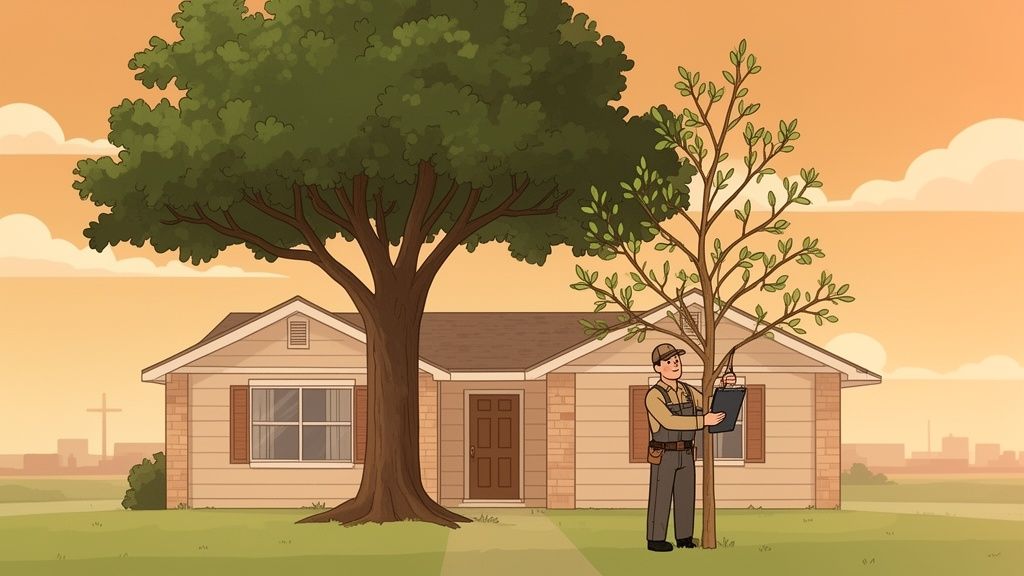
It’s easy to think of tree care as something you only need when a disaster strikes, like after a big storm rolls through. But the best tree care is proactive. It’s about keeping your trees healthy and strong so they can weather those storms in the first place.
This guide is designed to pull back the curtain on professional tree services. We’ll get into the details of everything from careful pruning that encourages healthy growth to the safe removal of a tree that’s become a hazard. My goal is to give you the knowledge you need to make the best decisions for your yard.
More Than Just a Trim
I'm pretty handy. Why can't I just grab a ladder and a saw and handle it myself?
That's a question I hear a lot, and I understand the DIY spirit. For a little light pruning on a small shrub, go for it! But caring for a mature tree is a completely different ballgame. It's a combination of science, skill, and having the right safety gear.
A while back, I met with a homeowner out near Dyess Air Force Base. He was losing sleep over a big mesquite that was leaning just a bit too close to his house for comfort. We did some structural pruning to lighten the load on the heavy side and improve its overall balance before the spring storm season hit. Sure enough, a nasty windstorm blew through a couple of months later. His tree stood firm while his neighbors were cleaning up fallen limbs. That small, proactive job saved him from potentially thousands in roof repairs.
That story gets to the heart of it. A true arborist doesn't just cut branches; they read the tree, diagnose potential issues, and make strategic cuts to ensure it stays healthy and safe for years to come.
Why Tree Care Is More Important Than Ever
The focus on professional tree maintenance isn't just happening here in Abilene—it's a trend across the country as people recognize the value healthy trees add to their homes. This has led to some serious growth in the tree care industry.
- A Growing Industry: The U.S. market for tree trimming services is on track to hit $39.5 billion by 2025.
- What's Behind It? A combination of a healthy housing market and a renewed focus from homeowners on making their properties safe and beautiful.
- The Local Angle: Here in Abilene, that means more people are looking for ways to protect their homes from our unpredictable weather and create inviting outdoor spaces for their families.
These numbers just confirm what we see every day: homeowners understand that professional tree care is a smart and necessary investment.
Throughout this guide, we'll explore what these services involve and how they contribute to a healthier, more beautiful Abilene. After all, healthy trees are a huge part of a great-looking yard—something we explore further in our guide on how professional landscaping can transform your Abilene property.
Our Core Tree Care Services for Abilene Homes
When you call a professional for a tree service in Abilene, TX, you’re not just hiring someone with a chainsaw. You're bringing in a certified arborist who understands the biology of your trees and knows how to help them thrive in our tough West Texas climate.
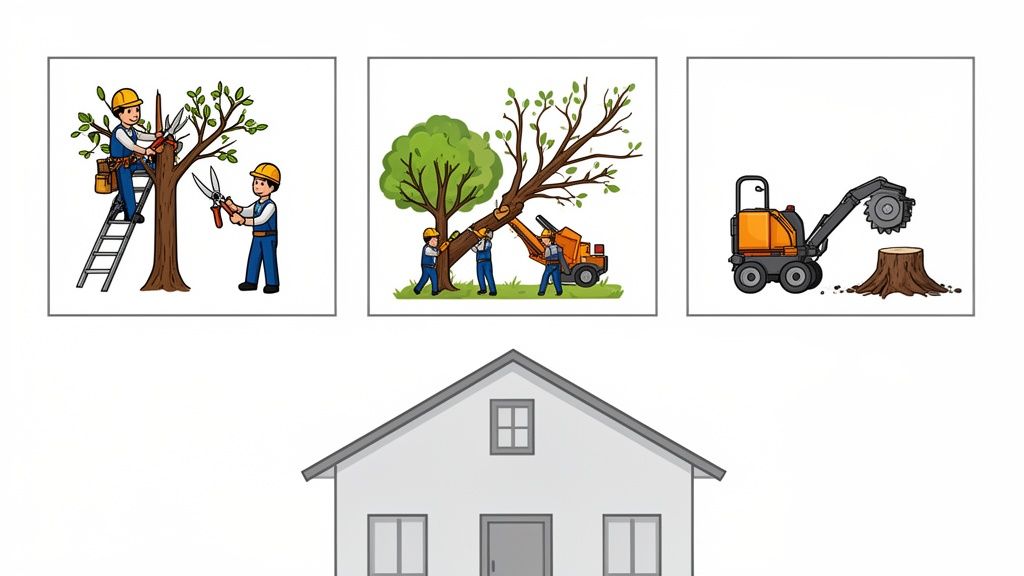
So, what does that really mean for your yard? Our work breaks down into three essential services: precision trimming, safe removal, and stump grinding. Each one solves a very different problem and requires its own set of skills, tools, and expertise.
The Art and Science of Tree Trimming
Many people see tree trimming as just a haircut for an overgrown tree. But in reality, it's more like a delicate surgical procedure that has a huge impact on a tree's health, safety, and beauty. A bad trim can cause lasting damage, while the right cuts help a tree flourish for years to come.
When is the best time to prune my live oak to survive the Texas heat?
This is a question I get all the time, and for good reason—our summers are brutal on every living thing, including our trees. For live oaks and most other deciduous trees here in Abilene, the best time to prune is during the dormant season, which runs from late fall into early spring.
Why then? Think of it this way: pruning during dormancy is like having surgery while you're resting, not while you're running a marathon. The tree isn’t juggling the stress of new growth and scorching heat, so it can direct all its energy toward healing those cuts and preparing for a strong spring.
I remember working on a gorgeous old pecan tree near the Paramount Theatre. The owner was anxious about its health but loved its classic shape. We performed a careful crown cleaning in late winter, taking out only the dead, dying, or crossing branches. By the time summer rolled around, it was fuller and more vibrant than it had been in years—all because we timed the work just right.
Safe and Efficient Tree Removal
There are times when no amount of care can save a tree. Whether it’s due to disease, severe storm damage, or it has simply become a danger to your home, removal is the only responsible choice. This is absolutely not a DIY project; it's a hazardous job that requires precision, experience, and an unwavering commitment to safety.
A professional crew makes sure the tree comes down in a controlled, predictable way—often piece by piece—to protect your house, fences, and the rest of your landscape. A reputable tree service in Abilene, TX will have the cranes, rigging, and expertise to tackle even the biggest trees in the tightest spaces.
A dead or dying tree isn’t just an eyesore; it can be classified as a nuisance under city and state law. According to the Texas Health and Safety Code, property owners can be required to remove conditions that create a public hazard, which absolutely includes dangerous trees threatening neighboring properties.
The Final Step: Stump Grinding
Once a tree comes down, you're left with the stump. It’s easy to think, "I'll just leave it," but that's usually a bad idea. Stumps are tripping hazards, they make mowing a pain, and they become a magnet for pests like termites and carpenter ants.
What’s the real difference between stump grinding and stump removal?
This is a fantastic question that homeowners often ask. The terms get thrown around, but they describe two very different processes:
- Stump Grinding: This is what we do most of the time. A powerful machine literally grinds the stump down to 4-8 inches below ground level. This allows you to fill the spot with soil, plant grass, and make it look like the stump was never there.
- Stump Removal: This is a far more aggressive process that involves pulling the entire stump and its main root ball out of the ground with heavy equipment. It’s invasive, costs more, and leaves a huge crater in your yard that needs to be filled. It's generally only done for major construction projects.
For 99% of residential situations, stump grinding is the smarter, more practical, and budget-friendly solution. It gets rid of the hazard and the pest risk without destroying your lawn.
Emergency Storm Damage Services
Here in Abilene, we all know how a calm afternoon can erupt into a violent thunderstorm without warning. When high winds or lightning strike, trees can fail spectacularly, dropping huge limbs or toppling over completely. When that happens, you need an emergency tree service in Abilene, TX that can get there fast.
Our crew is always on call to handle storm emergencies. Our first priority is always safety—clearing fallen trees from your roof, driveway, and power lines so you can start getting your life back to normal. A quick response can prevent a bad situation from getting much worse and gives you immediate peace of mind.
Understanding Tree Service Costs in Abilene
What's this going to set me back?
Let's get right to it. This is a perfectly fair question, and probably the most important one for any homeowner. The honest answer is, there’s no flat rate for tree work because every single job is different.
Think of it like taking your car to the shop. The mechanic can't give you a price until they look under the hood. I'm the same way with trees. My goal here is to pull back the curtain and show you exactly what goes into a tree service estimate in Abilene, so you know what to expect.
What Factors Influence the Price of Tree Services?
When I walk a property to put together an estimate, I'm not just pulling a number out of thin air. I’m doing a mental checklist, evaluating all the things that affect the time, equipment, and skill needed to get the job done right—and safely.
I remember a job a while back that really illustrates this. A homeowner needed two trees removed that looked almost identical from a distance. One was in the middle of the front yard, easy peasy. The other was crammed between the house and a brand-new fence. The quote for that second tree was quite a bit higher, which surprised him at first. I had to explain that its location meant we couldn't just fell it; we had to carefully take it apart piece by piece with special rigging to make sure nothing was damaged. That takes a lot more time and expertise.
That story really covers the main things we look at:
- Tree Size and Height: This one’s pretty straightforward. A towering 60-foot oak is a completely different project than a small, 15-foot ornamental tree. Bigger trees demand more hands on deck, more time, and often heavy-duty equipment like cranes or bucket trucks.
- Tree Accessibility: Can we get to it easily? A tree in an open field is simple. One in a tight backyard, with a pool or deck underneath, requires a much more delicate and strategic approach.
- Tree Species and Condition: Not all wood is created equal. A dense live oak takes more work to cut through than a softer pine. If a tree is dead, dying, or full of decay, it can be unpredictable and dangerous, requiring extra safety measures that add to the job's complexity.
- Scope of Work: What exactly do you need done? A simple pruning of a few low-hanging branches is a world away from a full tree removal plus stump grinding. We also factor in debris hauling—some folks prefer to manage the cleanup themselves to keep costs down, and that's perfectly fine.
Typical Tree Service Costs in Abilene, TX
Now for the numbers. While every job is custom, we can look at local data to get a solid idea of what to expect for common services here in the Abilene area. This helps you create a realistic budget and understand what's fair market value.
The table below breaks down the typical price ranges for the most requested tree services. Remember, these are averages—the factors we just discussed will cause the final price to shift up or down.
Average Tree Service Costs in Abilene TX
This table shows typical price ranges for common tree services in the Abilene area, helping homeowners budget for property maintenance. Prices can vary based on job complexity.
| Service | Average Cost (Based on Local Data) | Key Factors Influencing Price |
|---|---|---|
| Tree Trimming & Pruning | $127 per hour (for a 2-person crew) | Tree height, branch density, accessibility, tree health |
| Tree Removal | $388 (for a tree under 30 feet) | Height, diameter, location (proximity to structures), health |
| Stump Grinding | $3 per linear inch of diameter | Stump diameter, root system complexity, accessibility |
| Debris Haul-Away | $100 – $250 (can be a flat fee or hourly) | Volume of debris, ease of access for chipping equipment |
Seeing these numbers helps put everything into context. It shows you that pricing isn't arbitrary but is based on real-world time, equipment, and labor costs for our area. For more details on local pricing trends, you can learn more about these local cost averages for Abilene tree services.
Let's Walk Through a Hypothetical Quote
Say you have a 25-foot mesquite in your backyard that needs to go. It's reasonably healthy, and we can get our equipment to it without much trouble. Here’s how a sample estimate might be broken down:
- Tree Removal (under 30 ft): $388 (fixed fee)
- Stump Grinding (12-inch diameter): $36 (12 inches x $3/inch)
- Debris Haul-Away: $100 (optional fee)
- Total Estimated Cost: $524
When you get a quote from us, it will look a lot like this. We believe in total transparency, showing you exactly what you’re paying for. This way, you can compare quotes apples-to-apples and feel confident there won’t be any hidden fees or surprises when the job is done.
How to Choose the Right Abilene Tree Service
Hiring someone to work on the trees at your Abilene home is a big deal, and it’s about a lot more than just finding the lowest price. You’re trusting a crew with heavy machinery to work right next to your house, your family, and everything you’ve worked hard for. So, how can you be sure you’re bringing in a true professional?
It really comes down to finding someone who will do the job safely and stand behind their work. That bargain-bin quote can turn into a nightmare fast if the company doesn't have its act together.
The Non-Negotiables: Insurance and Certification
Before you even start talking about branches and price, there are two things you absolutely have to check: insurance and any relevant certifications. These aren't optional extras. They are your shield against financial disaster and the clearest sign of a company’s professionalism.
A few years back, I got a call from a homeowner in south Abilene who was in a real bind. He’d hired a cheap "tree guy" off a classifieds site. A huge limb got away from them and crushed his neighbor's new fence. When he asked for insurance info, the guy was gone—leaving the homeowner to pay for the repairs and deal with a furious neighbor.
I tell that story because it’s a perfect, if painful, example of why this first step is so critical.
What kind of insurance should a tree service have?
This is the most important question you can ask. A legitimate, professional company will have no problem showing you proof of two key policies:
- General Liability Insurance: This is what protects your property. If they drop a branch on your roof, your car, or that fence, their insurance covers the damage. If they don't have it, you do.
- Worker's Compensation: This protects their team. If one of their crew members gets hurt on your property, this policy pays for their medical care. Without it, you, the property owner, could be held liable.
Don't be shy about asking for a certificate of insurance. A pro will expect you to ask and will respect you for checking. You can even call the insurance agent listed on the certificate to confirm the policy is active.
Beyond the Basics: Local Experience and Reviews
Once you’ve confirmed they’re properly insured, you can start looking at their track record right here in Abilene. A company with deep local roots knows our unique challenges—our soil, our notorious wind, and how to properly care for a West Texas Live Oak so it can survive a summer drought.
How do I know if online reviews are trustworthy?
This is a smart question. Online reviews are a great resource, but you have to read between the lines. Ignore the overall star rating for a minute and look for patterns. Are the good reviews specific, mentioning the crew's skill or how well they cleaned up? Even more telling is how the company handles a bad review. A professional, helpful response to a complaint can be more reassuring than a dozen generic 5-star ratings.
For the most reliable feedback, ask for references to other jobs they’ve done in town—and actually give them a call. Any company that's proud of their work will have a list of happy customers ready to share.
This chart gives you a solid idea of what typical tree services cost, which can help you understand what goes into a professional quote.
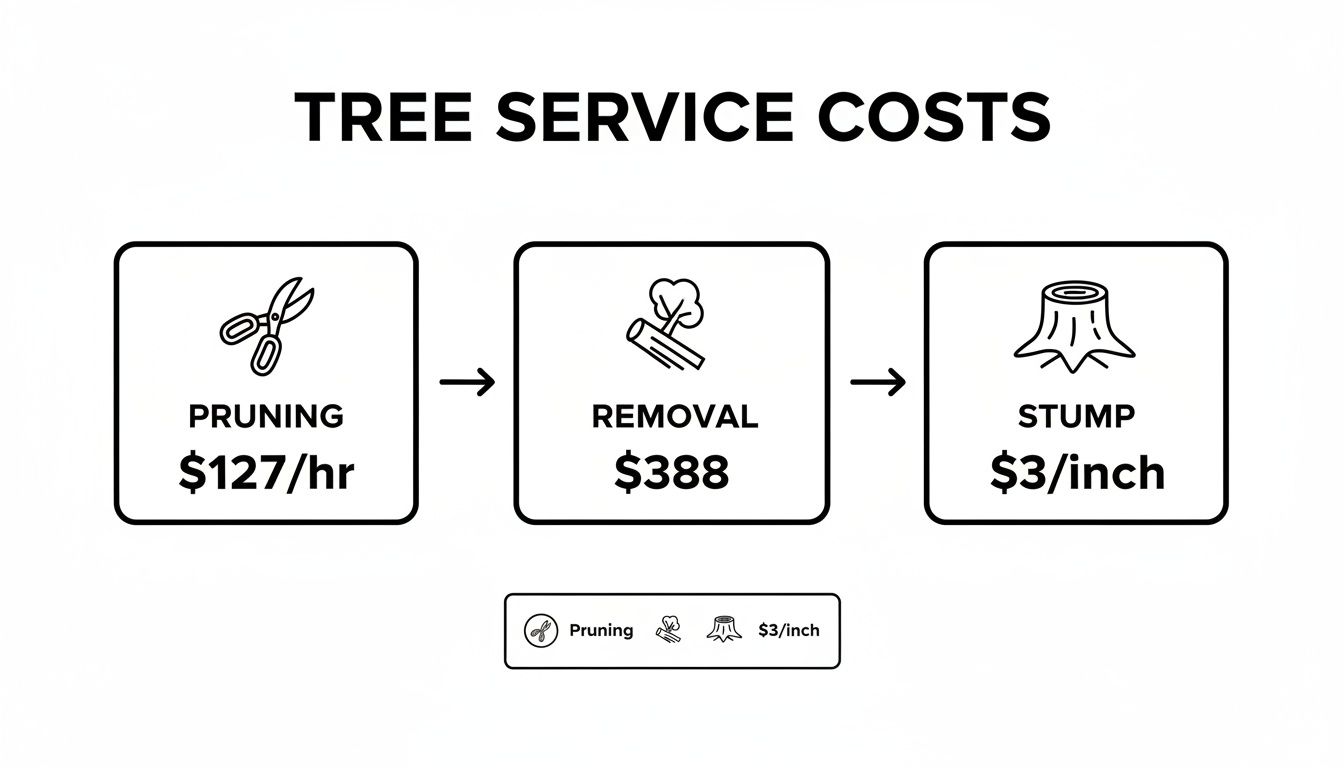
As you can see, the pricing structure changes depending on the job. Pruning is often hourly, while stump grinding is usually priced by the inch. This helps explain how a final estimate is calculated.
The demand for qualified tree professionals is clear even at the state level. In a single year, Texas agencies had 175 contracts open for bidding on tree-related services. This shows there’s a healthy market of vetted pros, just like the reliable experts at Abilene Home Service who handle everything from tree care to lawn mowing.
After a big tree removal, you're usually left with a mountain of debris. We can help with that, too. Learn more about our professional junk removal in Abilene and how we can clear your yard completely.
Preparing Your Property for Tree Service
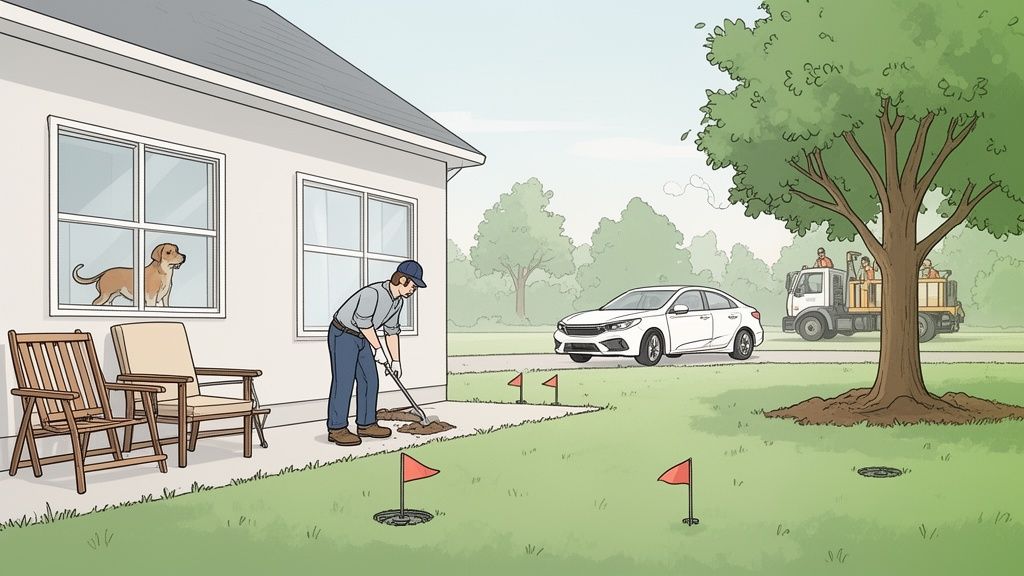
So, you've scheduled your tree service. Now what? It's a question we get all the time, and the answer is simple: a little prep work from you goes a very long way for our crew.
Think of it as setting the stage for a smooth, safe, and efficient project. When you help us by clearing the work area, we can dedicate all our attention to the health of your trees. We’ve seen firsthand how these small steps can make a big difference, protecting your property and helping us get the job done right.
Your Pre-Visit Property Checklist
Here's a quick rundown of the best ways to prepare your home for a professional tree service in Abilene, TX. Following these simple steps helps everything go off without a hitch.
Clear the Work Zone: The most important thing you can do is move anything that could get in the way. This includes cars in the driveway, patio furniture, grills, kids' toys, and even garden hoses. Clearing this space prevents accidental damage from falling limbs and gives our team and equipment room to operate safely.
Secure Your Pets: We love animals, but a work site is no place for them. The noise and activity can be stressful, and for everyone's safety, it's best to keep all pets securely inside the house until we're finished.
Unlock Gates and Access Points: Before we arrive, please make sure any gates to the work area are unlocked. If you have a preferred path for us to use, letting us know and ensuring it's clear saves time right from the start.
This preparation truly pays off. I remember a client who needed a large oak trimmed in their backyard. They had already moved their patio furniture and parked their cars on the street before we even pulled up.
Because the area was completely clear, our crew was able to position our equipment perfectly on the first try and get straight to work. We finished the job nearly an hour ahead of schedule, which saved the client money and got us out of their hair sooner. It was a perfect example of how teamwork leads to great results.
Point Out Hidden Landscape Features
Here’s a pro-tip that often gets missed: tell us about what we can't see. Your yard is full of underground systems that are essential but incredibly vulnerable during heavy-duty tree work.
What should I tell the crew about my yard?
Before we fire up a single chainsaw, we’ll do a walkthrough with you. This is the perfect time to point out any hidden or buried features around your property.
Be sure to let our crew leader know about things like:
- Sprinkler heads and irrigation lines
- Septic tanks or drain fields
- Underground landscape lighting wires
- Invisible dog fences
Marking these spots with small flags (which we’re happy to provide) is a fantastic way to keep them top-of-mind for our team. Protecting your entire property—both above and below ground—is our priority. This kind of thoughtful preparation is just as vital for other projects, a topic we cover in our guide to expert lawn care services in Abilene.
Frequently Asked Questions About Tree Care in Abilene
If you own a home in Abilene, you’ve probably stood in your yard at some point and wondered about your trees. Are they healthy? Do they need a trim? What's that spot on the trunk? It’s completely normal.
Over my years working with trees all across our area, I've heard just about every question you can imagine. To make things easier for you, I’ve put together the answers to the ones I get asked most often.
How can I tell if my tree is sick or dying?
This is, without a doubt, the question that carries the most weight for homeowners. A tree is a huge part of your property, and watching it decline is stressful. The good news is, trees usually give us a heads-up when something's wrong.
I've learned to spot these clues from a mile away. I remember getting a call from a gentleman over by Abilene Christian University who was worried about his big red oak. As soon as I pulled up, I saw what he was talking about: a lot of dead branches high up in the canopy, deep cracks running down the trunk, and bark peeling off near the ground. Those are textbook signs of a tree in serious trouble.
Here are a few things you can look for on your own property:
- Significant Deadwood: Don't worry about a few snapped twigs. I'm talking about large, bare branches, especially at the top of the tree. That’s a major red flag.
- Trunk Damage: Keep an eye out for deep vertical cracks, sunken-looking spots of dead bark (called cankers), or big patches where the bark is flaking or falling off completely.
- Fungus Growth: If you see mushrooms or shelf-like fungi growing on the trunk or popping up from the roots, it’s often a sign of internal decay. This is a serious issue that can make a tree unstable.
- Sudden Lean: A tree that has always been straight and suddenly starts to lean is waving a white flag. This often points to a failing root system.
- Leaf Issues: In the spring and summer, look at the leaves. If they're discolored, wilted, or just don't show up when your other trees are green and full, the tree is under severe stress.
Here in Abilene, our intense droughts can often mimic the symptoms of a disease, stressing a tree to its limits. The only way to know for sure is to have a professional take a look. We can tell you if it's something that can be treated or if the tree needs to come down safely.
Do I need a permit to remove a tree in Abilene, TX?
This is a great question, and I'm glad when people ask it. It’s always better to be certain than to run into trouble with the city later. Luckily, the answer is usually pretty simple.
For most residential properties inside the Abilene city limits, you generally do not need a permit to take down a tree on your own private land. That's a relief for homeowners who have a hazardous tree that needs to be dealt with quickly.
However, there are a couple of key exceptions. You might need a permit if the tree is located:
- In a public right-of-way: This is usually the strip of land between the sidewalk and the street.
- Designated as 'protected' or 'historic': While rare, some special trees in historic areas have protections.
My advice? It never hurts to make a quick call to the City of Abilene's Planning and Development Services just to be 100% sure. As part of our professional tree service in Abilene TX, we always handle this step for our clients. It's just part of doing the job right and giving you complete peace of mind.
How often should I have my trees trimmed?
I love this question because it means you're thinking about long-term tree health, not just waiting for a problem to pop up. The right trimming schedule really isn't a one-size-fits-all thing; it comes down to the tree’s age, species, and location.
For example, I have a client in the Wylie school district with several young trees we helped them plant a few years back. For those, I recommended a light, structural pruning every year. This helps them grow a strong frame from the get-go, setting them up for a long, healthy life.
When it comes to the big, mature West Texas shade trees like our oaks and elms, a good rule of thumb is to have them professionally pruned every 3-5 years. This is usually enough to clear out dead branches, improve airflow through the canopy, and keep them structurally sound against our high winds.
On the other hand, fast-growing trees need a bit more attention. Something like a hackberry or mulberry can get overgrown and develop weak branches quickly, so they often benefit from a trim every 2-3 years. A little bit of regular maintenance is always cheaper than an emergency call after a storm.
Is stump grinding really necessary after tree removal?
I get asked this all the time, and my answer is almost always a firm "yes." I know it can be tempting to skip the stump grinding to save a little money on the job, but from my experience, it's a shortcut that often creates bigger, more expensive headaches down the road.
Here's a perfect example: a client had us remove a dead pine but decided to leave the stump. About six months later, I got a frantic call—he'd found termites swarming all over it, just a few feet from his house's foundation. The bill for the pest control company was way more than the stump grinding would have cost in the first place.
Besides keeping pests away, here are the main reasons I always recommend it:
- Safety: A stump is a major tripping hazard, especially if you have kids playing in the yard or you're just trying to mow the lawn.
- Aesthetics and Function: Let's be honest, it's an eyesore. It gets in the way of your mower and prevents you from using that part of your yard. Grinding lets you reclaim that space for grass or a new garden bed.
- Pest Control: As that story shows, a decaying stump is basically a welcome mat for termites, carpenter ants, and other wood-boring bugs you definitely don't want setting up camp near your home.
When we grind a stump, we go down 4-6 inches below the surface. That’s plenty deep to let you add topsoil and plant grass right over the top, completely erasing any sign that a tree—and its potential problems—was ever there.