
If you're a homeowner in Texas, the first question that pops into your head when you hear the word "termites" is almost always, "How much is this going to cost me?" Let's get straight to it. On average, you can expect to pay around $500 for termite treatment, but the reality is that costs can fall anywhere from $290 to $1,150, sometimes even higher.
That initial number is just a starting point, though. Think of it as a baseline before we start factoring in the unique details of your home and the specific termite problem you're facing.
Your Quick Guide to Texas Termite Treatment Costs
I've been in your shoes. I remember spotting those dreaded mud tubes snaking up my own foundation here in Abilene and feeling my stomach drop. My mind immediately went to the cost—was this a few hundred bucks or a few thousand? That uncertainty is one of the worst parts, so my goal is to give you a clear, no-nonsense look at what you can expect to pay for termite treatment in Texas.
This is your budget cheat sheet. It will give you a solid idea of the financial side of things before you even make that first call to a professional.
What Is the Average Cost for Termite Treatment in Texas?
The final price tag really boils down to two main things: the size of your house (specifically its perimeter) and how bad the infestation has gotten.
Based on projections for 2026, treating a smaller home with a 100-linear-foot perimeter can cost anywhere from $290 to $1,540. For a larger home with a 400-linear-foot perimeter, that price can jump significantly, ranging from $1,160 to $6,160.
To give you a clearer financial picture, here’s a quick breakdown of how treatment costs typically scale with the severity of the problem.
Estimated Termite Treatment Costs in Texas (2026)
This table breaks down the typical price ranges for treating different sizes of termite infestations in Texas, giving you a quick financial snapshot.
| Infestation Severity | Average Cost Range in Texas | Potential Cost for a Large Perimeter (400 ft) |
|---|---|---|
| Small Infestation | $240 – $1,155 | Costs stay toward the lower end of the home's range. |
| Medium Infestation | $385 – $1,445 | Costs are in the mid-range for the home's size. |
| Large to Severe | $1,155 – $6,265+ | Costs can easily reach the high end, or exceed it. |
As you can see, these numbers really drive home the importance of catching an infestation early. Putting it off, especially in a termite-heavy area like West Texas, can quickly turn a manageable problem into a major expense.
What Factors Influence the Final Price?
Beyond the basic size of your home and the infestation, a few other key details will shape your final quote. The type of termite is a big one. Our common subterranean termites are usually less expensive to treat than drywood termites. Getting rid of drywood termites can involve more intensive methods, sometimes pushing the cost up to $6,250 or more.
My own experience taught me that no two termite jobs are the same. Your home's foundation—whether it's a concrete slab or a pier-and-beam with a crawl space—plays a huge role. Local soil conditions and any moisture problems around your house can also change the treatment plan and, therefore, the cost. We’ll get into those details a bit later, but for now, you have a solid ballpark estimate to work with. For more tips specific to our area, check out our guide on professional pest control in Abilene.
Alright, you've seen the general price ranges, but you're probably wondering, "What does that number actually get me?" Termite treatment isn't a one-size-fits-all service, and the specific method a pro recommends will be the single biggest factor driving your final bill. The cost of termite treatment in Texas has such a wide range precisely because the tools and strategies are so different.
Let's break down the most common treatment options you'll encounter. Understanding what they are and why a pro might suggest one over the other is key to making a smart decision.
This breakdown shows just how much the cost can swing, comparing an average expense to the potential bill for a severe, unchecked problem.
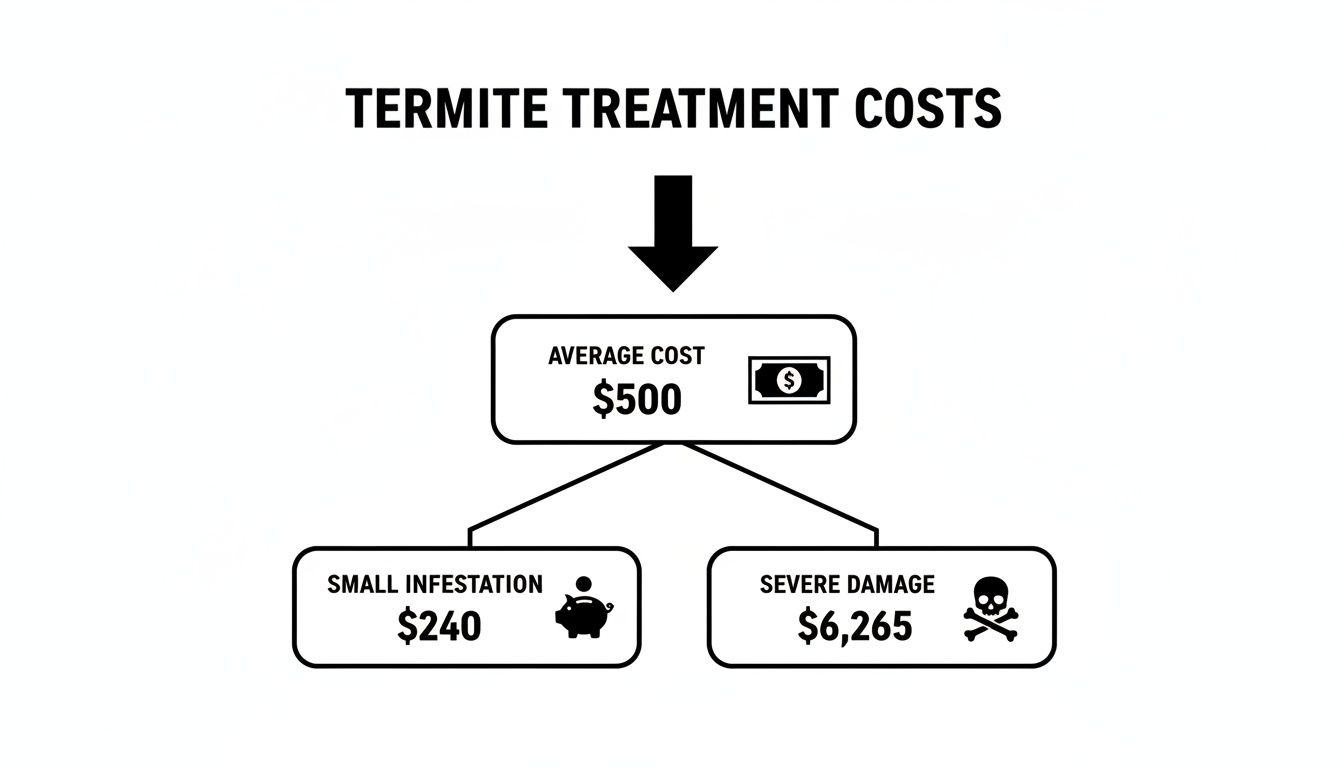
As you can see, catching an infestation early keeps the cost manageable. Letting it go can turn into a serious financial headache, which is why acting fast is always the best policy.
Liquid Barrier Treatments: The Defensive Moat
A liquid barrier is the classic, go-to defense against subterranean termites—the main species we deal with here in Texas. Think of it as building a chemical moat around your home's foundation. A technician will dig a narrow trench around the perimeter and apply a specialized termiticide directly into the soil. This creates an invisible, unbroken barrier that either kills termites on contact or repels them from ever reaching your house.
For a typical Abilene-area home, a full liquid treatment usually lands somewhere between $500 and $1,500. I actually faced this choice myself on my property near Dyess AFB. The idea of an immediate shield was definitely appealing.
Bait Station Systems: The Long-Term Strategy
Bait stations take a completely different approach. Instead of a chemical barrier, a professional installs several discreet bait stations in the ground around your home. These stations contain a food source—like wood or cellulose—laced with a slow-acting poison. Foraging termites find this "food," carry it back to their colony, and share it. Over weeks or months, the entire colony is slowly but surely eliminated from the inside out.
The initial setup for a bait station system often runs from $800 to $1,800, which is pretty comparable to a liquid treatment. The key difference is the ongoing monitoring contract, which typically costs $200 to $400 per year. For me, the thought of wiping out the entire colony—the source of the problem—was a huge selling point. It felt like a more permanent fix than just putting up a wall.
My personal decision came down to this: a liquid barrier offered immediate protection, while bait stations aimed to destroy the source of the problem. I ultimately chose the bait stations for the long-term peace of mind, even with the ongoing monitoring fee. It felt like a proactive investment rather than just a defensive one.
Localized Spot Treatments: For Minor Issues
If you're lucky enough to catch a very small, contained infestation, a spot treatment might be on the table. This is exactly what it sounds like: a technician targets a specific, known problem area by injecting termiticide directly into an infested wall void or a single piece of wood.
This is by far your cheapest option, often costing between $250 and $600. But here's the catch: it only kills the termites in that one spot. It does absolutely nothing to protect the rest of your house or deal with the hidden underground colony that's sending them in. It's really just a bandage, not a cure.
Fumigation: The Nuclear Option
Fumigation, or "tenting," is the most extreme and expensive treatment out there. It’s reserved almost exclusively for widespread drywood termite infestations, which are a different beast than our common subterranean variety. The entire house is draped in a massive tent and filled with a gas that seeps into every crack and crevice, killing every single termite inside.
The cost of this termite treatment in Texas is substantial, usually starting around $2,000 and climbing to over $8,000, as it's priced by the square foot. While it's incredibly effective, it's also a major disruption—you and your family will need to move out for several days.
Getting a handle on these methods is the first step in making sense of any quote you receive. For more insights on dealing with local pests, you can check out our other articles on pest control.
What Goes Into Your Final Termite Bill?
It’s the question every homeowner asks: "I got a few quotes… why are they all so different?" If you're wondering why your neighbor's termite bill was hundreds less than the estimate in your hand, you're not alone. It's a fair question, and the answer is that a termite treatment isn't a simple, off-the-shelf product.
The final price is a blend of several factors that are unique to your property. Think of it like a mechanic’s quote—an oil change has a set price, but a full engine diagnostic and repair is a whole different ballgame. The same principle applies here; professionals build a quote based on what they find during their inspection.
Let's break down exactly what they're looking for.
Your Home's Size and Foundation Type
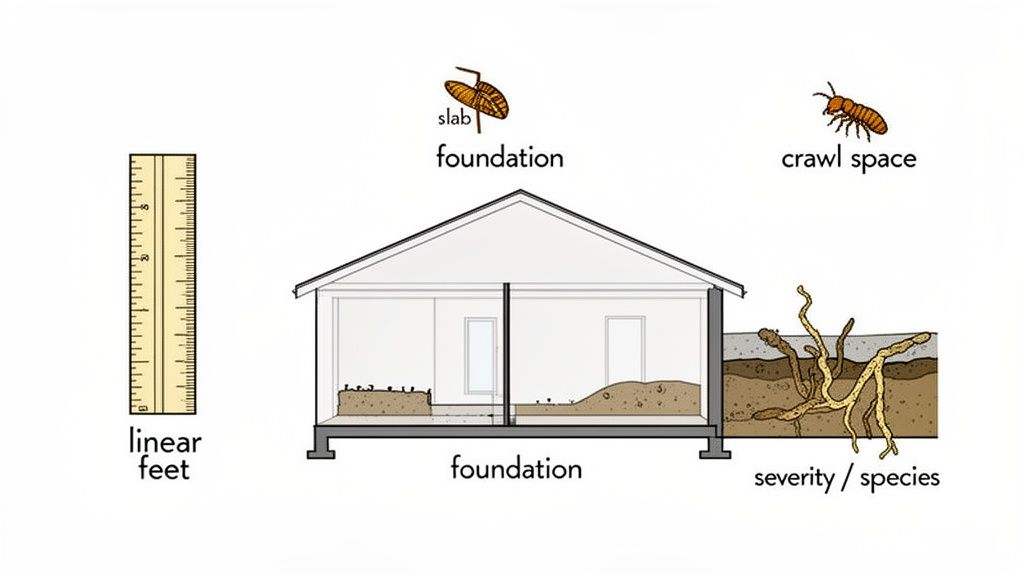
First off, size matters, but maybe not in the way you think. A pest control expert isn't calculating your home's square footage. They're measuring the linear feet around the outside of your foundation. This is the total perimeter that needs to be treated, and it directly affects the amount of termiticide and man-hours required. A long, single-story ranch home can easily have more linear feet than a two-story house with the same total living space.
The type of foundation your house sits on is another huge piece of the cost puzzle.
- Slab-on-Grade: This is your standard concrete slab foundation. It's the most common in modern Texas homes and is usually the most straightforward to treat. The process involves some strategic drilling through the concrete, often in garages or on patios, to create a complete chemical barrier in the soil underneath.
- Crawl Space or Pier-and-Beam: Homes with these foundations are more complex and, frankly, more work. Technicians have to suit up and get into some tight, dark spaces to treat the soil around every pier and the entire crawl space perimeter. This extra time and labor naturally increase the cost.
I’ve seen this firsthand. My own home has a slab foundation and was fairly simple to treat. A few years later, my parents, who live in an older pier-and-beam house, got a quote that was nearly double mine. The difference was almost entirely due to the difficulty of a technician having to maneuver around in that crawl space for a full day.
The Scale of the Infestation (and the Type of Termite)
Next up is the severity of the problem. If you've caught a small, isolated termite colony early on, the treatment will be simpler and less expensive. But if an established colony has been quietly chewing away at your home's structure for years, you’re looking at a much more involved and costly job.
A severe infestation isn't just about killing off more termites. It means the colony has likely created multiple entry points and tunnels, and may have already caused significant damage. A more aggressive and comprehensive plan is needed to make sure every last one is gone for good.
The specific species of termite also changes the game plan and the price. Here in Abilene, we almost always deal with subterranean termites. These guys live underground and are best managed with soil treatments like liquid barriers or bait stations. But in the rare case a home has drywood termites—which live inside the wood itself—the only effective solution is often whole-home fumigation (tenting), which is a completely different and far more expensive process.
Accessibility and Ground Conditions
Finally, the land right around your foundation plays a role. The dense clay soil we have in many parts of Texas can be tougher to treat than looser, sandy soil. Things you’ve built around your home can also present literal obstacles.
Extensive concrete patios, decorative landscaping, or wood decks built right up against the house can block access to the foundation. If a technician has to carefully drill through your prized stamped concrete or remove deck boards to do the job right, that extra labor is going to show up on the final bill. The easier it is to get to the perimeter, the smoother (and more affordable) the job will be. Keeping the wood around your home in good shape can also go a long way, and you can find some great tips in our proper wood care in our guides.
Because Texas's climate is so favorable to termites, a severe infestation can really drive up the price. Statewide, homeowners can see costs ranging from $1,155 to $6,265 for a major problem, and drywood termite fumigation can hit $4 per square foot. Abilene homeowners deal with the same risks from subterranean termites, but hiring a pro who knows our local conditions can help keep those costs in check. For more on this, you can discover more insights about how these factors affect costs across Texas on Angi.com.
Deciding Between DIY and Professional Termite Treatment
Walking through a hardware store, it’s hard to miss the DIY termite control kits. The thought is almost irresistible: "Can I just handle this myself and save a few hundred bucks?" It's a common question, and on the surface, the idea of a quick, cheap fix makes a lot of sense.
But when you're dealing with something as destructive as termites here in Texas, that initial savings can quickly turn into a catastrophic expense. This is a decision that deserves a serious look, so let’s have an honest conversation about the pros and cons of going it alone versus calling in a professional.
The Real Cost of DIY Termite Control
Let's be blunt: the only real advantage of DIY termite treatment is the lower upfront cost. A box of bait stakes or a jug of spray is always going to be cheaper than a professional service. Unfortunately, that's usually where the good news ends and the significant risks begin.
I've seen this play out time and time again. I remember one homeowner who was determined to manage a termite problem with store-bought bait stakes. For nearly a year, he thought he had it under control. The real shock came when he tried to sell his house and the buyer's inspection revealed that the colony hadn't just survived—it had spread deep into his home’s main support beams. The repair bill came in at over $10,000, completely dwarfing what a professional treatment would have cost from the start.
His story is a tough but crucial lesson. The DIY approach comes with some major blind spots.
For starters, can you correctly identify the termite species you're up against? Subterranean termites, the most common culprits in Abilene, demand a completely different battle plan than drywood termites. Using the wrong product is like trying to put out a grease fire with water—it’s not only useless, but it can actually make the problem much, much worse.
And what about the equipment? The termiticides available to the public just don't have the same potency as the professional-grade materials. More importantly, pros use specialized gear like high-pressure soil injectors to create a complete, unbroken chemical barrier around your foundation. A simple garden sprayer simply can’t get the job done.
The effectiveness of a termite treatment isn't just about the chemical—it's about the application. A small, untreated gap of just a few inches in a liquid barrier is like leaving your front door wide open for termites to march right through.
Why Professional Treatment Offers Better Value
When you hire a licensed pest control company, you’re buying much more than just chemicals and an hour of labor. You're investing in proven expertise, safety, and most importantly, peace of mind that’s backed by a guarantee. The cost of professional termite treatment in Texas includes critical services that no DIY kit can offer.
A professional service like Abilene Home Service always includes:
- A Comprehensive Inspection: A trained technician will pinpoint the exact species, find their hidden entry points, and map out the full extent of the infestation.
- A Tailored Treatment Plan: They won’t just spray and pray. They’ll build a strategy using the right products and methods for your specific home and termite problem.
- A Service Warranty: This is the game-changer. If termites show up again during the warranty period, the company comes back to re-treat at no extra charge. This is your insurance policy against failed treatments.
To really see the difference, it helps to put the two approaches side-by-side.
DIY vs. Professional Termite Treatment
This head-to-head comparison should help you decide whether to tackle termites yourself or bring in an expert. It breaks down what you truly get—and what you risk—with each path.
| Factor | DIY Treatment | Professional Service (e.g., Abilene Home Service) |
|---|---|---|
| Initial Cost | Low (typically $50 – $200 for products) | Higher ($500 – $1,800+) |
| Effectiveness | Low to moderate; often fails to kill the colony | High; targets the entire colony with proven methods |
| Expertise | Relies on homeowner's limited knowledge | Backed by certified, trained, and licensed technicians |
| Equipment | Basic, consumer-grade tools | Specialized, professional-grade equipment |
| Guarantee | None. If it fails, you bear the full cost of damage. | Yes. Includes a warranty for re-treatment. |
| Long-Term Risk | Extremely High. Hidden damage can lead to thousands in repairs. | Very Low. The warranty protects your investment. |
At the end of the day, it's your home and your choice. But given the sheer destructive power of termites and the high stakes involved, hiring a professional almost always proves to be the smarter, safer, and more cost-effective decision in the long run.
How to Evaluate Quotes and Choose the Right Abilene Pro

After you've had a few inspections, you’ll be looking at a stack of quotes. It’s completely natural to feel a bit overwhelmed right about now. The temptation is to scan for the lowest number and just go with that one. I've been there. But treating termites isn't like buying a TV—the cheapest option is rarely the best value.
I almost made that mistake myself. One bid came in significantly lower than the others, and I was ready to sign. But something told me to dig into the paperwork, and I'm glad I did. The rock-bottom price came with zero guarantees. A cheap treatment that fails is just expensive termite food. To avoid that trap, you need to know what to look for besides the price. Let's break down how to read between the lines and pick a pro with confidence.
What Should a Good Termite Quote Include
Think of a professional quote as the blueprint for your home's protection, not just a bill. If it’s vague, missing details, or looks like it was scribbled on a napkin, that’s your first red flag.
A solid, trustworthy proposal will always lay out these key pieces of information:
- A Detailed Property Diagram: This should be a clear map of your home’s footprint. It needs to pinpoint exactly where the technician found termite activity, flag any problem spots (like leaky faucets or poor drainage), and show precisely where the treatment will be applied.
- A Clear Description of Methods: The quote must state the exact treatment method—a liquid barrier, bait stations, or a hybrid approach. It should also name the specific product being used, like Termidor for a liquid treatment or the Sentricon system for baiting.
- A Transparent Cost Breakdown: You have a right to know where your money is going. The quote should separate the charges for labor, materials, and any ongoing annual monitoring fees. This transparency is vital for understanding the true cost of termite treatment in Texas and ensures there are no surprises later.
- Warranty and Service Plan Details: The warranty terms need to be crystal clear. How long does the protection last? What does it actually cover? Is there an annual renewal fee to keep the guarantee active?
For me, the warranty was the tie-breaker. The company I ultimately hired offered a comprehensive, transferable warranty. That didn't just give me peace of mind; it became a real asset when I sold my house years later, proving to the new owners that the property was, and would continue to be, protected.
Key Questions to Ask Every Provider
Getting multiple quotes is your opportunity to interview these companies. Don't be shy about asking tough questions. How they answer tells you everything about their expertise, honesty, and how they’ll treat you once the check is cashed.
Before you sign on the dotted line, make sure you have solid answers to these questions.
What exactly does your warranty or service agreement cover?
This is the single most important question. Does the warranty only cover re-treatment if termites come back, or does it cover repairing new damage? A re-treatment guarantee is standard, but a damage-repair warranty is the gold standard—much harder to find, but incredibly valuable. Also, ask if the warranty is transferable to the next homeowner.
What is your process if termites return?
A reputable company won't hesitate to answer this. They should have a clear, step-by-step protocol. You want to hear specifics about their response time and what actions they'll take to fix the issue at no extra cost.
I put this question to three different companies. Two gave me wishy-washy answers about "scheduling a follow-up." The third, the one I went with, said, "You call our direct line, and we will have a technician on-site within 48 hours to assess and re-treat the affected area, guaranteed." That level of specific commitment is what you're looking for.
Are your technicians licensed and insured?
This is non-negotiable. The company must carry liability insurance and provide proof that their technicians are licensed by the Texas Department of Agriculture. This protects you from any liability if there's accidental damage to your property—or a neighboring one—during the treatment process.
Frequently Asked Questions About Texas Termite Costs
Even after getting the facts, it's natural to have a few more questions pop up when you're talking about protecting your home. I get it. Here are the straight-up answers to the questions I hear most often from homeowners here in Texas.
Is Termite Treatment a One-Time Cost or an Ongoing Expense?
This is a big one. The initial treatment will be your single biggest investment. But for real, long-term protection, most homeowners wisely choose an annual monitoring plan afterward.
Think of it like a security system for your foundation. These plans usually run between $200 and $400 a year. For that, you get regular professional check-ups and, crucially, free re-treatments if termites dare to show their faces again.
Does Homeowners Insurance Cover Termite Damage or Treatment?
I wish I had better news here, but the answer is almost always a hard no. Standard homeowner policies see termite damage as a maintenance issue—something that could have been prevented.
This is a critical distinction. The financial burden for both eliminating the termites and fixing the damage they've caused lands squarely on your shoulders. It’s precisely why being proactive with professional treatment is so important; it’s an investment that can save you from jaw-dropping repair bills later.
How Long Does a Termite Treatment Last in Texas?
How long your protection lasts really comes down to the method we use. A properly applied liquid barrier can create a solid defensive line for about five years, although our intense Texas sun and soil conditions can sometimes shorten that lifespan.
Baiting systems are a different animal altogether. I actually chose bait stations for my own house because they offer indefinite protection, as long as you keep up with the professional monitoring. The system's effectiveness relies on that ongoing service, where a technician regularly checks the stations and replaces bait to keep the colony-killing cycle active.
When I was getting quotes for my own place, I grilled each pro on this. The best ones laid it out perfectly: a liquid barrier is like a 5-year shield, but bait stations are a lifetime security system that needs its annual subscription. Understanding that difference made my choice clear.
Can I Get a Free Termite Inspection in Abilene?
Yes, you absolutely can and should. Any reputable pest control company, including us at Abilene Home Service, will offer a free, no-strings-attached initial inspection. We believe you need all the information before you can make the right call.
This inspection isn't just a quick look-around. It’s a chance for a trained expert to thoroughly assess your property, identify the exact type of termite you're dealing with, and figure out the scale of the problem. Only then can we give you an accurate, honest quote that's truly tailored to your home's specific situation.