

Here in Abilene, we know our homes are our greatest assets. But there's a silent threat that can chew through that investment, causing thousands in damage before you even know it's there. A professional termites inspection & treatment plan is the only real defense against these hidden pests, protecting your house and your sanity.
Protecting Your Abilene Home From Silent Invaders
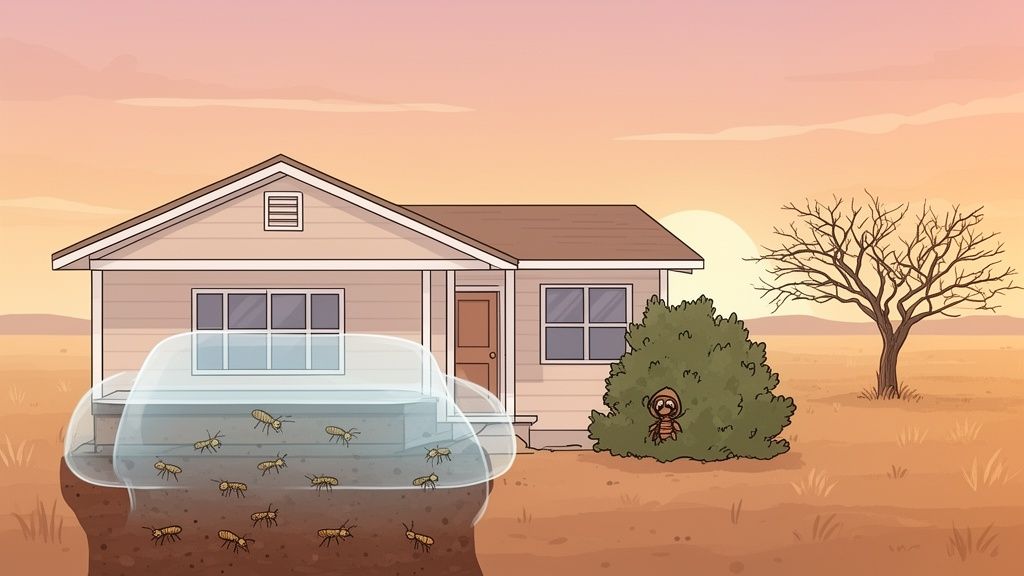
I'll never forget an inspection I did on a beautiful home over by Abilene Christian University. The owner pointed out a small, discolored spot on the ceiling, thinking it was an old water leak. It turned out to be the calling card of a massive termite colony that had been quietly feasting on the home's frame for years. The repair bill was shocking.
That’s exactly the kind of situation we want to help you avoid. This guide will walk you through everything a homeowner in our unique West Texas climate needs to understand about termites. We'll cover the warning signs, what a real inspection from a team like Abilene Home Service looks like, and the most effective treatment options for our area.
Whether you have a family to protect, are stationed at Dyess AFB, or manage local rental properties, this is your game plan for keeping your home secure.
Why Is Termite Protection So Important?
Question: Are termites really that big of a deal around here?
Answer: The short answer is a resounding yes. Termites aren't just creepy crawlies; they're a direct threat to the structural integrity of your house. Because they live and work behind your walls and under your floors, a full-blown infestation can go unnoticed for years while they literally eat you out of house and home.
Termites wreak havoc on homes across the United States, damaging approximately 600,000 properties each year. Homeowners shell out a staggering $5 billion annually just to control these pests and repair the destruction they cause.
Here in Texas, our warm, favorable climate makes us a prime target. When an infestation is left to fester, the average repair bill can easily run between $3,000 and $8,000. That's a heavy price to pay for something that is entirely preventable.
What Are the First Signs I Should Look For?
Question: What are the first warning signs of termites I can look for myself?
Answer: This is the number one question I get from concerned homeowners, and for good reason. Catching a problem early is the absolute best way to minimize damage and cost. While nothing replaces a professional inspection, you can definitely be your home's first line of defense by keeping an eye out for a few tell-tale signs.
To make it easier, here’s a quick rundown of the most common red flags.
| Warning Sign | What It Looks Like | Where to Look |
|---|---|---|
| Hollow-Sounding Wood | When you tap on a baseboard, door frame, or wall, it sounds thin, papery, or hollow. | Anywhere wood meets the foundation, window and door frames, and structural beams. |
| Mud Tubes | Pencil-thin tunnels of dried mud, soil, and wood pulp. This is their highway system. | Along concrete foundations, in crawl spaces, behind siding, and near plumbing pipes. |
| Discarded Wings | Piles of tiny, identical wings that look like fish scales. This is evidence of a recent swarm. | On windowsills, near doorways, in spiderwebs, and around light fixtures. |
| Warped or Bubbling Paint | Paint that looks blistered or warped, often with tiny holes in the drywall underneath. | On walls (especially near the floor), ceilings, and around window frames. |
Keep in mind that these signs often look like other common household issues, which is why termites can be so hard to spot.
Being vigilant is your best strategy. This also includes maintaining the exterior of your home, since damaged wood on fences or decks can attract termites to your property in the first place. Taking care of these outdoor elements is a key part of prevention, and you can learn more from our guide on how staining and cleaning outdoor structures can boost your home's value. Knowing these signs is your first step toward a termite-free home.
Meet the Enemy: Termites in West Texas
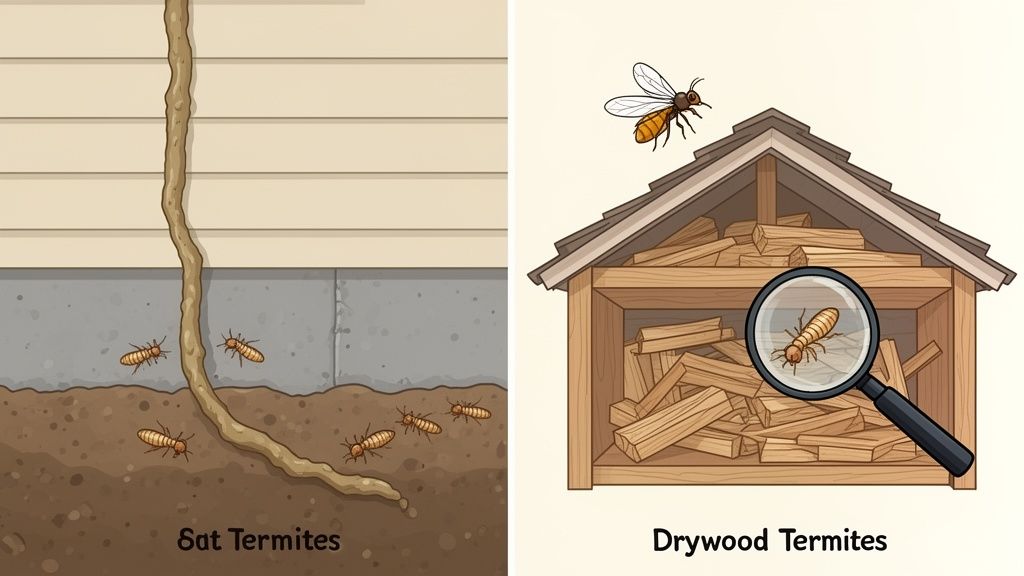
Before you can win the battle against termites, you have to know what you’re up against. Here in Abilene and throughout West Texas, we're primarily dealing with two very different, very destructive culprits: Subterranean termites and Drywood termites. Figuring out which one has invaded your property is the absolute first step, as it shapes the entire termites inspection & treatment plan.
Subterranean termites are the more common threat around here. Think of them as a massive, hidden army living underground. Their colonies are based in the soil where it’s moist, and they have to travel back and forth to their food source—the wood in your home. To do this safely, they build pencil-thin mud tubes that act like covered highways, protecting them from the dry air and predators.
I once saw these tubes running up the foundation of a house near Abilene State Park. They were completely hidden by a single overgrown shrub. The new owner had no clue that an entire termite city was commuting into his walls every day. That’s why checking your home's foundation and crawl space is so critical.
Subterranean vs. Drywood Termites
Then you have the Drywood termites, which are a whole different beast. These guys don't need any contact with the soil. They are aerialists, flying directly to exposed wood like attic rafters, door frames, or even a piece of antique furniture to set up shop.
Because they can start a colony almost anywhere, they can be incredibly difficult to pinpoint. You might have an infestation in your eaves that goes completely unnoticed for years. While both types cause devastating damage, they leave behind different clues and force us to use entirely different strategies to get rid of them.
What Do Termites Actually Look Like?
Question: What do termites actually look like, and how are they different from ants?
Answer: This is a fantastic question because it’s incredibly easy to mistake termites for common ants. A few key features give them away. A termite has straight, bead-like antennae and a thick, uniform body with no defined waist. An ant, on the other hand, has distinctly "elbowed" antennae and a pinched, narrow waist. Just knowing that one difference can give you a pretty good idea of what you’re looking at.
Are These Flying Ants or Termites?
Question: Every spring I see these flying bugs. How can I tell if they're flying ants or termites?
Answer: This is a critical point of confusion, especially during the swarming season. They’re both small, dark, and show up in big groups. Here’s what to look for:
- Wings: A termite has two pairs of wings that are all the same size and shape. An ant’s front wings are noticeably longer than its back wings.
- Waist: Termites have a broad waist, making their body look like one solid piece. Ants have that classic pinched waist.
- Antennae: Termite antennae are straight, while an ant's are bent or elbowed.
If you start finding papery, discarded wings on your windowsills and they’re all identical in size, that's a tell-tale sign of termites. It means a swarm happened right there, and you need to get a professional out to your house, fast.
A termite swarm isn't just a few bugs looking for a home; it's a sign of a mature, thriving colony that has likely been active for 3 to 5 years. These winged termites, called "alates," are the reproductive members sent out to expand the empire.
Seeing a swarm means a massive, hidden colony is already well-established nearby. It’s not the start of a problem—it’s confirmation that the problem has become serious. This is the moment to schedule a professional termites inspection & treatment before the structural damage gets any worse.
What Happens During a Professional Termite Inspection
When you have a professional out to your home for a termite inspection, it’s much more than just a quick walk-around. Think of it as a full-blown investigation—part detective work, part science—to uncover any hidden threats lurking within your walls.
It all starts with a simple conversation. I’ve learned over the years that the homeowner is my best source of initial clues. I'll ask questions like, "Have you noticed any swarming insects near your porch light?" or "Are there any weird, bubbly spots on the drywall that feel soft to the touch?" Your answers help me put the first few pieces of the puzzle together.
The Systematic Search Inside and Out
Once I have a good idea of what you’ve been seeing, the real search begins. This isn’t a random hunt; it's a careful, methodical process where we check all the known termite hotspots and vulnerable areas of your property. We're trained to spot the subtle signs that most people would walk right past.
Our process breaks down into a few key areas:
- Exterior Foundation Check: We’ll walk the entire perimeter of your home, paying close attention to the foundation. We’re looking for the tell-tale mud tubes termites build. I once found an active termite highway completely hidden behind a loose piece of vinyl siding—something the homeowner saw every single day without realizing what it was.
- Probing Accessible Wood: We gently probe exposed wood structures like your baseboards, door frames, and deck posts. We’re listening for a hollow sound and feeling for a soft, papery texture. It's a classic sign that termites have been feasting from the inside out.
- Inspecting Hidden Spaces: The most critical discoveries often happen where you rarely go. We’ll need to get into your attic and any crawl spaces, as these dark, undisturbed areas are common entry points and nesting grounds for termites.
What Questions Will the Inspector Ask?
A good inspector knows that your observations are invaluable. Be ready to share anything you've noticed, because it helps us zero in on potential problems much faster.
Question: Have you seen any discarded wings or swarming insects?
Answer: If you've found what looks like tiny, identical wings on your windowsills, that's a huge red flag. I remember a client who assumed she just had a "flying ant problem" every spring. Turns out, those piles of wings were the calling card of a mature termite colony right under her nose.
Question: Are there any areas with moisture problems or past water damage?
Answer: Termites need moisture to survive, so a leaky pipe, a damp basement, or an area with poor drainage is like rolling out the welcome mat for them. Pointing these spots out is crucial, as termites are 70% more likely to infest a home that has consistent moisture issues.
Using Technology to See Through Walls
Today’s inspections go far beyond what the naked eye can see. We bring specialized tools that help us detect termite activity hidden behind drywall and under your floors.
A professional inspection isn’t just about finding termites; it’s about providing you with a complete, transparent picture of your home’s health. We document everything with photos and clear explanations, so you know exactly what’s going on.
We often use moisture meters to pinpoint damp wood that could attract termites. In some cases, we’ll even use infrared cameras that can detect the heat signatures generated by a large, active colony. This kind of technology lets us identify problem areas with incredible accuracy without having to start tearing into your walls.
This comprehensive approach is why the professional termite control market has grown so significantly—it was valued at $217.3 million in 2024 and continues to expand as homeowners see the value in detailed, expert assessments.
At the end of our visit, you won't be left guessing. We'll give you a detailed report with photos of any problem spots, a clear explanation of our findings, and a straightforward, actionable plan if treatment is needed. For anyone in our area needing a team they can trust, take a look at the services for professional pest control in Abilene, TX. Our goal is simple: to leave you with answers, confidence, and a clear path forward.
Choosing the Right Termite Treatment for Your Home
So, the inspection confirmed you have termites. The first question that pops into everyone’s head is, "Okay, now what? How do we get rid of them?" The truth is, there's no one-size-fits-all answer. The best treatment really depends on the type of termite we're dealing with, how big the colony is, and the way your house is built.
Once we’ve identified the culprit—usually either Subterranean or Drywood termites here in Abilene—we can map out the most effective way to take back your home. Let's walk through the main options so you know exactly what to expect.
This chart breaks down the thought process pretty clearly.
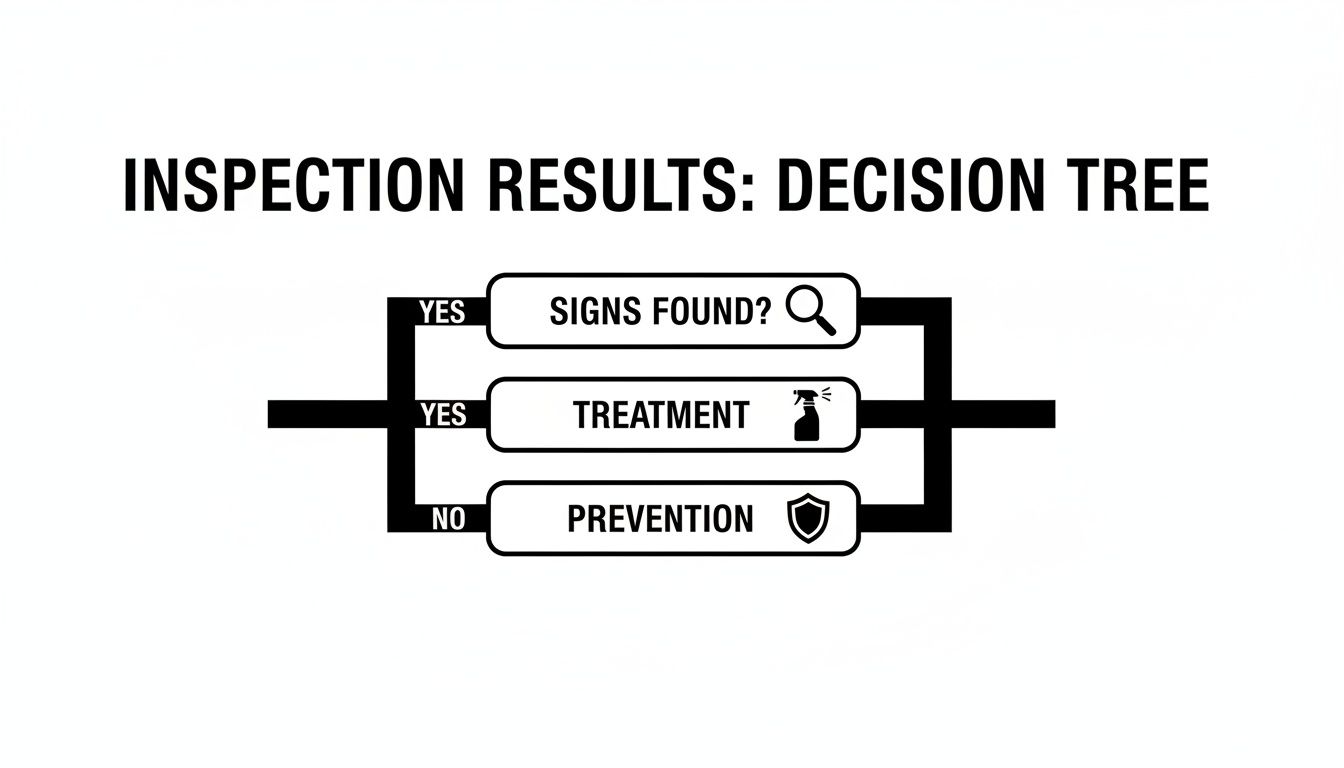
If we find active termites, treatment is the immediate next step. If we don't, we shift gears and focus on solid preventative measures to keep it that way.
Treatments for Subterranean Termites
Because these termites live in underground colonies, our strategy has to hit them where they live. The two most reliable methods are liquid soil treatments and specialized baiting systems.
H3: Liquid Soil Treatments
Think of this as creating an invisible, protective barrier in the soil around your foundation. We dig a small, precise trench and apply a non-repellent liquid termiticide, like the industry-leading Termidor, which termites can't see, smell, or taste.
Foraging termites cross through the treated zone, picking up the active ingredient on their bodies. They then carry it back to the colony like a Trojan horse, spreading it to others through routine contact and grooming. It’s a chain reaction that eventually reaches and eliminates the queen, causing the entire colony to collapse.
H3: Termite Baiting Systems
Baiting systems work less like a barrier and more like a strategically placed trap. I remember one home where a water well was situated very close to the foundation, making a liquid treatment impossible. A baiting system was the perfect—and safest—solution.
We install discreet bait stations in the ground around your home's perimeter. These stations contain a cellulose material that termites actually prefer over the wood in your house. The bait contains a slow-acting growth inhibitor. Worker termites feed on it, carry it back to the colony, and share it, which gradually stops the colony's life cycle.
To give you a clearer picture, here’s a quick comparison of the most common termite treatments we use.
Comparing Common Termite Treatment Methods
| Treatment Method | Best For | Pros | Cons |
|---|---|---|---|
| Liquid Soil Treatment | Comprehensive, immediate protection against subterranean termites. | Creates a long-lasting protective barrier; fast-acting once termites contact it. | More invasive application (trenching); can't be used near wells or water sources. |
| Termite Baiting System | Environmentally sensitive areas; properties with wells; ongoing monitoring. | Very low environmental impact; targets the entire colony over time; easy to monitor. | Slower to eliminate the colony; requires ongoing service to check stations. |
| Spot Treatment | Small, localized drywood termite infestations. | Less invasive and less costly than fumigation; targets a specific problem area. | May not eradicate termites in other undiscovered areas of the home. |
| Whole-Structure Fumigation | Widespread or multiple drywood termite infestations. | 100% effective in eradicating all drywood termites throughout the structure. | Requires vacating the home for several days; more expensive and disruptive. |
Ultimately, choosing the right method is about matching the solution to the specific problem at your property.
Treatments for Drywood Termites
Drywood termites are a different beast entirely. They live inside the wood and don't need contact with the soil, so our approach has to be completely different.
For a small, isolated infestation—maybe just in a door frame or a piece of furniture—we can often use a spot treatment. This involves injecting a product directly into the wood galleries to eliminate the localized colony.
However, if the infestation is widespread or in multiple spots, the only way to guarantee total elimination is with whole-structure fumigation. This is the "tenting" process you've probably seen around town. We seal the entire house and introduce a gas that penetrates every inch of wood, ensuring no termite survives. It’s definitely more involved and requires you to be out of the house for a few days, but it offers complete peace of mind.
A good pest control expert won't just tell you what to do. They'll lay out all the options, explain the pros and cons for your specific home, and help you make an informed decision you feel confident about.
It’s worth noting that the termite control industry is always improving. North America actually makes up about 25% of the global market's revenue, mostly because so many of our homes are wood-framed and homeowners are proactive about protection. This high demand pushes companies to develop better, more effective technologies. You can read more about these global market trends and forecasts if you're interested, but the bottom line for you is that the tools we have today are more targeted and effective than ever before.
Long-Term Prevention to Keep Termites Away
Once your home is officially termite-free, the job isn’t quite done. I always tell my clients, "We’ve won the battle, but now it’s time to fortify the castle." This is where you shift from active combat to smart, long-term defense to make sure they don’t come back.
Question: What can I do to prevent termites from coming back?
Answer: A lot! Your own vigilance is the single most powerful tool you have. It all comes down to eliminating the two things termites desperately need to survive: food (wood) and water (moisture).
Make Your Home a Moisture-Free Zone
Termites are absolutely dependent on moisture. Without a reliable water source, a colony simply can't survive, let alone thrive. Your number one priority is to make your property as dry and uninviting as possible.
I once worked on a house where termites reappeared a couple of years after a full liquid treatment. We couldn't figure out why until we found the culprit: a single, slowly dripping spigot right against the foundation. That tiny, constant drip created the perfect moist patch of soil for a new colony to get a foothold.
Here’s how to eliminate moisture problems around your home:
- Gutters and Downspouts: Keep them clean and make sure they’re channeling water well away from your foundation. I recommend adding splash blocks or extenders to push runoff at least three to five feet from the house.
- Fix Leaks Immediately: Routinely check your outdoor faucets, sprinkler heads, and AC drip lines for any leaks. Even a small, persistent drip is a welcome sign for thirsty termites.
- Check Your Grading: The soil around your foundation should always slope away from the house. If it’s flat or slopes inward, rainwater will pool right up against your home's base, creating a problem.
Eliminate Potential Termite Food Sources
Next up is the food supply. Termites eat cellulose, the organic fiber found in wood and paper products. Your goal is to remove their easy access to this food source. Think of your yard as a buffet—it’s time to close it down for good.
You should maintain a gap of at least 18 inches between any wood on your home and the soil below. Creating this buffer zone makes it much harder for subterranean termites to build their hidden mud tubes directly into your home’s structure.
Here are the most important steps to take:
- Store Firewood Properly: A stack of firewood against the house is like a five-star hotel for termites. Keep firewood at least 20 feet away from your home and stacked up off the ground.
- Manage Your Mulch: Wood mulch is great for garden beds, but it's also a food source that holds moisture right against your foundation. Always pull mulch back at least four to six inches from the house to create a dry, clear barrier.
- Clean Up Yard Debris: Don't let old tree stumps, fallen branches, or leftover construction lumber pile up. These are open invitations for termites to establish a satellite colony right on your property. For more tips, check out our articles on professional wood care and maintenance.
The Value of an Annual Termite Inspection
Finally, the most critical piece of your long-term strategy is an annual professional inspection. Think of it like a yearly physical with your doctor. It’s a proactive check-up to catch any new warning signs before they can turn into major damage.
During an annual inspection, a trained technician will re-examine all the hot spots—the foundation, crawl space, attic, and more—for any new signs of activity. If you have a baiting system, this is when they'll check the stations and replace bait as needed. This ongoing monitoring protects your initial investment and gives you the ultimate peace of mind, year after year.
Your Frequently Asked Questions About Termites
Homeowners in Abilene ask us a lot of questions about termites, and for good reason—your home is one of the biggest investments you'll ever make. We believe in giving you clear, straightforward answers so you can feel confident about protecting it. Let's walk through some of the most common concerns we hear about professional termites inspection & treatment.
How Much Does a Termite Inspection Cost in Abilene?
Question: How much does a professional termite inspection cost?
Answer: This is usually the first thing people want to know. The great news is that many professional companies, including us here at Abilene Home Service, often provide the initial termite inspection for a very small fee or even for free. Think of that first visit as a diagnostic check-up. My main job is to figure out if you have a termite problem and, if so, exactly what we're dealing with. A full Wood-Destroying Insect Report (WDIR), which is a formal document often required for real estate sales, is a different service and comes with a standardized cost.
Can I Treat Termites Myself?
Question: Can't I just buy something at the store and treat termites myself?
Answer: I get this question all the time, and I always strongly advise against trying to treat termites on your own. The products available at the big-box hardware stores just aren't powerful enough to wipe out a hidden colony, which can number in the thousands deep in the soil or behind your walls. Over the years, I've seen countless homeowners waste time and money on spot treatments, only to have the infestation come roaring back, often worse than before.
A professional termites inspection & treatment is the only real solution because it’s designed to eliminate the entire colony, right down to the queen. If you don't get to the source, you're not really solving the problem, and you risk thousands of dollars in future structural damage.
How Do I Know if the Treatment Worked?
Question: After the treatment is done, how will I know if it actually worked?
Answer: A reputable company will always stand behind its work. How we confirm success depends on the treatment method. For baiting systems, we'll schedule regular follow-up visits to check the bait stations for feeding activity. If we used a liquid treatment, the surest sign of success is a complete stop to all termite activity—no new mud tubes, no swarms in the spring, and no new wood damage. We also provide a service guarantee for your peace of mind, so you can rest easy knowing your home is protected.
Will Termite Treatment Harm My Pets or Garden?
Question: I have pets and a garden. Is the termite treatment going to be dangerous for them?
Answer: Your family's safety is always our number one priority. The termiticides and application techniques we use today are incredibly targeted and designed for minimal environmental impact. Liquid treatments are injected directly into the soil where termites live, not sprayed all over your yard. Bait systems are housed in locked, tamper-resistant stations that pets can't get into. Before we start, we will walk you through every safety step, like keeping pets and kids inside for a short period, to ensure everyone and everything on your property is safe.