
It’s a sinking feeling every Abilene homeowner knows. You look out at your beautiful St. Augustine or Bermuda grass, and there it is—an ugly, expanding brown patch. So, what causes brown patches in grass? The frustrating truth is, it's rarely just one thing. It could be a fungus like Brown Patch, destructive insects like grubs, or even an honest mistake with your watering schedule.
Decoding Your Lawn's Distress Signals
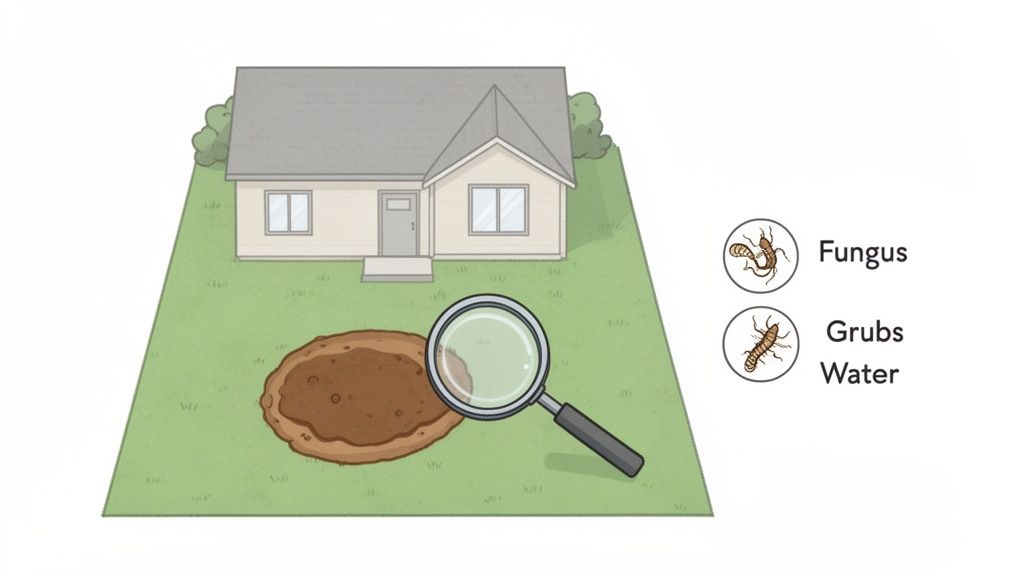
When a mysterious spot shows up, it's easy to jump to conclusions. I remember the first time a perfect brown circle appeared in my own yard; my mind immediately went to a busted sprinkler line. But your lawn is actually sending out a distress signal, and learning to read it is the first real step toward fixing the problem.
Think of this as your field guide for figuring out what your lawn is trying to tell you. This section will give you a quick overview to start your investigation, helping you match the symptoms you see with the most common culprits we run into here in West Texas.
Starting Your Investigation
Before we get into the nitty-gritty of each cause, it helps to know that nearly every brown patch can be traced back to one of three things: disease, pests, or environmental stress.
Just by answering a couple of simple questions, you can start to zero in on the likely issue.
Question: Is the patch spreading fast?
If a small spot seems to have doubled in size practically overnight, you're probably dealing with a fast-moving fungal disease. I've personally seen this happen; one day I have a spot the size of a dinner plate, and two humid days later it's the size of a car tire. Fungi absolutely love the warm, humid conditions we get in Abilene during the spring and fall.
Question: Does the grass pull up easily?
Try grabbing a handful of the brown grass. If it peels back like a piece of old carpet with no resistance, the roots have been severed from below. This is the classic calling card of underground pests, especially grub worms.
Key Insight: The pattern and behavior of the brown patch are your biggest clues. A perfectly round circle that grows daily suggests a disease, while an irregularly shaped dead spot that feels spongy often points to insects.
Figuring this out early helps you avoid making the problem worse. For example, throwing fertilizer on a patch caused by fungus will just feed the disease with excess nitrogen. You can learn more about finding that perfect nutrient balance in our guide to lawn fertilization for Abilene homes.
Quick Diagnostic Guide to Brown Patches in Abilene
To kickstart your detective work, this table is a fantastic starting point. It lays out the visual cues and peak seasons for the most frequent issues we see in local warm-season grasses.
Use this to get a preliminary idea of what you might be facing.
| Potential Cause | Visual Cues | Peak Season in Abilene |
|---|---|---|
| Brown Patch Disease | Circular patches, often with a grayish "smoke ring" at the edge on dewy mornings. Blades rot at the base. | Late Spring & Fall (Hot days, humid nights) |
| Grub Damage | Irregular patches of dead grass that feel spongy and pull up easily like a rug. | Late Summer & Early Fall |
| Drought Stress | Widespread browning, grass blades look thin and folded, and footprints remain visible on the lawn. | Summer (Hot, dry periods) |
| Pet Urine Burn | Small, concentrated dead spots, often with a vibrant green ring around the outside. | Year-Round |
While this guide is a great first step, keep in mind that sometimes these issues can overlap. The next sections will dive deeper into each one, giving you the confidence to make an accurate diagnosis.
Unmasking Brown Patch: The Most Common Fungal Foe
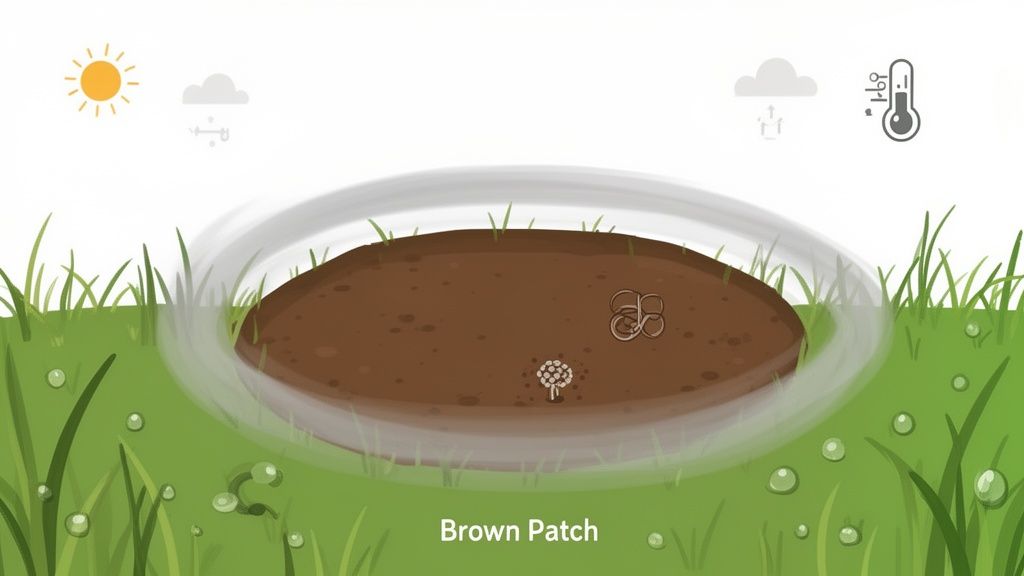
When you spot those distinct, almost perfect circles of dying grass, your prime suspect should be Brown Patch. It's the most common fungal disease I see here in Abilene, and it's usually the reason behind those panicked calls from homeowners wondering why their beautiful St. Augustine is suddenly failing.
The fungus behind it, Rhizoctonia solani, is a bit like a sleeper agent that’s always present in your soil. You can’t really get rid of it completely—it's a natural part of the ecosystem. It just lies dormant, waiting for the perfect moment to strike.
What Triggers a Brown Patch Outbreak?
Question: What are the perfect conditions for Brown Patch to appear?
In short, Abilene's weather. This lawn disease absolutely loves that specific combination of hot days, high humidity, and warm nights that we know all too well. It really takes off when air temperatures hit the mid-80s with high humidity, especially when the nights stay above 65°F.
It's the most widespread turf disease in the world, and in a bad outbreak, the damage can spread across 22.6% to 68.1% of a susceptible lawn, turning vibrant green into a patchwork of blight. If you want to dive deeper into the science, you can find great insights on turfgrass diseases from turfgrass pathologists.
I learned this firsthand one spring after fertilizing my own lawn. I was so proud of how green and thick it was getting, but all that lush new growth, combined with a few humid nights, created the perfect buffet for the fungus. Within a week, I had several large, brown circles.
My Personal Lesson: A lush, heavily fertilized lawn isn't always a healthy one. Pushing too much new growth with excess nitrogen, especially from fast-release fertilizers, is like handing the enemy extra ammunition.
How Can I Tell if It's Definitely Brown Patch?
Question: What are the unique signs of Brown Patch?
To be sure, you need to look for its unique calling cards, which set it apart from other lawn problems. Here’s your checklist:
- Distinct Circular Patches: Brown Patch almost always shows up as roughly circular areas that can be anywhere from a few inches to several feet across.
- The "Smoke Ring": Early in the morning when there's dew on the grass, you might spot a grayish or dark-purplish ring around the edge of the patch. This is the "mycelium"—the active, growing part of the fungus—and it’s a dead giveaway.
- Rotten Leaf Sheaths: The fungus attacks the grass blade right at its base. Gently pull on an affected blade at the edge of the patch. If it slides right out of its sheath and the bottom looks brown and rotted, that's Brown Patch.
If you’re seeing these signs, you can be pretty confident in your diagnosis.
Why Does My St. Augustine Grass Get It So Badly?
Question: My St. Augustine grass seems to get Brown Patch every year. Why?
It's a common frustration here. While all warm-season grasses can get Brown Patch, St. Augustine and Centipede lawns are especially vulnerable. Their broad leaves and dense growth habit are fantastic at trapping moisture and humidity right at the soil level, creating the ideal microclimate for the fungus to thrive.
Your lawn care habits also play a massive role. Watering in the evening is one of the biggest mistakes I see. This leaves the grass blades wet all night, giving the fungus a solid 8-10 hours of uninterrupted time to infect the turf. Always, always water in the early morning so the Texas sun has plenty of time to dry the grass blades.
Learning to spot the early signs of Brown Patch is the key to solving the mystery of "what causes brown patches in grass." Catching it before it spreads can save you a ton of time, money, and heartache—and keep you from having to replace huge sections of your lawn.
What If It's Not a Fungus? Exploring Other Lawn Problems
When you've got brown spots that don't look like the classic circles of Brown Patch disease, it's time to play detective. A lot of different things can stress out a lawn, and the most obvious answer isn't always the right one. Other common culprits, from tiny pests to tough soil conditions, can also leave you wondering why your grass is turning brown.
Sometimes, the problem isn't a disease at all, but something munching away just out of sight. These pests can cause widespread damage that’s easy to mistake for drought. I once spent weeks watering a sad-looking patch of grass, absolutely convinced it was just thirsty, only to find out the real problem was feasting on the roots right under my feet.
Are Pests the Problem?
Question: What kinds of pests cause brown patches in Abilene?
In our area, the two troublemakers we see most often are grubs and chinch bugs. They attack your grass in completely different ways, but both leave a trail of dead, brown turf.
- Grub Worms: These are those plump, C-shaped white worms you might find when digging in your garden—they’re the larvae of beetles, like the common June bug. They live underground and chew through grassroots, cutting off the lawn's ability to absorb water and nutrients. The damage usually pops up in late summer and early fall. You'll see irregular patches of spongy, dead grass that you can literally pull up like a piece of old carpet.
- Chinch Bugs: These little guys are sun-worshippers. They use tiny, piercing mouthparts to suck the life right out of grass blades, injecting a toxin as they go that finishes the job. Chinch bug damage almost always appears in the hottest, sunniest parts of your lawn. It starts as yellowish-brown patches that look just like the grass is drying out, but the patches will keep spreading.
Is the Environment Stressing Your Lawn?
Every now and then, the reason for brown patches isn't a living thing at all. Sometimes it's the environment itself—the soil your lawn is growing in can create conditions where grass just gives up.
Question: What if my soil is too hard?
I get this question a lot, especially here in Abilene with our dense, clay-heavy soil. Over time, things like foot traffic, heavy lawnmowers, and even just rainfall can cause the ground to become incredibly dense and packed down. We call this compaction.
Think of soil compaction like a traffic jam for your grassroots. The soil particles are packed so tightly together that there's no room for air, water, or nutrients to get through. The roots can't breathe, can't grow deep, and can't find what they need to survive. The result is thin, stressed-out, and browning grass.
Key Takeaway: Compacted soil literally suffocates your lawn from below. You can water and fertilize perfectly, but if the roots can't access those resources, the grass above ground will weaken and start to die in patches.
Accidental Damage and Other Causes
Finally, don't forget to consider simple accidents. These problems usually create very distinct, localized brown spots that don't spread the way a disease or pest infestation would.
Question: Could I have caused the brown spots myself?
It happens more often than you’d think. A couple of the most frequent issues I see are chemical spills and pet waste.
- Chemical Burns: Spilling concentrated fertilizer or weed killer is a surefire way to scorch your grass. This leaves a dead patch that’s often the exact shape of the spill. Even a leaky fertilizer spreader can leave behind tell-tale brown stripes or splotches.
- Pet Urine: If you have a dog, you've probably seen this one: small, round dead spots, often surrounded by a super-bright green ring. This is caused by the high concentration of nitrogen in dog urine. It acts like an extreme overdose of fertilizer, burning the grass in the center while super-feeding the grass right around the edges.
By thinking through these other possibilities—pests, compacted soil, and simple accidents—you can get a much clearer picture of what’s truly going on with your lawn and find the right solution for those frustrating brown patches.
Playing Lawn Detective: Simple Tests to Find the Real Culprit
Once you’ve got a hunch about what’s causing those brown patches, it’s time to get your hands dirty and confirm it. Just guessing can lead you down the wrong path, wasting time and money on treatments that don’t work—or worse, that actually harm your lawn.
The good news is you don’t need a fancy science lab. A few simple diagnostic tests, done right in your own yard, can give you a definitive answer. I’ve used these exact methods myself to figure out what was plaguing my own grass, and they’re the key to moving from "I think it's a pest" to "I know it's grubs."
Start With the Obvious: A Few Physical Checks
Let's begin with the easiest tests. By simply interacting with the damaged turf, you can quickly rule out some of the most common issues, especially certain pests and soil problems.
The Tug Test: Your Go-To for Grub Detection
Question: How do I test for grubs?
This is the classic test for grub damage. Head to the edge of a brown patch, right where the dead grass meets the green. Grab a handful of the turf and give it a firm pull. If it peels right up like a loose piece of carpet with barely any effort, you've found your culprit. This is the tell-tale sign of grubs. They live just below the surface, chewing through the roots and severing the grass from the soil. The turf is literally unattached.
The Screwdriver Test: Is Your Soil the Problem?
Question: How do I test for compacted soil?
Next, let's check the soil itself. All you need is a long screwdriver. First, try pushing it into a healthy, green section of your lawn. Then, go to the middle of a brown patch and do the same. If it's a struggle to push it in the brown area but it slides in easily in the green spot, you're dealing with compacted soil. Hard, dense soil chokes the life out of your grassroots, blocking water, air, and nutrients from getting where they need to go.
Uncovering Pests That Hide in Plain Sight
Some pests are a lot sneakier. They don't sever the roots, but their damage looks almost identical to a lawn that’s just thirsty from the Abilene heat. This is where you need a slightly more involved—but incredibly effective—trick.
This flowchart gives you a quick way to think through diagnosing the two most common lawn pests we see around here.
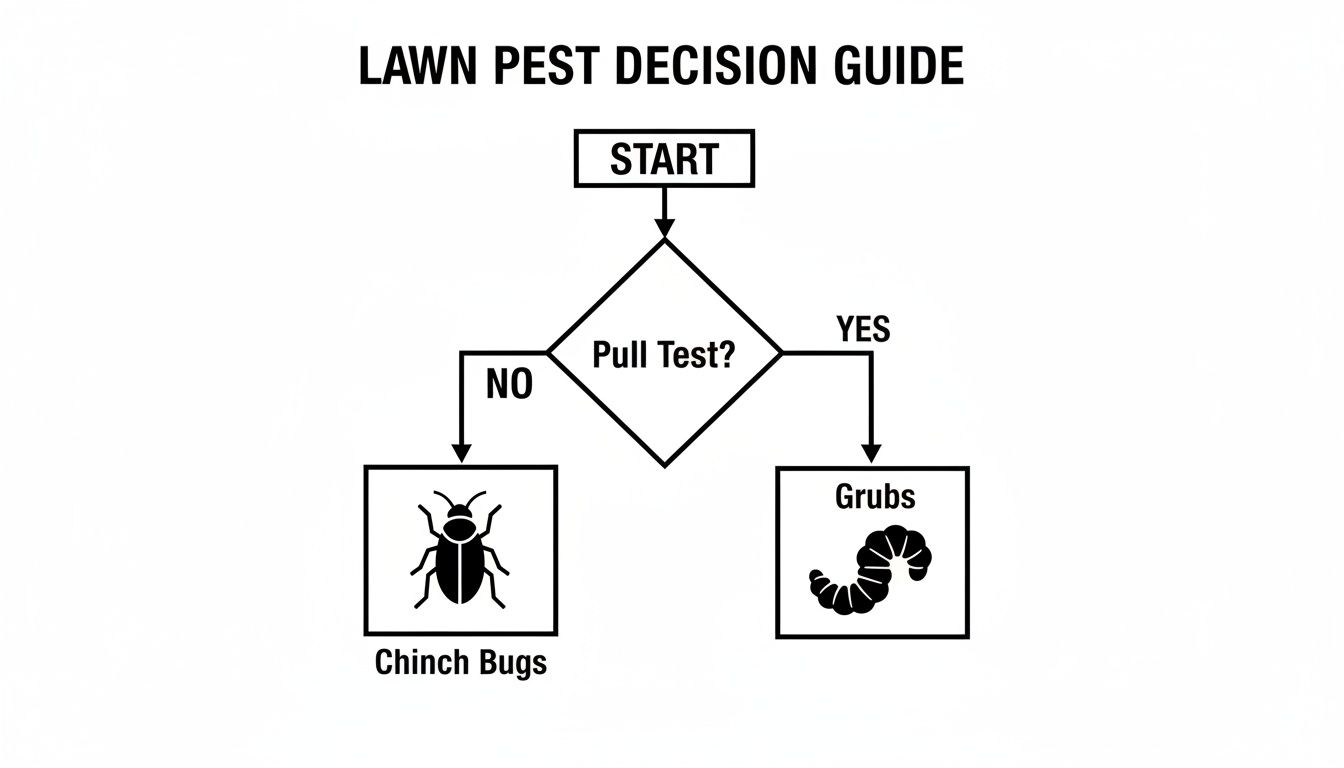
As the guide shows, that simple Tug Test is your first step in figuring out if you're dealing with grubs below ground or chinch bugs above it.
The Soapy Water Flush: A Trick for Finding Chinch Bugs
Question: How can I find chinch bugs if I can't see them?
I can tell you from personal experience, chinch bugs are masters of disguise. One summer, I was convinced my lawn was just struggling with the heat. I kept watering, but the dry-looking patches just kept getting bigger. A friend showed me this simple method, and within minutes, I knew I had a chinch bug invasion.
Here’s how to do it:
- Grab a large coffee can or a similar cylinder and cut off both ends.
- Push it a couple of inches into the ground right on the edge of a brown spot, where the yellowing grass meets the healthy green.
- Fill the can with water and add a generous squirt of lemon-scented dish soap.
- Now, just watch and wait for about 5-10 minutes.
The soap solution irritates the chinch bugs, forcing them to the surface for air. If you see tiny black bugs with distinctive white wings folded across their backs floating up, you’ve found them.
Comparing Tricky Look-Alikes
Let’s be honest—sometimes the symptoms look frustratingly similar. Drought, fungus, and insects can all create brown patches, but they demand completely different fixes. Getting it right is crucial. For example, your mowing habits can make a huge difference in lawn health; for more on that, see our article on how often to mow Bermuda grass.
To help you tell these issues apart, here is a quick comparison table.
Drought Stress vs Fungal Disease vs Insect Damage
| Symptom | Drought Stress | Brown Patch Fungus | Grub or Chinch Bug Damage |
|---|---|---|---|
| Patch Shape | Widespread, uniform browning; often affects the whole lawn. | Distinct, roughly circular patches that get bigger over time. | Irregular, blotchy patches that start small and merge together. |
| Grass Blades | Blades look thin, folded, and may have a grayish-blue tint. | Blades have tan-colored spots (lesions) with dark borders; may seem rotted at the base. | Blades look chewed on or sucked dry; turn a uniform yellowish-brown. |
| Soil Feel | Hard and dry to the touch. | Often feels damp or soggy, especially in the early morning. | Feels spongy and soft under your feet. |
| Pull Test | Grass stays firmly rooted, but the whole plant is dry. | Blades pull out easily, leaving a rotted sheath behind. | The entire section of turf lifts up like a piece of carpet. |
By using this detective kit of simple tests and comparisons, you can stop guessing. You'll be able to confidently figure out what’s really causing those brown spots and take the right steps to bring your beautiful Abilene lawn back to life.
Your Lawn Care Game Plan: Fixing and Preventing Brown Spots
Alright, you’ve figured out why your lawn has brown patches. Now for the good part: how to fix them and, even better, how to stop them from coming back.
Believe me, I’ve learned this lesson the hard way. The best approach is always a proactive one. If you build a healthy, resilient lawn from the ground up, you’ll spend far less time and money fighting fires later. It all comes down to a solid care routine built for our unique Abilene climate.
Good Habits Are Your Best Defense
Your first line of defense isn't a bag of fertilizer or a bottle of fungicide—it's how you mow, water, and care for your lawn week in and week out. Making a few simple tweaks to your routine can completely change the game, robbing pests and diseases of the easy foothold they're looking for.
Watering the Right Way (and the Wrong Way)
This is the number one thing people ask me about, and it's absolutely crucial for our Bermuda and St. Augustine lawns. The golden rule is simple: water deeply and infrequently.
Giving your lawn a light sprinkle every day is one of the worst habits you can get into. It trains the roots to stay near the surface and keeps the grass blades constantly damp—a perfect storm for fungal diseases.
- Go for a Deep Soak: Your lawn needs about 1 inch of water per week. It's best to deliver this all in one go, which encourages the roots to grow deep into the soil searching for moisture. This creates a tougher, more drought-resistant lawn.
- Timing is Everything: Water early in the morning, between 4 a.m. and 9 a.m. This gives the hot Texas sun plenty of time to dry the grass blades during the day, preventing the overnight dampness that fungus thrives on.
We've put together a lot more detail on this topic, tailored specifically for our area. You can find it in our complete guide to watering Bermuda and St. Augustine grass.
Giving Your Lawn Some Breathing Room
Beyond the basics, a few key maintenance jobs can work wonders for your lawn’s underlying health. Think of them as a tune-up for the soil and air around your grass.
What to Do for Hard, Compacted Soil
Question: My soil is hard. What's the best way to fix it?
If that screwdriver test told you your soil is packed down like a rock, core aeration is your new best friend. This process pulls up small plugs of soil, breaking up compaction and creating channels for air, water, and nutrients to finally get down to the roots where they're needed. I make a point to aerate my own lawn at least once a year—it’s a non-negotiable for dealing with our heavy clay soil.
Airflow above the ground matters, too. Trim up any low-hanging tree limbs or overgrown shrubs that are casting too much shade. Letting in more sunlight and air helps dry out those persistently damp spots where diseases love to set up shop.
That combination of heat and moisture is the main trigger for brown patch. In fact, research shows that when nighttime temps stay above 68°F with humidity near 100%, huge sections of a lawn can be wiped out in just 6-8 hours. This is why good airflow is so critical.
DIY Fixes vs. Calling in the Pros
For small, isolated problems, a DIY approach can work just fine. You can easily fix a small spot of pet urine burn by flushing the area with water and scattering some new seed. Realizing your mower blade is too low and raising it can solve scalping overnight.
My Two Cents: When I was first getting serious about my own lawn, I tried to handle everything myself. I learned pretty quickly that while you can DIY your way through prevention, you can't always DIY your way out of a real crisis. I once wasted time and money on three different store-bought fungicides trying to stop a stubborn Brown Patch outbreak before I finally threw in the towel and called for backup.
When you're up against a fast-moving disease or a full-blown grub infestation, you need to bring in the heavy artillery. The products available to licensed professionals are simply stronger and work much faster than anything you can grab off a shelf. Knowing when to call for help is what separates a small, treatable problem from a disaster that requires a total lawn replacement.
When to Call a Lawn Care Professional
Sometimes, no matter how much you try, a DIY approach just won’t cut it. I learned this lesson the hard way one spring when I was absolutely convinced I could tackle a fungal problem on my own. I must have spent weeks and a small fortune on different store-bought remedies, only to watch the brown patches keep spreading.
By the time I finally caved and called a professional, the damage was so extensive that I had to re-sod a huge, expensive section of my lawn. That experience taught me a valuable lesson: knowing when to ask for help is just as critical as knowing how to do the "Tug Test."
So, when is it time to throw in the towel and call for backup?
Is the Problem Getting Worse, Not Better?
Question: At what point should I stop trying to fix it myself?
The most obvious red flag is when your brown patches are spreading like wildfire, despite your best efforts. You’ve been watering correctly, you tried a DIY treatment, but the problem is only accelerating. This is a clear signal that the issue, whether it’s a fast-moving disease or a widespread pest infestation, is beyond what homeowner-grade products can handle.
I once had a client who noticed a few small, tell-tale circles of Brown Patch. He grabbed a granular fungicide from the local big-box store, but then a week of classic Abilene humidity and rain hit. Those small spots exploded into massive, connected dead zones. The store-bought product simply couldn't keep up with that aggressive fungal growth.
Are You Confident in Your Diagnosis?
Question: What if I'm not sure what's causing the brown spots?
Another key moment to pick up the phone is when you’re just not sure what you're dealing with. Maybe the symptoms are mixed—it looks a bit like grub damage, but also has some signs of a fungus.
Guessing wrong here can make things much, much worse. For example, let's say you apply a high-nitrogen fertilizer because you think it’s just a nutrient deficiency. If the real culprit is Brown Patch disease, you've just poured gasoline on a fire. You’re literally feeding the fungus, helping it destroy your lawn even faster. A professional diagnosis takes that dangerous guesswork out of the equation.
An expert from Abilene Home Service can definitively identify the issue, whether it's by recognizing subtle signs of disease or identifying a specific pest. They’ve seen it all and can quickly tell the difference between problems that look confusingly similar to the untrained eye.
Why Professional-Grade Products Make a Difference
Frankly, the biggest advantage of calling in a pro is getting access to their toolkit. The treatments available to licensed lawn care companies are simply more potent and effective than anything you can buy at a retail store. They're formulated for faster, more reliable results against stubborn diseases and pests.
But it isn't just about raw power; it's also about safety and precision. Professionals are trained to apply these products correctly, making sure they’re effective while minimizing any risk to your family, pets, or the environment. When you're facing a serious lawn crisis, getting it right the first time is the quickest and often most cost-effective path back to a healthy, green yard.
Frequently Asked Questions
Once we figure out what's causing those ugly brown patches, Abilene homeowners usually have a few more things on their minds. Here are the answers to the questions I get asked most often out in the field.
Question: Can my grass recover from Brown Patch on its own?
That’s a big "maybe." I've seen established St. Augustine or Bermuda grass bounce back on its own once our weather cools off and the humidity drops. This happens because the fungus usually just attacks the leaf sheath, not the roots themselves.
But here’s the catch: recovery is a slow process. A really bad infection can easily kill off entire sections of your lawn, leaving you with the expensive job of re-sodding. Honestly, a professional fungicide treatment is the surest way to stop the disease in its tracks and protect your investment.
Question: What is the best way to water my lawn in Abilene to prevent brown spots?
This is probably the most important advice I give: water deeply, but not often. You want to train your grass roots to dig deep for moisture, which makes the whole lawn tougher against our brutal summer heat.
For the clay soil we have around Abilene, a good target is 1 inch of water per week, all in one or two sessions. And timing is everything. Always water in the early morning, sometime between 4 a.m. and 9 a.m. This gives the grass blades plenty of time to dry out during the day, so you're not giving fungus the damp, dark conditions it needs to thrive overnight.
Question: Are some grass types better at resisting Brown Patch in Texas?
Absolutely. While it’s everywhere here in Abilene, older types of St. Augustine like 'Raleigh' are unfortunately very susceptible to Brown Patch. It's a constant battle with them.
If you’re putting in a new lawn or replacing a dead patch, look for improved varieties. Cultivars like 'Floratam' and 'Palmetto' have much better natural resistance. Making a smart choice on grass type is a great long-term strategy for a healthier, less frustrating yard.
Question: Will fertilizer fix the brown spots in my lawn?
This is a common mistake, and it can be a disaster. The short answer is no, and in fact, it often makes a fungal problem much, much worse.
Throwing a high-nitrogen fertilizer on a Brown Patch outbreak is like pouring gasoline on a fire. You’re just feeding the fungus, helping it spread even faster. I always tell my clients to hold off on fertilizing any stressed or sick-looking grass until you know exactly what the problem is and have it under control.