


When that first warm breeze finally rolls through Abilene, it's a sure sign that spring is here. But for homeowners, it’s also the starting gun for getting the yard back in shape. Looking out at a lawn that’s been beaten down by a West Texas winter can feel daunting. I’ve been there—staring at a patchy, sad-looking yard and wondering where to even begin.
The secret I’ve learned over the years isn't about working harder; it's about working smarter with a solid game plan. A good plan turns that mountain of a chore into a series of manageable, satisfying steps.
Why Your Timing Is Everything in Abilene
Question: Where do I even start with my spring yard work?
The answer isn't just "grab a rake." In Abilene, our spring yard work is a race against two things: weeds and the summer sun. Getting the timing right is crucial. Acting early lets you get ahead of notorious weeds like crabgrass before they even have a chance to sprout. It also gives your turf the head start it needs to develop deep, strong roots before our summer heat arrives and tries to bake everything to a crisp. Honestly, waiting too long is the single biggest mistake I see.
I learned this lesson the hard way. One year, I was late putting down my pre-emergent, and I spent the entire summer fighting a losing battle with weeds. Now, I don't see spring prep as a chore—it’s a strategic investment to save myself a ton of work and frustration down the road.
This timeline breaks down the season into three distinct phases: early spring for cleanup and prep, mid-spring for growth and treatment, and late spring for fine-tuning and maintenance.
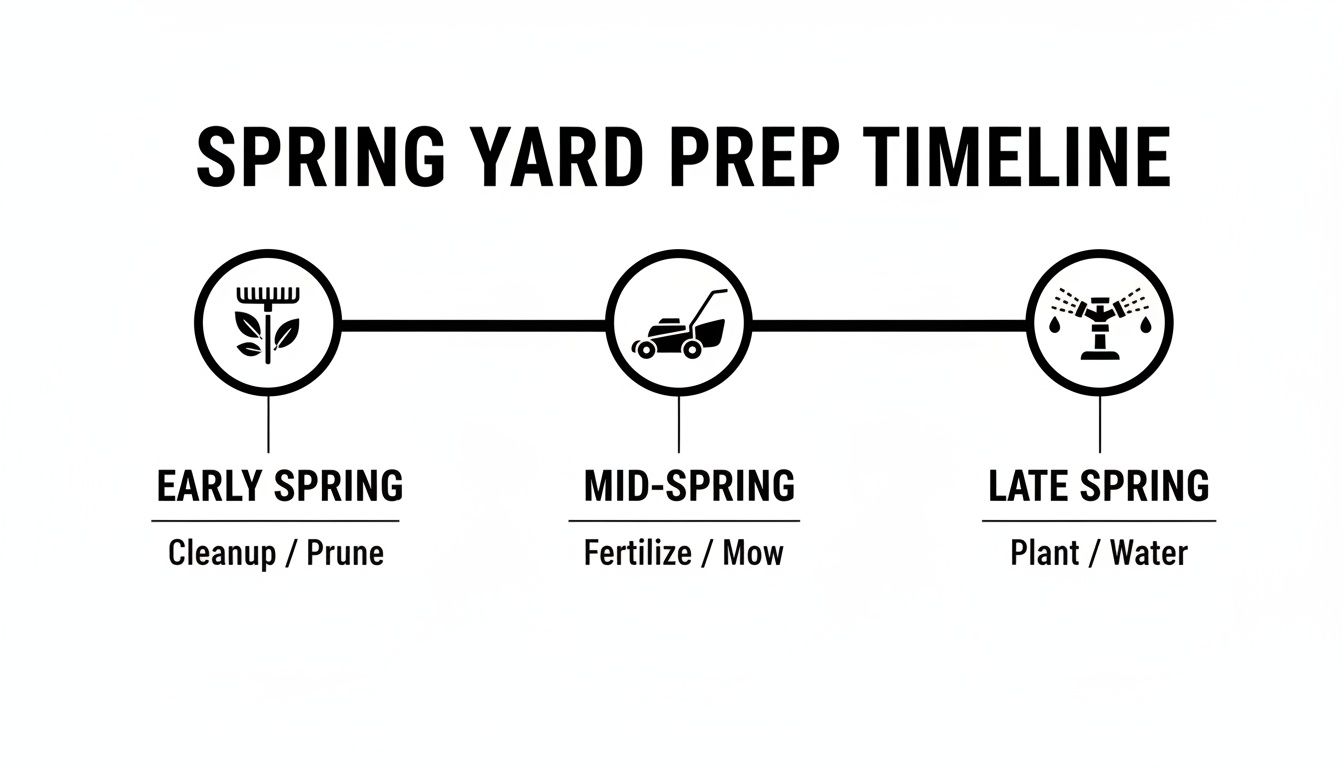
As you can see, the focus shifts as the weather warms up, ensuring you’re giving your yard exactly what it needs, right when it needs it.
To make it even clearer, here’s a simple checklist breaking down what to do and when.
Abilene Spring Yard Prep Timeline
| Timeline | Key Tasks | Why It Matters in West Texas |
|---|---|---|
| Early Spring (Late Feb-March) | General cleanup (leaves, debris), pruning dormant trees/shrubs, applying pre-emergent herbicides. | This is your chance to get ahead of the weeds and clear the way for new growth before the season truly kicks off. |
| Mid-Spring (April) | Dethatching, aeration, first mow of the season, applying fertilizer. | As the ground warms up, this is when you wake up your lawn, helping air, water, and nutrients reach the grassroots. |
| Late Spring (May) | Check irrigation systems, apply post-emergent for any breakthrough weeds, mulch beds. | Now it's about preparing for the heat. A tuned-up sprinkler system and fresh mulch are key for water conservation. |
This schedule helps you pace the work so it never feels overwhelming. You don’t have to do it all at once!
Your Game Plan for a Great-Looking Yard
Think of this guide as your roadmap for the next few months. A good spring plan really boils down to a few key areas that build on each other.
Here’s a sneak peek at what a successful spring looks like:
- A serious cleanup: Get rid of all the leaves, fallen branches, and general clutter that winter left behind.
- Getting your tools ready: A sharp mower blade and a well-oiled machine make all the difference.
- Waking up the lawn: This involves dethatching, aerating, and that all-important first mow.
- Playing defense against pests & weeds: Applying pre-emergents is your best move for preventing headaches later.
My own yard transformation started with these exact steps. I just focused on a thorough cleanup, gave my mower a tune-up, and tackled the lawn one piece at a time. The payoff was a lush, green yard that made all that effort feel more than worth it. We’ll dive into each of these topics to give you the confidence to do the same.
Waking Up Your Lawn the Right Way
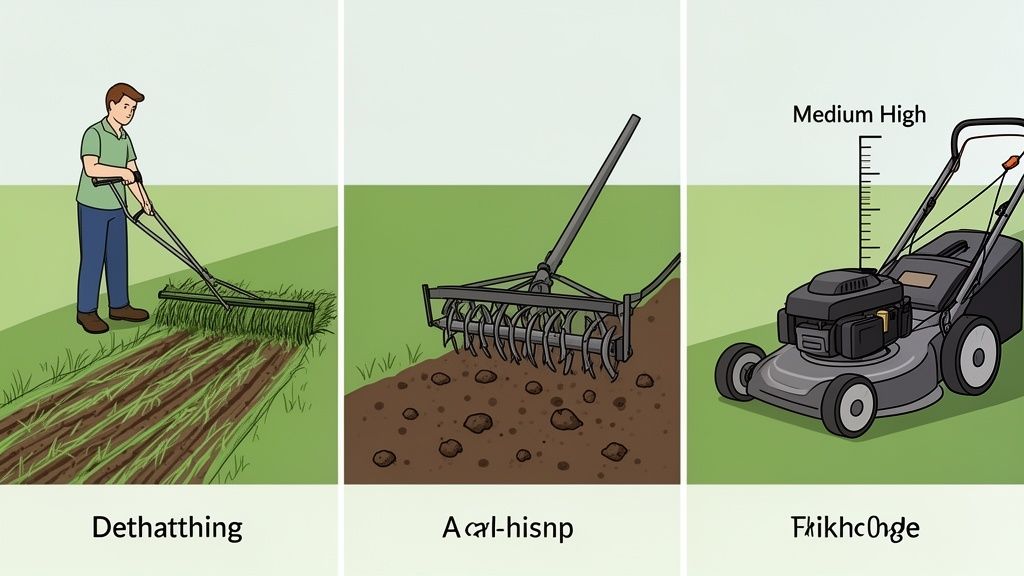
Getting your lawn to go from that dormant, winter-brown to a lush green carpet takes more than a splash of water, especially here in the Abilene climate. After you've cleared away the leaves and debris from winter, it's time to get your hands dirty and focus on the turf itself.
It all starts with a job most people skip: dethatching. This just means removing the thick, spongy mat of dead grass, roots, and stems that gets packed down between the soil and the green grass blades. We call this layer thatch.
I’ll never forget the first time I rented a power rake for my own yard. I was floored by the sheer amount of dead material it pulled up—I had huge piles lining the curb and honestly thought I’d killed my lawn for good. But a few weeks later, the results spoke for themselves. The grass came roaring back thicker and greener than ever.
My Dethatching Takeaway: Don't be afraid to get aggressive. That thatch is literally suffocating your lawn, blocking out the air, water, and nutrients it desperately needs to get to the soil. Raking it out is one of the best things you can do for your yard this spring.
Why Aeration is a Must in Abilene
Once you’ve cleared out all that dead material, the next vital step is aeration. This is the single most important task for tackling a huge problem for Abilene homeowners: our dense, heavy clay soil.
Question: Do I really need to aerate my lawn?
Yes, you absolutely do. Over time, our clay soil gets incredibly compacted, making it almost impossible for grassroots to dig in deep and strong. Aeration fixes this by pulling small plugs of soil out of the ground. Think of it this way: trying to grow grass in compacted clay is like trying to grow a plant in a brick. By creating all those little channels, you’re giving the roots room to finally breathe and expand. This simple process makes a massive difference in your lawn's ability to soak up water and fertilizer, which is crucial for surviving a hot Texas summer. Proper watering is a science in itself, and you can learn more from our complete guide on lawn watering tips for Bermuda and St. Augustine grass.
The Right Way to Aerate and Seed
Knowing when to aerate is just as critical as knowing why, and this is where a lot of people go wrong. It’s surprising, but recent survey data shows that only 25% of U.S. homeowners aerate and seed correctly. A staggering 78% of those who do it perform the task in the wrong season, leaving their lawns weak and vulnerable to weeds.
For our warm-season grasses in Abilene, early spring is the perfect window for dethatching and aerating. This timing gives you excellent seed-to-soil contact, making it the ideal time to seed any bare spots with a good drought-tolerant variety once soil temperatures are consistently above 50°F. You can see more landscaping insights like this from the U.S. Census Bureau.
Here’s a quick rundown of how aeration directly helps your lawn:
- Reduces Soil Compaction: It loosens up that hard-packed clay, giving roots the space they need to grow.
- Improves Water and Nutrient Uptake: Water and fertilizer can finally get down into the soil where they belong instead of just running off the surface.
- Enhances Thatch Breakdown: It pulls soil microorganisms up into the thatch layer, helping it decompose naturally.
- Strengthens Roots: Deeper, healthier roots mean a tougher, more drought-resistant lawn.
Your First Mow of the Season
With all that important groundwork done, you can finally get to that first satisfying mow of the year. This isn't just about tidying things up; it's a signal to your grass that the growing season is officially on.
Question: What’s the right height to set my mower for the first cut of the year?
The key to this first cut is the height. You don't want to scalp the lawn by cutting it too short, which can stress the grass before it’s even fully awake. For my Bermuda grass, I always set the mower blade to one of its higher settings for the first one or two mows. This tells the grass to focus on building a strong root system first, creating a solid foundation for the vigorous growth that’s about to come as things heat up.
Giving Your Lawn the Edge: Fertilizer and Weed Prevention
Once you've given your lawn a good stretch by dethatching and aerating, it's time to shift from cleanup to strategy. This is where we get ahead of the game, stopping problems before they even have a chance to start. The fight against pesky summer weeds like crabgrass is truly won or lost right now, in the early days of spring.
The secret weapon here is a powerful combination: pre-emergent herbicides and the right fertilizer. Nailing the timing and application of this duo is what makes the difference between a gorgeous, green lawn and a summer spent battling weeds.
The All-Important Timing for Pre-Emergents in Abilene
Question: When do I actually put down pre-emergent here in Abilene?
This is a fantastic question because the answer isn't a date on the calendar but rather a specific temperature window. You have to apply these products just before weed seeds—especially crabgrass—start to sprout. I learned this lesson the hard way a few years back. I put my pre-emergent down in mid-March, feeling pretty good about it, but a surprisingly warm February had already given the crabgrass a head start. I spent that entire summer on my hands and knees pulling weeds, promising myself I’d never make that mistake again.
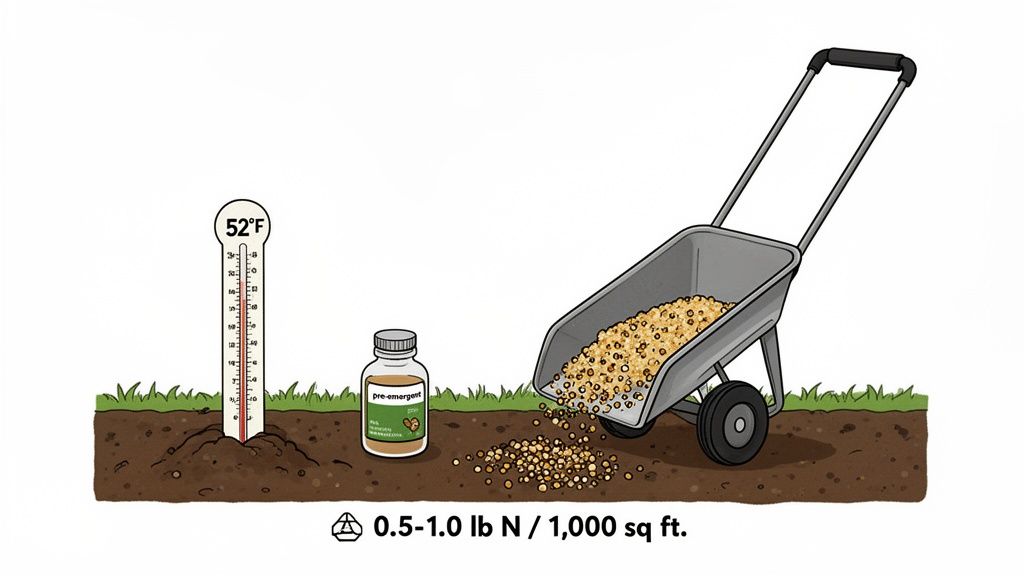
The real key is to watch your soil temperature. Once it holds steady between 50°F and 55°F for a few days in a row, it’s go-time. This is the magic window when crabgrass seeds wake up. Miss it, and you’re in for a long, frustrating summer.
You don't need fancy equipment, either. A simple meat or soil thermometer pushed a few inches into a sunny patch of my lawn will do the trick. Just check it in the morning for the most accurate reading.
Choosing the Right Food for Your Lawn
With your weed barrier in place, the next move is to feed your turf. Fertilizing gives your grass the energy it needs to green up fast and grow thick, which helps crowd out any stubborn weeds that might have pushed through your pre-emergent.
For the warm-season grasses we have in Abilene, like Bermuda and St. Augustine, a balanced fertilizer application in the spring is crucial. Experts agree that starting pre-emergent applications when soils hit that 50°F to 55°F sweet spot is non-negotiable. In a place like Abilene, missing this window can lead to a 30-50% spike in weed problems. As for feeding, a good rule of thumb is to apply 0.5 to 1.0 lb of nitrogen per 1,000 sq ft in early spring. For more insights on this, The Lawn Care Nut has some great tips for warm-season lawns.
When you're at the store staring at bags of fertilizer, here's what you should be looking for:
- Slow-Release Nitrogen: This is a must-have. It feeds your lawn steadily over weeks instead of all at once, which encourages strong, consistent growth without forcing you to mow every other day.
- Balanced Nutrients: Check the N-P-K ratio on the bag. These numbers represent the percentages of Nitrogen, Phosphorus, and Potassium. A balanced formula is best for overall spring health.
- Application Rate: Read the bag! It sounds simple, but every product is different. Using too much can scorch your lawn and do more harm than good.
If you want to dive deeper into the science behind feeding your specific grass type, our guide to professional lawn fertilization is a great resource.
A couple of years ago, after a brutal drought left my yard with some big, bare spots, I had to get creative. I knew that just fertilizing would invite weeds to take over those patches. I ended up using a starter fertilizer that was safe for new seeding and contained mesotrione. It allowed me to overseed the bare spots while still preventing crabgrass. It was the perfect fix, proving that sometimes the standard approach isn't enough.
Prepping Beds, Borders, and Hardscapes
A lush green lawn is a fantastic start, but a truly polished yard gets its character from the details—the garden beds, borders, and hardscapes that frame your property. Once you've given your turf a head start, it's time to turn your attention to these supporting elements. This is how you create that complete, well-cared-for look.
First things first: it's time to wake up your dormant plants with some smart pruning. This is especially crucial for any shrubs and trees that set their blooms on new spring growth.
Over the years, I've developed a simple rule for pruning that has never steered me wrong: the "three D's." I just walk my property and keep an eye out for any branches that are dead, damaged, or diseased. Snipping these off does more than just tidy up the plant; it channels all its energy into producing healthy, vigorous new growth instead of wasting it on a failing limb. It’s a small bit of work that pays off big time.
Revitalizing Your Garden Beds with Mulch
With everything pruned and cleaned up, the next job is to lay down a fresh blanket of mulch. In our dry West Texas climate, mulch is your best friend. It’s one of the single most beneficial things you can do for your garden beds, as it helps the soil hold onto precious moisture, keeps weeds from taking over, and even regulates the soil temperature.
Question: How much mulch is too much?
It's a great question, because you can definitely overdo it. The sweet spot is a layer about 2-3 inches deep. If you go much deeper, you can actually suffocate the plant's roots or create a damp haven for pests. Go any shallower, and you just won't get the moisture-retaining and weed-blocking benefits. I find a solid 2-inch layer is perfect for my beds—it keeps the soil cool and moist without ever getting soggy.
Honestly, applying fresh mulch is one of the most satisfying spring chores. It instantly makes the entire yard look neat and intentional. For me, that’s the final touch that says the garden is officially open for the season.
Inspecting Your Hardscapes and Structures
Now that your plants and beds are ready, the final piece of the puzzle is checking on your property's hardscapes. I’m talking about the functional workhorses like your irrigation system, fences, and gutters that often get ignored all winter. A quick inspection now can save you from a world of hurt later.
For instance, I make it a habit every spring to run my sprinkler system, zone by zone, before I actually need it. I walk the whole yard looking for a few common problems:
- Broken or Clogged Heads: Winter freezes can easily crack plastic sprinkler heads, and it's amazing how often a lawnmower can knock one out of alignment.
- Poor Coverage: I watch for sputtering heads or dry spots that aren't getting any water at all. These are the spots that will turn into big, brown patches by June.
- Leaks: See any puddles forming around a sprinkler head? That’s a tell-tale sign of an underground leak that needs to be fixed right away.
This little walkthrough takes me maybe 20 minutes, but it guarantees my lawn gets even water coverage from day one. It's a non-negotiable part of my spring prep.
In that same vein, giving your fences and gutters a quick once-over is a smart move. Check for loose fence posts or panels that may have been rocked by strong winter winds. And clearing out your gutters now prevents overflows and water damage when those heavy spring rains hit. For a deeper dive, you can learn more about boosting your home's value by cleaning and staining outdoor structures in our dedicated article. A little attention to these structural elements keeps your entire property safe, functional, and looking its absolute best.
DIY or Hire a Pro? Making the Right Call for Your Abilene Yard
Alright, let's have an honest chat. After running through that spring prep checklist, it’s easy to feel a bit overwhelmed. Dethatching, aerating, pre-emergents, mulching… it’s a lot to tackle. This brings up the big question: Which jobs are perfect for a weekend warrior, and when is it smarter to just call for backup?
Some of these tasks are genuinely satisfying to do yourself. Things like general cleanup, a bit of pruning, and spreading fresh mulch can save you money and give you an immediate, visible reward for your hard work. There's nothing like stepping back to admire a freshly mulched flower bed you did yourself.
But other jobs are a different beast entirely. I learned this the hard way a few years back when I decided to aerate my own yard. I rented one of those manual core aerators you have to stomp on. An hour later, I was drenched in sweat, my back was killing me, and I’d barely covered a few dozen square feet. That's when I had my lightbulb moment: there's a very good reason the pros use those heavy, gas-powered machines.
When DIY Makes Perfect Sense
Plenty of spring yard tasks are well within reach for most homeowners. If you’ve got the time and a few basic tools, these projects can be both rewarding and budget-friendly.
Good DIY Projects Include:
- General Cleanup: This is the easy first step—raking old leaves, picking up sticks, and clearing out debris.
- Basic Pruning: Snipping away dead or damaged branches on your shrubs and smaller trees is simple maintenance.
- Mulching: Spreading a new layer of mulch is one of the most straightforward ways to give your landscape an instant facelift.
- Simple Mower Maintenance: Every homeowner should know how to sharpen their mower blade, change the oil, and clean the deck.
These are jobs that don’t demand specialized equipment or deep technical knowledge, making them great candidates for your to-do list.
When to Call in the Professionals
There comes a point where time, the right equipment, or specific expertise becomes the main issue. This is particularly true for technical jobs where a small mistake can set your lawn back for the whole season. For many busy families or those stationed at Dyess AFB, the real question isn't about ability, but availability.
Question: How can I get a great-looking yard without giving up my entire weekend?
This is exactly where a professional service like Abilene Home Service becomes a smart investment. You’re not just paying someone to do the work; you’re buying back your free time and getting the peace of mind that comes with expert execution.
Take applying pre-emergent herbicides, for example. The timing here is absolutely critical. Pros not only have the experience to know when to act, but they also use calibrated equipment to ensure precise, even coverage. We saw this firsthand between 2009-2010 when professional crews were performing thousands of perfectly timed applications each spring—that level of precision is simply non-negotiable for getting real results. With homeowner schedules getting tighter, that kind of expertise is more valuable than ever. You can dive deeper into how the pros handle early spring lawn care and why it matters so much.
Bringing in a pro for certain jobs is about investing in peace of mind. I know I can handle my own mowing, but I leave the chemical applications and core aeration to the experts because they guarantee a level of precision I simply can’t match with a spreader from a big-box store.
Ultimately, the decision comes down to that classic trade-off: your time versus your money. If you have the passion and the hours to burn, going the DIY route can be fantastic. But if you want guaranteed results without the learning curve or the weekend sacrifice, calling a team like Abilene Home Service is the fastest path to a beautiful, stress-free spring.
Common Questions About Spring Yard Prep in Abilene
We've walked through the big spring prep checklist, but I know a few specific questions always come up when I'm talking with fellow Abilene homeowners. Let's tackle some of the most common ones I hear.
What's the One Task I Absolutely Can't Skip?
If you only have the time or money to do one major thing for your yard this spring, make it a timely pre-emergent herbicide application. Seriously. This is the single biggest game-changer for lawns in our area.
Here in Abilene, our main headache is aggressive summer weeds like crabgrass. When you apply a quality pre-emergent just as the soil temperature is consistently hitting that 50°F to 55°F sweet spot, you create a barrier that stops those weed seeds from ever sprouting. If you miss that narrow window, you'll spend your entire summer pulling weeds instead of enjoying your yard.
For my own lawn, I use a cheap soil thermometer I got online. I start checking sunny spots in late February. It takes five minutes but saves me hours of frustration later, setting the whole lawn up for success.
My Lawn Has Bare Patches. Should I Just Reseed the Whole Thing?
Probably not. Unless your lawn is over 50% weeds or bare dirt, a complete tear-out and renovation is usually overkill. For those ugly bare patches left behind by last summer's heat or a well-worn path from the kids, overseeding is a much smarter and more affordable fix.
The trick is all in the timing and prep. Mid-spring, right after you've raked out the dead stuff (dethatched) and maybe poked some holes (aerated) in those specific spots, is the perfect time. This gives the new seed a clean slate and direct contact with the soil. A classic mistake is to throw down a "weed and feed" product, which will stop your new grass seed from growing just as effectively as it stops weeds.
Instead, for those problem patches, try this:
- Use a garden rake to vigorously scuff up the bare spot, clearing out dead grass and loosening the top layer of soil.
- Spread a high-quality grass seed that’s suited for our West Texas climate.
- Lightly cover the seed with a thin layer of compost or quality topsoil.
- Apply a starter fertilizer made for new grass growth.
- Keep the area consistently moist—think damp, not drenched—for about two weeks until the new grass is established.
I had a couple of stubborn spots by my driveway last year. I followed this exact method, and they filled in perfectly within a month, blending right in with the rest of the lawn.
How Do I Know if I Should Hire a Professional?
This is a great question, and it really boils down to three things: your time, the right equipment, and the results you're after. Just be honest with yourself.
- Time: Do you realistically have the weekend hours to dedicate to this? Doing it right can take a while.
- Equipment: Do you own a core aerator or a broadcast spreader, or are you willing to rent them? More importantly, are you comfortable using them?
- Results: Are you confident you can get the timing and application rates just right for things like fertilizer and herbicides? Or would you rather pay for a guaranteed outcome?
If you're second-guessing any of these, calling a pro like Abilene Home Service is a smart move. Personally, I enjoy mowing and pruning, but I leave the big aeration jobs and chemical applications to the experts. They have calibrated equipment that ensures perfect coverage, and frankly, I'd rather spend that Saturday playing catch with my kids. For a lot of homeowners, the peace of mind is easily worth the cost.
Should I Water My Lawn a Little Bit Every Day or Give It a Good Soaking Once a Week?
This one’s not even a debate: deep and infrequent watering is always the right answer for building a tough, drought-resistant lawn in West Texas.
Watering lightly every day just teaches the roots to be lazy and stay near the surface. That creates a weak, needy lawn that completely fries the second our Abilene summer heat kicks in. It’s a fast track to a brown, crunchy yard by July.
On the other hand, when you water deeply—aiming for about 1 inch per week—you force the grassroots to grow down deep looking for that moisture. This builds a strong, resilient turf that can actually handle our climate. I use the old "tuna can test" at home. I just toss a few empty cans out on the lawn before the sprinklers run. When they're full, I know I've delivered the right amount of water for that session.