

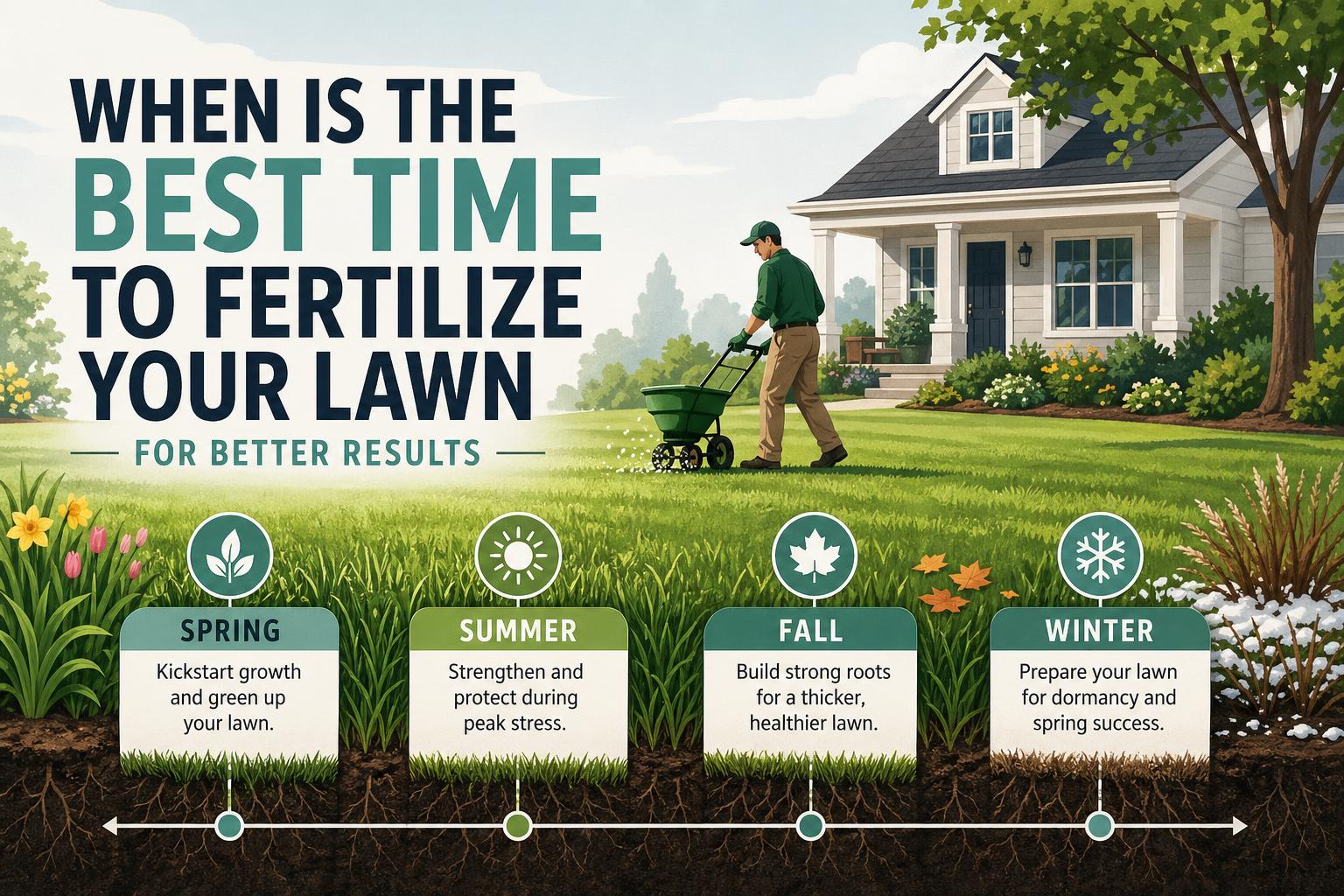

When Is the Best Time to Fertilize Your Lawn?
Why timing matters
Fertilizer feeds grass nutrients that support growth, color, and root development. But fertilizer is a tool — the wrong timing wastes money, can burn the lawn, and may harm nearby plants or waterways. The best results happen when applications match peak grass growth and root activity.
Know your grass type
The first decision is whether your lawn is a warm-season or cool-season grass. This determines the best windows for feeding.
- Warm-season grasses (common in and around Abilene, TX): Bermuda, Zoysia, St. Augustine. These grow fastest in late spring through summer.
- Cool-season grasses: Tall fescue, Kentucky bluegrass, ryegrass. These grow best in spring and fall and slow down in hot summers.
If you aren’t sure, inspect your lawn in summer. Aggressive green growth and quick recovery after mowing usually point to warm-season grass. When in doubt, a local lawn care provider can confirm the species.
Seasonal fertilizing schedules
Timing differs by grass type. These are practical schedules you can follow.
Warm-season lawns (Bermuda, Zoysia, St. Augustine)
Best windows: late spring through summer.
- First application: Wait until lawn has greened up and soil temperature is consistently around 60–65°F—often mid to late spring in Abilene.
- Follow-ups: Every 6–8 weeks while actively growing (late spring, early summer, mid-summer).
- Stop fertilizing: By late August or early September for many warm-season lawns to let turf harden off before winter. A light potassium-only program in early fall can help stress tolerance.
Cool-season lawns (tall fescue, bluegrass)
Best windows: early fall and early spring.
- Primary application: Early fall (September–October) is the most important time. Roots are active and will store nutrients for winter.
- Secondary application: Early spring for green-up. Avoid heavy summer fertilization which stresses cool-season grasses.
Product types and application rates
Know what’s in the bag and how much nitrogen your lawn needs. Fertilizers list N-P-K ratios (nitrogen-phosphorus-potassium). Nitrogen drives leaf growth and color.
Common guidance:
- Apply about 1 lb of nitrogen per 1,000 sq ft per application for many fertilizers. Repeat as recommended for total annual nitrogen — typically warm-season: 2–4 lbs N/yr, cool-season: 3–5 lbs N/yr.
- Prefer slow-release nitrogen for steady feeding and lower burn risk.
- Use a spreader and follow label rates — more is not better.
What to check before you fertilize
Quick pre-application checklist:
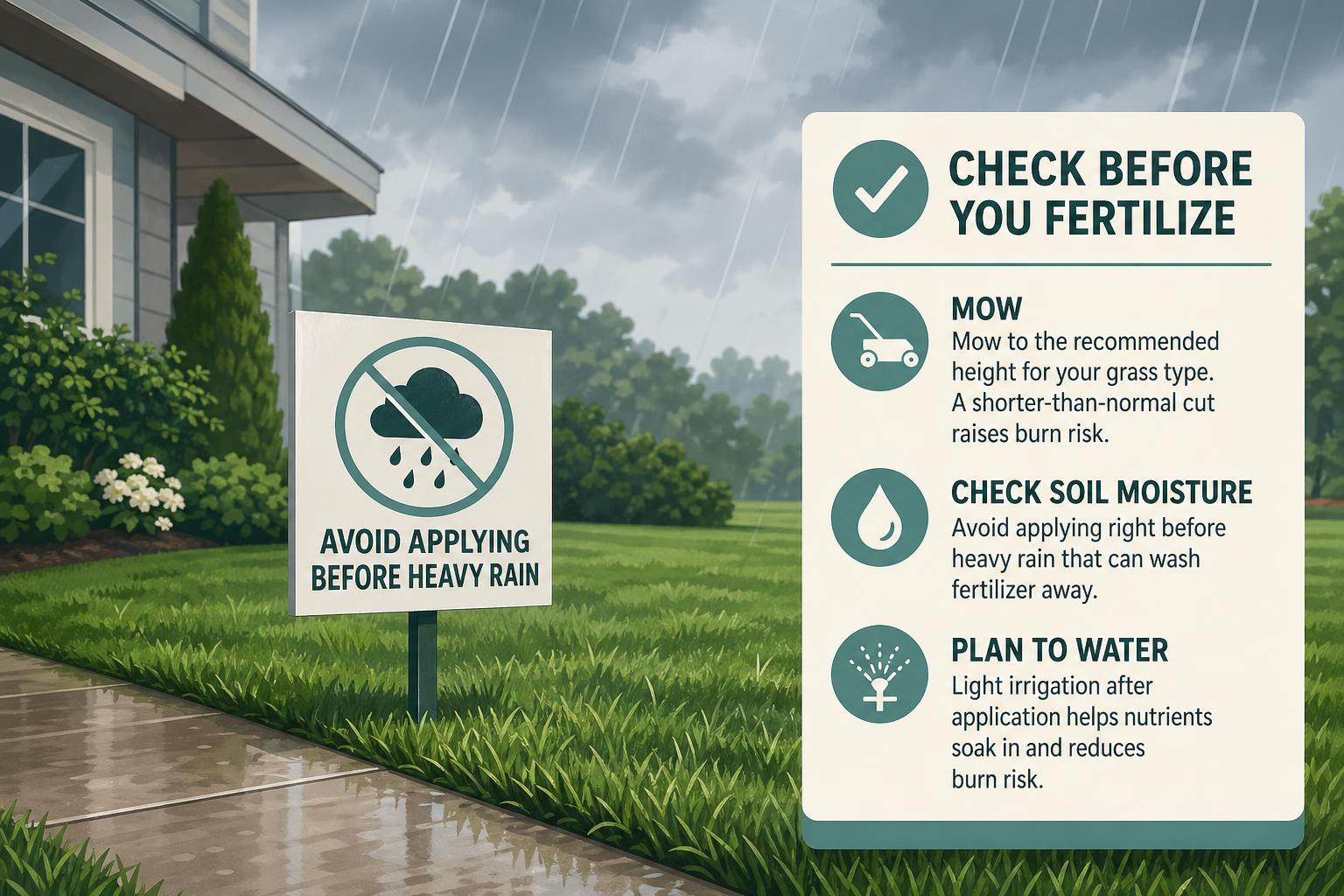
- Mow to the recommended height for your grass type. A shorter-than-normal cut raises burn risk.
- Check soil moisture: avoid applying right before heavy rain that can wash fertilizer away. Light irrigation after application helps activate most products.
- Look for signs of disease, pests, or compaction. Fertilizer won’t fix underlying problems; it can make some issues worse.
- Consider a soil test for pH and nutrient levels — your county extension service can help. A soil test prevents over-application and targets missing nutrients.
Cost and DIY vs. professional help
Ballpark costs:
- DIY bag fertilizer: $25–$60 per 40–50 lb bag that typically covers 5,000 sq ft depending on product strength.
- Professional fertilization service: $50–$120 per visit for an average yard. Packages with multiple visits and additional services raise the yearly cost.
DIY is fine for homeowners comfortable using a spreader and reading labels. Hire a pro if you want seasonal planning, pest diagnosis, or soil testing done right. If you hire, review credentials and ask for a written plan — the FTC has useful guidance on choosing a contractor: how to hire a contractor.
When to call a professional
Call a lawn care pro if:
- Your lawn has large bare patches, persistent disease, or insect damage.
- Soil compaction or drainage problems are present.
- You’re unsure what grass type you have or how much fertilizer to apply.
A pro can perform a soil test, diagnose problems without risking further harm, and provide a clear fertilizing plan. If you’re in Abilene and want help, our lawn care team can inspect and recommend a schedule: Lawn Care Abilene Tx.
Quick seasonal plans for Abilene homeowners
Practical, no-nonsense plans for a typical yard in Abilene, TX.
Warm-season lawn (typical in Abilene)
- Late March–May: First slow-release application after green-up.
- June–July: Second application if using 2–3 total applications per season.
- August (optional): Final light feed or switch to potassium-only to prepare for dormancy.
Cool-season lawn (less common locally)
- September–October: Main application to support fall root growth.
- March–April: Light application for spring green-up.
Prep tip: mow before fertilizing for even coverage. If you need mowing first, see our Lawn Mowing service.
Conclusion
When is the best time to fertilize your lawn? It depends on grass type and the season. Warm-season lawns do best with fertilizer from late spring through summer; cool-season lawns get the most benefit from fall and early spring applications. Use slow-release products, follow label rates (about 1 lb N/1,000 sq ft per application is a common rule), and check soil moisture and health first. When unsure, get a soil test or professional inspection so you don’t waste time and money.
If you live in Abilene and want a site-specific plan, Call (940)235-6789 or visit our lawn care page to schedule an inspection and fertilization plan tailored to your yard: Lawn Care Abilene Tx.
FAQs
How often should I fertilize?
For warm-season grasses, every 6–8 weeks during the growing season. For cool-season grasses, focus on early fall and early spring. Total annual nitrogen depends on grass type and product; follow label instructions.
Can I fertilize after rain?
A light rain is fine. Avoid applying immediately before heavy storms that can wash fertilizer off the lawn and into drains. Light irrigation after application usually helps products work better.
Do I need a soil test?
Yes, a soil test is the best way to avoid over- or under-applying nutrients. County extension services can run tests affordably and recommend specific N-P-K ratios.
Should I fertilize if I have weeds?
Treat the underlying weed problem first. Fertilizer can favor some weeds if turf is thin. Combine weed control with a planned fertilization schedule for best results.
How do I choose a contractor?
Ask for references, written plans, and work history. For guidance on hiring, see the FTC’s advice on how to hire a contractor.
If you want help creating and following a fertilization schedule tuned to your lawn in Abilene, Call (940)235-6789 to set up an inspection.