


When you own a home in Texas, a professional termite inspection isn't just a good idea—it's one of your best lines of defense against some seriously expensive, hidden damage. Think of it less as an optional task and more as a crucial structural check-up. For many real estate deals, especially those involving VA loans, it’s not optional at all.
Why a Termite Inspection Is a Texas Homeowner's Best Defense
Let's be honest, our homes are our biggest investments. Here in the Lone Star State, that investment faces a silent but relentless threat: termites. Our warm, humid climate is basically a paradise for them, which is why they cause billions of dollars in structural damage across the U.S. every year.
I learned this the hard way with a previous house. A colony was quietly chewing away behind the walls, and by the time we found them, they'd already caused thousands in damage. It was a stressful, expensive lesson on the true value of being proactive.
What is a termite inspection in Texas, really?
A professional termite inspection in Texas is much more involved than a quick walk-around. It’s more like a comprehensive health exam for the bones of your house. A licensed inspector will systematically comb through your property, looking for any evidence of wood-destroying insects (WDIs).
So, what does that actually look like? The process involves a few key steps:
- Interior and Exterior Examination: The inspector thoroughly checks all accessible areas, from the foundation right up to the attic.
- Focus on Vulnerable Areas: They zero in on high-risk spots like damp crawl spaces, basements, wooden window sills, and any place where wood meets soil.
- Search for Evidence: They're trained to spot the telltale signs—mud tubes climbing up the foundation, hollow-sounding or damaged wood, discarded wings from swarmers, and, of course, live termites.
This diagnostic work is what helps you catch a problem before it becomes a catastrophe. It's a small investment for some serious peace of mind.
Why are regular inspections so important if I don't see any termites?
It's easy to think, "If I don't see any termites, I must be in the clear." Unfortunately, that's exactly what termites count on. They are masters of stealth, capable of eating away at your home's structural supports for years without leaving any obvious clues.
A neighbor of mine here in Abilene learned this during a routine inspection for a home refinance. He was shocked to find out an active subterranean termite colony had been feasting on the support beams in his crawl space. The final repair bill was over $8,000.
That’s why regular inspections are so critical. They accomplish two main goals:
- Early Detection: Finding an infestation early is the single most important factor in limiting the damage and keeping repair costs from skyrocketing.
- Prevention: A good inspector will also point out conditions that make your home a magnet for termites, like leaky faucets creating moisture or firewood stacked against the house. Taking care of these issues is a huge step in termite prevention. For more tips on protecting the wooden elements of your home, you might want to explore some professional wood care and maintenance strategies.
Understanding the Texas WDI Report for Home Buyers and Sellers
If you're buying or selling a house in Texas, you're going to hear the acronym "WDI" a lot. It stands for Wood-Destroying Insect Report, and it’s a critical piece of the puzzle. Think of it less like a report and more like a health check-up for the home's wooden structure.
When I was buying my first house here in Texas, the WDI report felt like just another complicated form in a mountain of paperwork. But after our inspector walked us through it, I saw just how essential it was. This document is the official, written summary of a professional termite inspection, outlining everything found—or not found—regarding termites and other wood-destroying pests.
Why is the WDI Report So Important in Texas?
For many lenders, especially those handling VA loans, a WDI report isn't optional. It’s often a requirement to get your mortgage approved. Lenders want to be sure the massive asset they're financing isn't literally being eaten from the inside out. It's why a professional termite inspection has become a standard step in the home-buying process across Texas. You can get more details on why these inspections are so vital for Texas homeowners on our site.
The report really protects everyone involved:
- For Buyers: It gives you a clear, documented picture of the home's condition when it comes to wood-destroying insects. This lets you make a smart decision, negotiate for repairs, or even walk away from a deal if the problems are too extensive.
- For Sellers: A clean WDI report is a fantastic selling point. And if the inspection does find something? Having that report allows you to get ahead of the problem and fix it, which can prevent a deal from falling apart later on.
What does a WDI Report actually tell me?
I was initially worried the report would be full of confusing technical jargon, but it’s actually designed to be pretty clear once you know its purpose. The report is a standardized form issued by the Texas Department of Agriculture, and it focuses on answering a few specific questions.
It's a common misunderstanding that a WDI report is a "termite warranty" or a guarantee that a home is 100% termite-free. Its real job is to report on the visible evidence of wood-destroying insects found on the day of the inspection.
A standard Texas WDI Report will lay out:
- Inspection Findings: This is the heart of the document. The inspector will check a box indicating if there is visible evidence of an active infestation, signs of a previous infestation, or no visible evidence of either.
- Location of Findings: If any evidence is spotted, the report will describe exactly where (for example, "mud tubes on exterior foundation near the garage" or "damaged wood in the crawl space below the main bathroom").
- Conducive Conditions: The inspector will also note any conditions that make the property a magnet for termites. This could be anything from wood siding touching the soil, a leaky faucet causing excess moisture, or even a woodpile stacked right against the house.
- Treatment History: It will also mention if there are signs of past termite treatments, like small drill marks in the foundation or a service sticker left behind by a pest control company.
What are my next steps if the inspector finds termites?
Seeing evidence of termites on a WDI report can definitely make your stomach drop. I remember selling a home where the inspection revealed signs of a past infestation that had already been treated. My heart sank, but it didn't end up being a deal-breaker.
Here’s how to handle it:
- If you're the buyer: First, don't panic. Talk it over with your real estate agent and the inspector. In many cases, you can negotiate with the seller to have the home professionally treated and any damage repaired before you close on the house.
- If you're the seller: Be proactive. Get a quote for treatment and repairs from a reputable pest control company right away. Taking charge of the situation shows the buyer you're acting in good faith and can be the key to saving the sale.
Spotting the Hidden Signs of Termites Around Your Home
While a professional termite inspection in Texas is the only way to be certain, you are your home’s first line of defense. Termites are masters of stealth, but they do leave a trail. If you know what to look for, you can spot a problem long before it becomes a disaster.
I learned this the hard way after dealing with an infestation years ago. Now, I’m constantly asked by neighbors what they should look for between professional visits. It really comes down to training your eye to spot the little things that most people miss.
What are mud tubes and why do they matter?
In Texas, the single most common sign of subterranean termites is their mud tubes. These aren't just random bits of dirt; they're like covered freeways the termites build to travel safely from their underground colony to the wood in your home. These tubes protect them from predators and keep them from drying out.
I make it a habit to walk the perimeter of my house every few months just to look for these. Here’s where I focus:
- Foundation Walls: Scan for pencil-thin lines of dried mud climbing up from the ground onto your concrete or brick.
- Crawl Spaces and Piers: If you have a crawl space, this is a prime spot. Check the piers and any support beams for these muddy trails.
- Utility Entry Points: Pipes and utility lines give termites an easy access point, so inspect carefully where they enter your house.
Don't just brush them off as dirt splashes from the rain. If you gently break a small piece open and see tiny, white, ant-like insects moving inside, you’ve found an active termite highway.
How can I spot damage inside the wood itself?
Termites eat wood from the inside out, which means the damage can be completely hidden at first. You have to go looking for it.
Last year, while getting our deck ready to be re-stained, I tapped on a support post with my screwdriver handle and it just sounded… off. It was hollow and felt soft. A little probing revealed that termites had been feasting on it from the inside. It’s a perfect example of why keeping wood clean and maintained is so important. In fact, we have a whole guide on how to boost your home’s value by cleaning and staining outdoor structures.
It can be tough to know if what you're seeing is termites or something else entirely. Here’s a quick comparison to help you sort it out.
Termite Warning Signs vs Common Household Issues
| Observation | What It Could Be (Termites) | What Else It Could Be (Non-Termites) |
|---|---|---|
| Discarded Wings | Evidence of a termite swarm. Reproductive termites shed their wings after they've found a mate and are ready to start a new colony. | Flying ants also swarm, but their wings are different sizes. Termite wings are all equal in size and look like tiny fish scales. |
| Bubbling or Peeling Paint | Termites chewing on the wood or drywall behind the paint can introduce moisture, causing it to bubble or peel. | This is also a classic sign of a water leak from plumbing, a roof issue, or a poorly sealed window. |
| Hollow-Sounding Wood | The termites have eaten away the inside of the wood, leaving just a thin, fragile outer shell that sounds hollow when tapped. | Wood rot from fungus can also soften wood, but it usually feels spongy or damp and is caused by excessive moisture. |
| Tiny Holes in Wood | Drywood termites push their feces (called frass) out of "kick-out" holes, which look like tiny piles of sand or coffee grounds. | Powderpost beetles also make tiny holes, but their droppings are a fine, flour-like powder, not distinct pellets. |
It's easy to misdiagnose the problem, but a closer look can usually point you in the right direction—and tell you when it's time to call in a pro.
What are swarmers and discarded wings?
Finding a cloud of winged insects in your home or a pile of discarded wings on a windowsill is definitely alarming. This is a termite swarm, where "alates," or reproductive termites, fly out to start brand-new colonies.
I’ll never forget the call I got from a panicked friend one spring morning. She’d found hundreds of tiny, shimmery wings all over her kitchen floor. It was the only sign she had that a massive, mature colony was living right under her feet.
Seeing a swarm means a large, established colony is close by—possibly inside your walls or beneath your foundation. Don't just vacuum them up and hope for the best. If you can, scoop some of the wings or bugs into a zip-top bag for identification and call a professional for a termite inspection right away. It's the most urgent sign you can get.
What to Expect During a Professional Termite Inspection
So, you’ve made the call and have a termite inspection in Texas on the calendar. What actually happens when the technician arrives? If you've never had one done, it can feel a bit mysterious. I remember my first time—I wasn't sure if I was supposed to clear out every closet or just try to stay out of the way.
It turns out the process is methodical, not chaotic. A good inspector operates like a detective, following a specific checklist to uncover not just live termites, but any evidence they leave behind. They're also hunting for moisture issues and structural weak points that might as well be a welcome mat for a future colony.
What areas of my home will be inspected?
This is probably the most common question I get from friends and neighbors. The simple answer is: everywhere they can safely access. A thorough inspector needs to see the "bones" of your house, so expect them to be pretty comprehensive.
I learned this firsthand when I bought my current home. The inspector was polite but incredibly focused, moving from one zone to the next with a clear game plan. He explained that since termites can find countless ways in, a full-body scan of the property is the only way to be certain it's clear.
A standard inspection covers a few key zones:
- The Exterior: This is always the starting point. The inspector will walk the entire perimeter of your foundation, keeping a sharp eye out for tell-tale mud tubes, wood-to-ground contact (like siding or a fence post touching the soil), and damage around windows and door frames.
- Crawl Spaces and Basements: These are prime real estate for termites. If your home has them, an inspector will spend significant time here. They're dark, often hold moisture, and offer direct, undisturbed access to your home's wooden structure.
- The Attic: Another high-priority spot. An inspector will check for signs of swarmers (like discarded wings), hidden water leaks from the roof, and any damage to rafters or supports.
- Interior Rooms: Inside, the focus shifts to baseboards, walls, and floors. They pay special attention to areas with plumbing, like kitchens, bathrooms, and laundry rooms, where moisture can attract termites.
This quick guide shows the top three signs an inspector—and you—can look for to spot a termite problem.
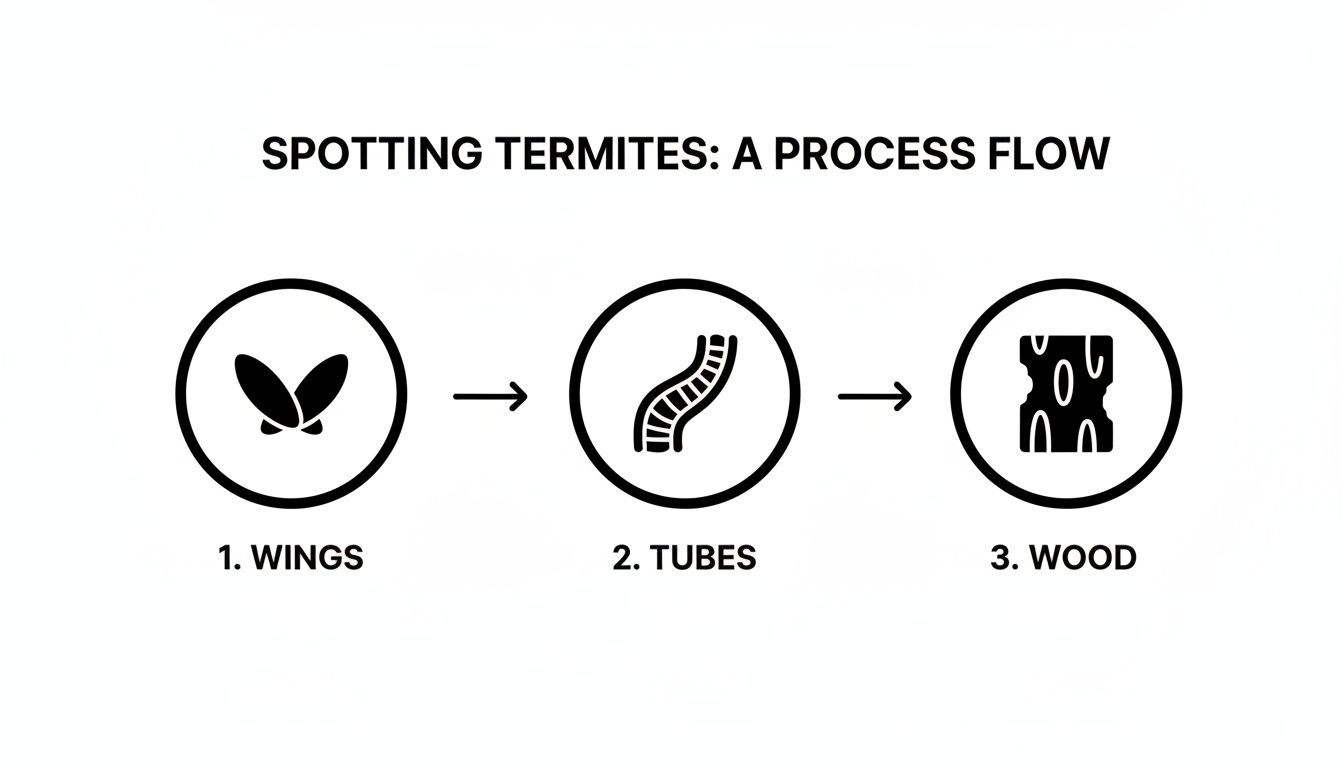
As you can see, termites aren't exactly subtle if you know what you're looking for. They leave behind very distinct clues, from the wings of swarmers to the mud tubes they build and the damaged wood they hollow out.
What tools do professionals use that I don't have?
While a sharp eye is crucial, a professional termite inspection goes beyond a simple visual check. Technicians rely on specialized equipment to find what's hiding behind your walls.
A few years back, my inspector got a high reading with his moisture meter on a wall that looked perfectly fine to me. We opened it up and found a small, active colony that had started behind the shower. Thanks to that little device, we caught them years before the damage would have become visible.
Here are some of the key tools an inspector will likely have in their kit:
- Flashlight and Probing Tool: These are the classics for a reason. A powerful flashlight is essential for illuminating dark crawl spaces and attics, while a simple probing tool (like a screwdriver) is used to tap on wood. A hollow sound is a dead giveaway for internal damage.
- Moisture Meter: This handy device detects the percentage of moisture inside wood and drywall. Since termites need a damp environment to thrive, high moisture readings can instantly flag a hidden water leak or a potential termite hotspot.
- Infrared (IR) Camera: This is a more advanced piece of tech that visualizes temperature differences. Active termite colonies actually generate a small amount of heat, and an IR camera can sometimes "see" these thermal anomalies through a wall, revealing an infestation that would otherwise be completely invisible.
By combining their training with these tools, a licensed inspector gives you a complete picture of your home’s health. It’s about more than just finding bugs; it’s about giving you the information you need to protect your biggest investment.
How to Choose a Licensed Termite Inspector in Texas
Let's be honest—not all pest control companies are created equal. When it comes to something as specialized as a termite inspection, who you hire is the single most important decision you'll make. It’s the difference between real peace of mind and just hoping for the best.
When you hire someone for a termite inspection in Texas, you're putting the health of your biggest asset in their hands. This isn't the time to just Google "cheap termite guy." You need a real pro who is properly licensed, fully insured, and has a reputation for being thorough.
How do I know if a termite inspector is qualified and trustworthy?
That’s the million-dollar question, isn't it? Getting this right can save you a mountain of stress and thousands in repairs down the road. I've learned the hard way that you have to do your own homework. It's all about verifying their credentials, not just taking their word for it.
My first move is always to check their license. Here in Texas, anyone handling regulated pest control products must be licensed by the Texas Department of Agriculture (TDA). You can—and absolutely should—look them up right on the TDA's website. No license? That’s a huge red flag, and the conversation ends there.
Next, I ask to see proof of insurance. A professional operation will have general liability insurance (in case they accidentally put a foot through your ceiling) and workers' compensation. If they hesitate or can't produce a certificate, I walk away.
When I was getting quotes for my last inspection, one guy got really cagey when I asked about insurance. That was it for me. A true professional has their paperwork in order and is proud to show you—it’s a basic sign of good business.
Finally, I dig into recent reviews from people right here in the Abilene area. I don't just glance at the star rating; I read the comments. I'm looking for details on their thoroughness, how well they communicated their findings, and whether they showed up on time.
What are the risks of hiring an unlicensed inspector?
Trying to save a few dollars by hiring someone off the books might seem tempting, but the potential downside is massive. Licensed professionals are trained to handle powerful chemicals safely. Someone who isn't could easily put your family and pets at risk. In fact, pesticide-related health findings from state health surveillance show just how serious improper handling can be.
Worse, an unlicensed inspector could easily miss the subtle signs of a termite problem, allowing the damage to continue unchecked. And if they cause any damage, they won't have the insurance to cover it. Taking a few extra minutes to find a licensed, insured, and reputable inspector isn't just a good idea—it's a non-negotiable part of protecting your home.
Your Action Plan After the Inspection Report
The inspection is done, and now you’re holding the report. This is where the rubber meets the road, and honestly, it can feel a little nerve-wracking whether the news is good or bad. It’s the moment of truth for your home.
I find homeowners always land on two big questions: "What now?" if termites were found, and "What now?" if the report came back clean. Let’s walk through the game plan for each situation, starting with the one that causes the most stress.
What do I do if termites are found?
Seeing the words "active infestation" on your report can feel like a punch to the gut. The first time I saw that on a report for my own property, my mind immediately jumped to the worst-case scenario. But the reality is almost always far more manageable, as long as you act deliberately.
Don't panic. First, take a moment to go over the report with the inspector. You need to understand exactly what they found—is it an old, resolved issue or an active colony? Where is the damage located? Once you have the facts, it's time to line up treatment with a professional pest control company.
In Texas, the pros usually rely on a few trusted methods:
- Liquid Soil Treatments: This is a classic for a reason. A technician creates a protective chemical barrier in the soil around your foundation, stopping subterranean termites in their tracks as they try to get inside.
- Baiting Systems: A more modern approach involves placing specialized bait stations around the property. Termites find the bait, share the slow-acting ingredient with the rest of the colony, and ultimately eliminate the threat from the inside out.
- Wood Treatments: When termites are already inside the wood, technicians can inject foams or other targeted termiticides directly into the galleries and voids to kill them on contact.
After you select a treatment plan, the company will give you a detailed proposal and get you on their schedule. Don't forget to also get a separate quote from a qualified contractor to fix any structural damage the inspector noted. If you're looking for trustworthy local pros for this kind of work, you can see how we vet our partners and learn about our approach to professional pest control in Abilene, TX.
What should I do if the report is clear?
A clear report is fantastic news! It means your termite inspection in Texas found no signs of an active infestation. I remember breathing a huge sigh of relief the last time my own inspection came back clean. But this isn't the finish line—it's the starting line for smart prevention.
Think of it like getting a clean bill of health from your doctor. You wouldn't immediately go back to bad habits; you'd take proactive steps to stay healthy. The same principle applies to your home.
A clean report is your baseline, not a permanent guarantee. It's your starting point for a proactive maintenance plan to keep your home protected for the long haul.
This is the perfect opportunity to build an annual maintenance checklist. Here’s a simple routine I follow to make my own property less inviting to termites:
- Manage Moisture: Every spring and fall, I walk the perimeter of my house. I fix dripping outdoor faucets, clear out gutters so they drain properly, and check that my sprinklers aren't soaking the foundation.
- Eliminate Wood-to-Soil Contact: I make sure any firewood stacks, spare lumber, or even thick mulch piles are kept at least 18 inches away from my home's siding and foundation.
- Seal Off Entry Points: Once a year, I look for and seal any new cracks in the foundation or gaps around pipes and utility lines. These are easy highways for termites.
- Book the Next Inspection: This is the most important step. I put a reminder on my calendar to schedule my next professional termite inspection for the same time next year. Annual checkups are the single best way to catch potential problems before they become catastrophes.
Frequently Asked Questions About Texas Termite Inspections
Even after covering the basics, a few specific questions always come up. Let's tackle some of the most common ones I hear from homeowners right here in Texas to clear up any lingering confusion.
Can I just do my own termite inspection?
It’s tempting to think you can save a few bucks by doing a quick walkthrough yourself, and frankly, you should keep an eye out for obvious signs like mud tubes or wood damage. But that’s no substitute for a professional termite inspection in Texas.
A licensed inspector brings years of training and specialized tools—think moisture meters and thermal cameras—to the job. They can spot the subtle, hidden evidence of termites that an untrained eye will almost always miss. Catching an infestation early, before it causes visible damage, is the key to avoiding thousands in repairs.
I’ll admit, I used to think I could spot any problem myself. But after watching a pro use an infrared camera to find a termite colony that was completely invisible to me, I realized you can't replicate the expertise of someone who spends their days hunting for termites. A professional inspection gives you documented certainty, which is crucial for your peace of mind or for satisfying the requirements of a real estate deal.
How long does a termite inspection typically take?
This is a great practical question. For a standard-sized home in the Abilene area (around 1,500 to 2,500 square feet), a really thorough inspection should take somewhere between 60 and 90 minutes.
Of course, that time can change based on a few things:
- The Home's Size and Layout: A larger, multi-story house with a basement, crawlspace, and complex attic will naturally demand more time.
- Accessibility: If an inspector has to move boxes just to get into the attic or crawlspace, it slows things down. Clearing those access points ahead of time is a huge help.
- What They Find: If the inspector uncovers signs of termite activity, they'll need extra time to carefully document the extent and specific locations of the problem.
Can a veteran pay for a termite inspection on a VA loan in Texas?
Yes, absolutely. This is a common point of confusion because the rules have changed for the better. It used to be that VA guidelines required the seller to pay for the Wood-Destroying Insect Report (WDIR).
However, the VA updated its policy, and Texas is now one of the states where the veteran homebuyer is permitted to pay for their own termite inspection. This is a big win for veterans, as it makes their offers more competitive by removing a potential cost hurdle for sellers.