


Surviving a West Texas summer isn't just about the heat—it's about the bugs. From fire ants and mosquitoes to chiggers and ticks, these pests absolutely thrive in our signature heat and humidity, which means a proactive defense is non-negotiable for any homeowner around here.
Surviving Summer In Abilene: The Bugs Are Here
It only takes one ruined backyard barbecue to learn your lesson about fire ants. I'll never forget one get-together where a hidden mound turned a relaxing evening into a frantic, painful dance. One second we were flipping burgers, the next, several of us were swatting at ankles covered in angry red welts. It’s a classic Abilene story and a harsh reminder of how fast uninvited guests can crash a perfect West Texas evening.
Living in the Big Country means you have to make peace with the reality of summer: beautiful, sun-drenched days that also happen to be a breeding ground for a whole host of pests. Our unique climate, with its blistering heat followed by sudden, drenching thunderstorms, is basically a paradise for them.
This diagram gives you a quick snapshot of three of the most common culprits you’ll be dealing with.
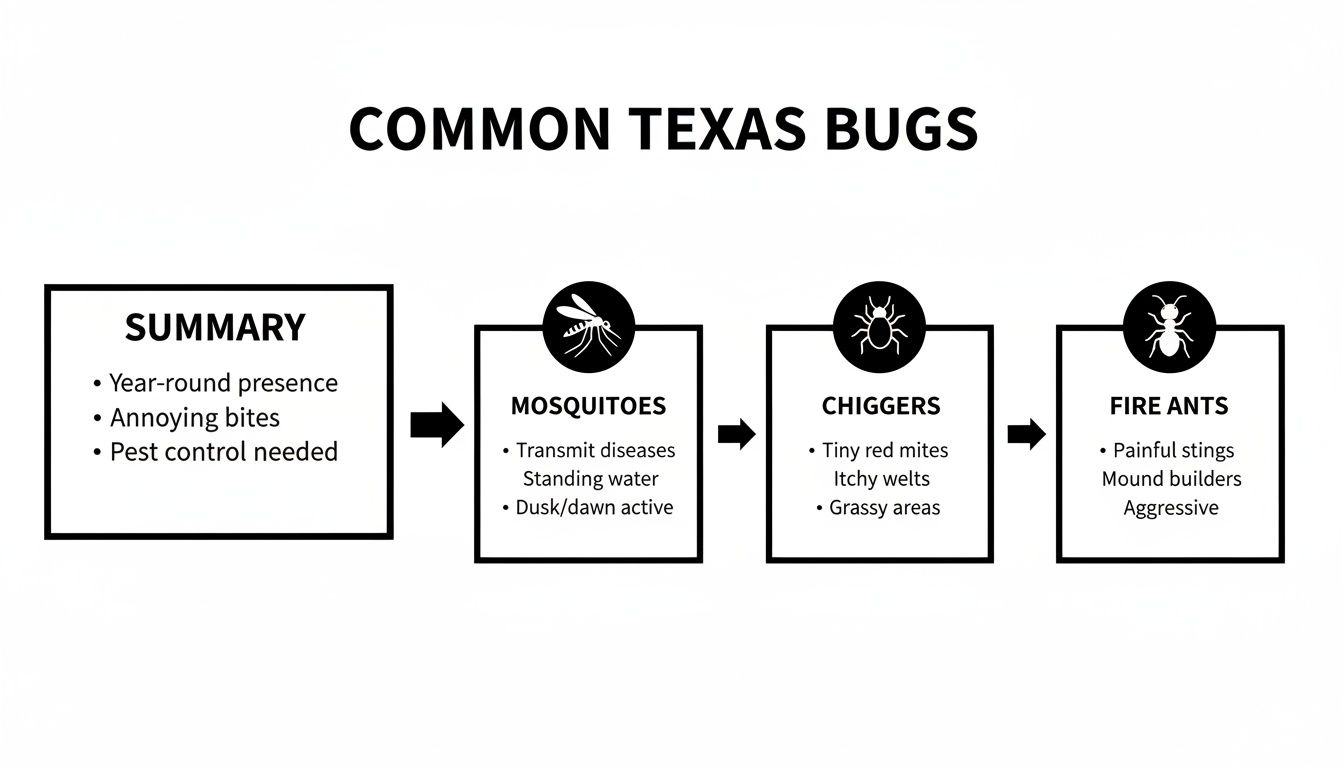
As you can see, the threat is everywhere. Mosquitoes pop up in any standing water, chiggers wait in tall grass, and fire ants are always ready to claim your lawn. Different parts of your property attract different pests, and you have to be ready for all of them.
What makes Abilene a hotspot for summer pests?
I often get asked by folks new to the area, "Why are the bugs so bad here in the summer?" The answer really comes down to two key factors: our intense heat and our unpredictable moisture.
The triple-digit temperatures we see all summer long dramatically speed up insect life cycles. This means they mature and reproduce much, much faster. A mosquito, for instance, can go from a tiny egg to a biting adult in just a handful of days.
Then you add in our classic summer downpours. One big storm can leave standing water all over your property.
I once discovered a full-blown mosquito nursery thriving in a forgotten toy bucket that had collected less than an inch of rainwater. It was a stark lesson in just how little water it takes to create a huge problem.
This combination of accelerated reproduction and endless breeding grounds is what leads to those booming pest populations that can feel so overwhelming from June to September.
What are Abilene's most unwanted summer pests at a glance?
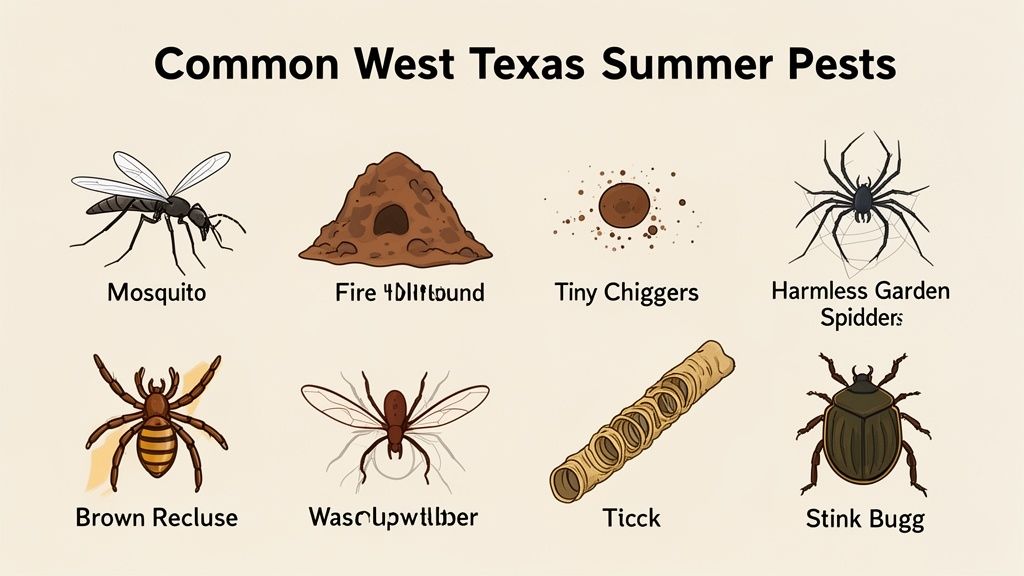
To effectively protect your home and yard, you first need to know your enemy. This quick-reference table is your field guide to the most common summer bugs in Texas, where they love to hide, and what you can do about them.
| Pest Name | Common Hiding Spots | Primary Threat Level | Best Defense Strategy |
|---|---|---|---|
| Fire Ants | Sunny, open areas in lawns; along sidewalks | High (Painful stings, aggressive) | Mound treatments & perimeter defense |
| Mosquitoes | Standing water (gutters, birdbaths, puddles) | Medium (Annoying bites, disease risk) | Eliminate standing water & use repellents |
| Chiggers | Tall grass, weeds, shaded & moist areas | Low (Intensely itchy bites) | Regular lawn mowing & personal repellent |
| Wasps | Under eaves, on porch ceilings, in bushes | High (Painful stings, allergic reactions) | Professional removal of nests near home |
Getting familiar with these pests is the first step toward taking back your yard. Now that you know what you’re looking for, we’ll move from identification to practical, actionable plans for both prevention and treatment. You'll get the tools you need to enjoy your Abilene summer—without the constant swatting.
Know Your Enemy: A Guide to West Texas Summer Pests
Before you can win the war, you have to know who you’re fighting. Figuring out what’s buzzing, crawling, or biting around your property is the first step to taking back your yard. Here in West Texas, a lot of bugs look alike, and mistaking a harmless one for a real problem (or worse, the other way around) can mean wasted money or a painful lesson learned. Let's get you familiar with the usual suspects.
What do I need to know about mosquitoes?
You know that high-pitched whine that seems to appear right by your ear the second you get comfortable on the patio? That’s the mosquito, an absolute master of ruining a good evening. After one of our classic Abilene summer thunderstorms, they turn any standing water into a five-star resort for laying eggs.
I once dealt with a massive swarm that took over my backyard. I couldn't figure out where they were coming from until I finally checked a clogged gutter I’d put off cleaning. It was a wake-up call—a simple check after a rain could have saved me weeks of getting eaten alive. They’re worst at dawn and dusk, so be ready.
Why are fire ants such a problem?
Fire ants have earned their reputation. These little reddish-brown ants build those sneaky, dome-shaped mounds in the sunniest parts of your lawn—right where the kids and dogs love to run around. The real trouble is that after you mow, the mounds can flatten out and become almost impossible to see.
Disturb one of those mounds, even slightly, and you unleash an army. They don't just bite once; they latch on and sting repeatedly, leaving behind those awful, pus-filled blisters. I made that mistake once while weeding a flowerbed and ended up with a dozen stings on my hand before I even knew what was happening. A single colony can house over 200,000 ants, which is why one wrong step can turn a nice day into an agonizing one.
What exactly are chiggers and why do they itch so much?
Chiggers are the ghosts of the insect world. These microscopic mites are practically invisible, and you won’t even know you’ve walked through them until hours later when the maddening itch starts. They love hiding out in tall grass, weedy patches, and shady, damp areas.
I learned this the hard way after a day out at Abilene State Park. The next morning, my ankles and waistline were covered in ferociously itchy red welts. It was a classic case of chigger bites and a lesson that now has me showering immediately after spending any time in wooded or grassy areas.
Don’t underestimate these tiny pests. Chigger bites are actually caused by the mite's digestive enzymes breaking down your skin, which is why the itch is so persistent and miserable.
Why am I seeing roaches in my house during the summer?
Texas is home to several kinds of roaches, but the two you'll most likely find in your house are the big American cockroach (what many of us call a "water bug") and the smaller, faster-breeding German cockroach. They're just looking for food, water, and a place to escape the heat, and our hot summers drive them right inside.
I remember helping a friend who was seeing roaches in his kitchen. We found they were coming in through a tiny gap around the water pipe under his sink. You’ll usually find them in dark, moist spots—think under the kitchen sink, behind the fridge, or in laundry rooms and bathrooms. If you see one scurrying across the floor during the day, it's a bad sign. It almost always means there’s a much larger group hiding in the walls.
So, are all these bugs dangerous?
That’s a big question, and the answer isn't a simple yes or no. While many are just a pain, some pose a real threat to your family and pets. It helps to sort them into a few categories.
Truly Dangerous: Fire ants and certain wasps can cause severe allergic reactions (anaphylaxis). Ticks are a major concern because they can transmit serious illnesses like Lyme disease and Rocky Mountain spotted fever. Venomous spiders, like the Brown Recluse and Black Widow, require extreme caution and professional help.
Nuisance Pests: Chiggers won't make you sick, but their bites can make you miserable for a week. Stink bugs are harmless but will invade your home in droves and smell awful if you crush them.
The In-Betweeners: Mosquitoes are mostly annoying, but they can carry West Nile virus. Roaches can trigger allergies and asthma, especially in kids, and they can contaminate your food.
Knowing the difference helps you decide what to tackle first. Correctly identifying the pest is always the best way to keep your home safe and your family protected.
Creating Your Pest-Proof Defense Plan
When it comes to summer bugs in West Texas, the best defense is a good offense. I’ve learned over many hot Abilene summers that making your home an unwelcome place for pests is far easier than trying to get rid of them once they've moved in. An ounce of prevention really is worth a pound of cure, especially when that "cure" is chasing mosquitoes in 100-degree heat.
This isn’t about complicated, expensive procedures. It's about building smart, consistent habits. Let's walk through the three key battlegrounds: your landscape, your lawn, and the exterior of your house. Get these right, and you can turn your property from a pest magnet into your own private oasis.
How can I master my landscape and lawn to prevent pests?
Your yard is ground zero—the first place pests like fire ants, chiggers, and ticks try to establish a foothold. If your yard is an inviting habitat, it’s only a matter of time before they start exploring your home.
One of the most common questions I get from Abilene homeowners is, "When is the best time to check my gutters for mosquitoes?"
My answer is always the same: right after a summer thunderstorm. It’s shocking how fast those prime breeding grounds can pop up. A single handful of wet, decomposing leaves in your gutter is all it takes to hatch hundreds of mosquito larvae. In fact, a single bottle cap full of water is enough.
I once helped a client who was getting eaten alive on their back patio. The culprit? A decorative saucer under a potted plant. It had been holding stagnant water for weeks, creating a non-stop mosquito factory. It's often the small, overlooked spots that cause the biggest headaches.
That warm, humid air we get all summer is a perfect recipe for a mosquito population explosion. It's why our team at Abilene Home Service is so focused on eliminating every last drop of standing water we can find.
Why should I create a bug-free buffer zone?
Think of overgrown shrubs and tree limbs as highways for pests. They use them to get from your yard directly onto your siding, roof, and eventually, inside. Creating a clear buffer zone around your foundation is one of the most effective things you can do.
Here’s the simple checklist I use for my own property:
- Trim Everything Back: Keep all bushes, tree branches, and other landscaping trimmed back at least 12-18 inches from your siding and roof. This is a simple but powerful deterrent for ants, roaches, and spiders.
- Rethink Your Mulch: Pests love the cool, damp environment of wood mulch. I always recommend keeping mulch at least six inches away from your foundation. Better yet, use a less bug-friendly material like gravel or rubber mulch in the area immediately against the house.
- Mow Consistently: A well-kept lawn does more than just look good. Ticks and chiggers hate short, sunny grass, preferring to hide in taller, shadier vegetation. For more local advice on keeping your lawn healthy, check out our guide to lawn care in Abilene.
What should I do to fortify my home's exterior?
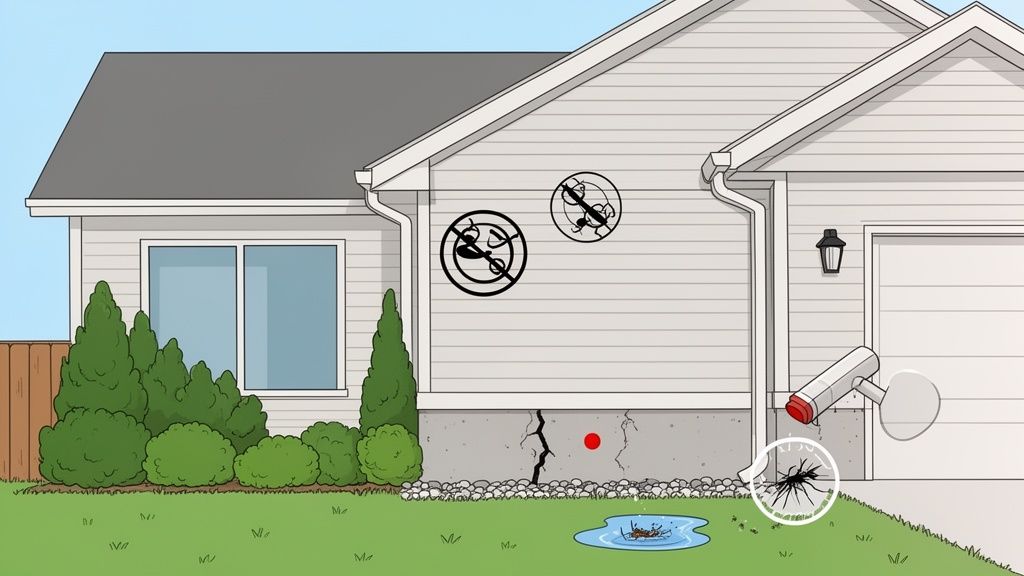
Once your yard is in order, the final step is to seal up the house itself. Pests are masters at finding tiny cracks and gaps you’d never even notice.
Treat your home like a castle and block every possible entry point. I suggest doing a full walk-around of your home’s exterior at the start of each summer, looking specifically for these weak spots:
- Foundation and Siding: Seal any cracks you find in the foundation or siding with a quality exterior caulk. Roaches and ants can squeeze through gaps you wouldn't think possible.
- Utility Lines: Pay close attention to where pipes, wires, and vents enter your home. Stuff any gaps with steel wool (rodents can't chew through it) and then seal them with expanding foam.
- Windows and Doors: Check every window screen for tiny rips or tears and repair them. Make sure the sweeps on the bottom of your doors form a tight seal with the threshold.
And for enjoying those long Texas evenings on the patio, simple outdoor fans to keep bugs away are surprisingly effective. The constant breeze makes it difficult for weak fliers like mosquitoes and flies to get near you, making your outdoor space much more pleasant.
Practical DIY Treatments for When Bugs Get Through
No matter how buttoned-up your house is, a few pests are bound to slip through the cracks. It's just a reality of summer here in Texas. But when they do, you don’t always have to go nuclear. I’ve found that having a few solid, targeted DIY tricks up your sleeve can handle most minor invasions safely and effectively.
This isn’t about just spraying and praying; it’s about knowing what works for which bug. Here are a few of the real-world methods I use when those unwelcome guests show up.
What's my go-to wasp knockdown spray?
There's nothing quite as startling as spotting a new wasp nest taking shape under your eaves or on the porch ceiling. For those small, fresh nests—about the size of a golf ball or smaller—you don't need a heavy-duty chemical spray. I have a simple mixture that works like a charm every time.
My recipe is just dish soap and water. I mix about two tablespoons of dish soap into a regular spray bottle full of water and give it a good shake. The soap is the key; it breaks down the water's surface tension, letting it clog the wasps' breathing spiracles. They drop almost instantly.
I always apply this spray first thing in the morning or late in the evening when the wasps are back at the nest and less active. Just stand a safe distance away and drench the nest. It's an incredibly effective way to handle small nests without spraying harsh chemicals where my kids and pets play.
How should I treat a fire ant mound in my yard?
This is one of the most common questions I get from Abilene homeowners, and the right answer really depends on the situation. For a single mound, you’ve got two main DIY strategies: contact killers and baits.
Contact Killers: These are usually dusts or liquid drenches that you pour directly on the mound. They work incredibly fast, killing the ants they touch on contact. I'll use this method when a mound pops up somewhere I can't ignore it, like right next to the patio steps. The downside? They rarely kill the queen, who's buried deep underground. More often than not, the colony just moves a few feet over and builds a new mound.
Baits: These are my preferred solution for the long haul. Baits are granular products the worker ants think is food. They haul it back to the colony, where the slow-acting poison is passed around to everyone, including the queen. This is how you wipe out the entire colony for good. I use baits for any mounds out in the lawn where I don't need an immediate fix. You have to be patient—it can take a week or two—but it's a much more permanent fix.
If you’re seeing mounds all over your yard, a broadcast bait applied across the entire lawn is going to be your most effective bet.
Can I really get rid of roaches on my own?
Yes, you absolutely can, but you have to be relentless. Just spraying the one roach you see skittering across the floor is a losing battle. That one roach is only a tiny fraction of the problem—the other 95% of the population is likely hiding in your walls and cabinets. A successful DIY plan hits them from three sides: sanitation, exclusion, and targeted treatments.
First things first, you have to cut off their food and water. I once helped a neighbor win this battle. We did a deep clean of the kitchen and bathrooms, stored all their food (including pet food) in airtight containers, fixed a drippy faucet under the sink, and made sure their pet's water bowl wasn't left out overnight.
Next, it’s time to bring out the tools:
- Bait Stations: Place these in the dark corners where roaches travel—under sinks, behind the fridge, and in the back of cabinets. The roaches eat the bait and unknowingly carry it back to the nest, poisoning the colony from the inside out.
- Boric Acid: This is a fine powder that works wonders in places you can't easily spray. Use a puffer to apply a very thin, almost invisible layer in cracks, crevices, and behind electrical outlets. Roaches crawl through it and it kills them, but it has to be kept dry to work.
This combined approach is your best shot at winning the war against roaches. It takes diligence, but you can definitely get the upper hand. And if you're fighting a battle on two fronts with mosquitoes, our guide on how to get rid of mosquitoes has the specific advice you'll need for them.
Most importantly, always be safe. Read and follow the product labels to the letter, especially if you have kids or pets. And remember, while these DIY tactics are great for smaller issues, some infestations are just too big or too risky to handle on your own.
When Should You Call a Professional for Your Bug Problem?
Every homeowner in West Texas has a bottle of bug spray under the sink. It’s a fact of life here. And for a few ants on the counter or a spider in the corner, that’s usually all you need. But there’s a point where you have to wave the white flag.
Knowing when your bug problem has graduated from a DIY-fix to a full-blown infestation is crucial. Trying to tough it out with store-bought products can sometimes just make things worse, costing you more time and money in the long run. I’ve seen it happen countless times. Here are the tell-tale signs that you’re out of your league and it’s time to call for backup.
The Same Pests Keep Coming Back
This is the big one. You spray for ants, and they vanish for a week, only to show up again by the back door. You put out roach baits, things quiet down, and then a month later, they’re back with a vengeance.
When pests keep returning, it’s a clear sign that you're only treating the symptoms. You're just knocking off the stragglers you can see, not the nest or the source of the infestation. A professional is trained to think like a pest—they know how to trace an ant trail back to the colony or find the hidden entry points roaches are using to get inside.
A buddy of mine learned this the hard way renting a place near Abilene Christian University. He kept seeing roaches in the kitchen and spent weeks trying every spray and trap from the hardware store. It would seem to get better, then suddenly explode again. It wasn't until he saw them scurrying around in broad daylight that he finally gave up and called for help. Sure enough, the pros found a massive nest deep inside a wall void, a spot his sprays could never touch.
You’re Dealing with a Serious Health Risk
Some pests aren't just a nuisance; they're a genuine threat to your family's health and safety. When you encounter these, it’s no time to experiment. You need an expert, and you need one fast.
This isn't a situation to mess around with. Call a pro immediately if you find:
- Venomous Spiders: If you spot a Black Widow or a Brown Recluse, especially in a high-traffic area, don't try to be a hero. A professional has the right gear and experience to remove them safely.
- Large Wasp or Hornet Nests: A tiny, newly-formed wasp nest might be a DIY job if you're brave. But if you find a large, established nest—especially from aggressive species like yellow jackets—back away slowly and pick up the phone.
- Ticks: Finding a single tick on your dog after a walk is one thing. But finding multiple ticks in your home or on your pets suggests a yard infestation that requires a broad treatment plan.
You're Seeing Signs of Structural Damage
This is the kind of discovery that makes a homeowner's stomach drop. If you see sagging floors, wood that sounds hollow when you tap it, or weird piles of "sawdust" along the baseboards (that's actually termite frass), you could have a major termite or carpenter ant problem.
These pests literally eat your house from the inside out. The damage they cause can be catastrophic and cost a fortune to repair. Don't wait. A professional inspection is the only way to figure out how bad the damage is and, more importantly, stop it from getting any worse.
The scariest pest problems are the ones you can't see. By the time you notice visible signs of termite damage, the infestation is often well-established and has already compromised your home's integrity.
Sometimes the silent threats aren't even inside the house. For example, the invasive emerald ash borer (EAB) is quietly destroying trees all over the state. First found in Texas in 2016, this beetle has now spread to 31 counties. Its larvae tunnel under the bark, killing beautiful ash trees in just 2-4 years. Our experts at Abilene Home Service often spot the early signs—like a tree losing 20-30% of its canopy—during routine lawn visits. You can see the latest spread information from the Texas A&M Forest Service.
When you're fighting a battle you can't win, or facing pests that threaten your home and family, it’s time to bring in an expert. If you’ve reached that point, learn more about our professional pest control services in Abilene and let us get a handle on the problem for good.
Your Top Questions About Summer Bugs in Texas Answered
Once you’ve got a handle on identifying and preventing pests, the real-world questions start to pop up. When you're staring down a frustrating bug problem, you just want straight answers. Let's dig into some of the most common questions I hear from homeowners all over Abilene.
How can I prevent bringing bed bugs home after a summer vacation?
This is a smart question, and one I get all the time, especially from families and folks from Dyess Air Force Base who are often on the move. Summer travel is, hands down, the easiest way for these pests to hitch a ride right back into your house.
My family has a non-negotiable routine after every trip. When you get to your hotel, the first rule is: never put your suitcase on the bed. Use the luggage rack, but give it a quick once-over first for tiny black spots (that's bed bug waste). I always use my phone's flashlight to check the mattress seams and the headboard, just in case.
When you get back to Abilene, unpack your bags in the garage or on a concrete patio—anywhere but a bedroom. All your clothes, even the clean ones, go straight into the wash on the hottest cycle your machine can handle. Then, everything goes into the dryer on high heat for at least 30 minutes. That high heat is what kills any bugs or eggs that might be hiding. The last step is to vacuum your suitcases, inside and out, before you put them away. It might sound like a hassle, but it’s nothing compared to a full-blown infestation.
It's a scary thought, but summer travel is a leading cause of bed bug infestations. One female can lay 1-5 eggs every single day, which can lead to hundreds of bugs in just a few weeks. The problem is so widespread that pest professionals report single-family homes are the most common treatment site at 91%, followed by apartments and condos. You can see just how fast they can spread in this travel-related pest research.
Are natural pest control methods effective against tough Texas bugs?
That’s a big one, especially for families with kids and pets running around. The short answer is: sometimes, but it really depends on the pest and how bad the problem is.
For minor issues, some "green" methods can definitely help. Diatomaceous earth, for instance, works pretty well on crawling bugs like ants or roaches, but it has to be kept completely dry to be effective. The moment it gets wet, it’s useless.
I've also seen people try the old trick of pouring boiling water on a fire ant mound. While it feels satisfying to watch, it usually only kills the workers at the surface. The queen is safe deep underground, and the colony just pops back up a few feet away in a week.
The biggest weakness with most natural remedies is that they have no residual effect. They only work on contact and don't offer any lasting protection, which means you have to apply them over and over. For a serious fire ant problem that’s taken over your whole yard, a natural approach just isn't going to cut it. In those cases, a targeted, professional-grade treatment is often the safer and more effective choice.
My neighbor's yard is a mess. How do I stop their pests from coming over?
This is one of the most frustrating situations a homeowner can face. You can do everything right on your own property, but if the yard next door is a bug haven, you’re constantly fighting an uphill battle. While you can’t make your neighbor clean up their act, you can absolutely fortify your own property line.
What I always recommend is creating a strong perimeter "barrier" around your home. This is a highly effective strategy where a long-lasting, professional-grade insecticide is applied along your foundation, fence lines, and the edges of your property. Think of it as a defensive line that intercepts pests as they try to migrate from your neighbor's yard to yours.
At the same time, it’s crucial to double down on your own exclusion efforts. I had to do this myself once when I lived next to a rental property. I made sure to seal up my house tight, taking a walk around the outside and looking for gaps where pipes and wires enter the home. I repaired torn window screens and checked the weather stripping on the bottom of my doors to make sure it created a tight seal. Combining a professional barrier treatment with a well-sealed home is your best defense against a neighbor's neglect.