


If you've ever typed "do it yourself pest control com" into a search bar, you're in the right place. Taking control of pests in your Abilene home is absolutely possible, and honestly, it can be pretty satisfying. For many of the common critters we see here in West Texas, a smart, consistent DIY plan is all you need to keep them at bay.
Starting Your DIY Pest Control Journey in Abilene
I get it. There's a certain pride in handling things around the house yourself. I'll never forget the jolt I got when I found my first scorpion casually hanging out in the garage. It was a classic "welcome to Abilene" moment and a sharp reminder that we’re not living here alone. That little encounter is what got me serious about learning how to protect my own home.
For many of us, it’s not just about saving a buck. Taking charge of your own pest situation connects you to your property in a new way. You start noticing the little things—a crack in the foundation, a leaky spigot—before they turn into big invitations for pests.
Why a Hands-On Approach Matters
For me, tackling pests myself became about understanding my home's entire environment. I quickly learned that your first and best line of defense isn't a spray bottle; it's a well-maintained yard. You'd be surprised how much of a difference it makes. Learning how professional Abilene, TX lawn care can eliminate pest habitats really connects the dots between a healthy lawn and a pest-free home.
This guide is the result of my own trial and error over the years. It’s a mix of practical, cost-saving tips and the hard-won lessons from dealing with everything from stubborn fire ants to the spiders that love our Texas climate.
Question: Can a simple mistake really make a pest problem worse?
Absolutely. My first go at ant control was a total failure. I saw a trail in the kitchen, grabbed the most potent-looking spray at the store, and let them have it. They disappeared for about 24 hours, and then they came back in even greater numbers. That's when I learned a crucial lesson: I was just wiping out the scouts, not dealing with the colony itself.
Is DIY Pest Control Right for You?
So, is going it alone the right call? For general prevention and smaller infestations, it can be a fantastic option.
- You're in the driver's seat: You get to choose the products and the schedule. This is a huge plus if you have pets or small kids and want to be extra careful about what you're using.
- It’s budget-friendly: There's no doubt that handling routine pest management yourself can save you money over monthly or quarterly professional services.
- You become an expert on your own home: You'll start to spot potential entry points and problem areas you never noticed before.
Think of this guide as your starting point. It will help you figure out when a quick "do it yourself pest control com" search is the perfect first step, and when it’s time to bring in a local pro for the heavy lifting.
How to Correctly Identify Common Pests in Abilene
The first, and most critical, mistake in any pest control effort is misidentifying your target. The strategy for roaches is completely useless against ants, and what works on a harmless wolf spider won't do a thing to a brown recluse. Before you even think about buying supplies from a do-it-yourself pest control provider, you have to become a bit of a pest detective.
Question: How important is it to identify a pest before I treat it?
It's everything. I learned this the hard way. For months, I kept seeing what looked like tiny mud splatters along my foundation and would just hose them off. It wasn’t until I saw a professional pest truck next door that I got curious, did some digging online, and felt my stomach drop. Those weren't dirt splatters—they were termite mud tubes. My simple mistake of misidentification could have cost me thousands.
Let's make sure that doesn't happen to you.
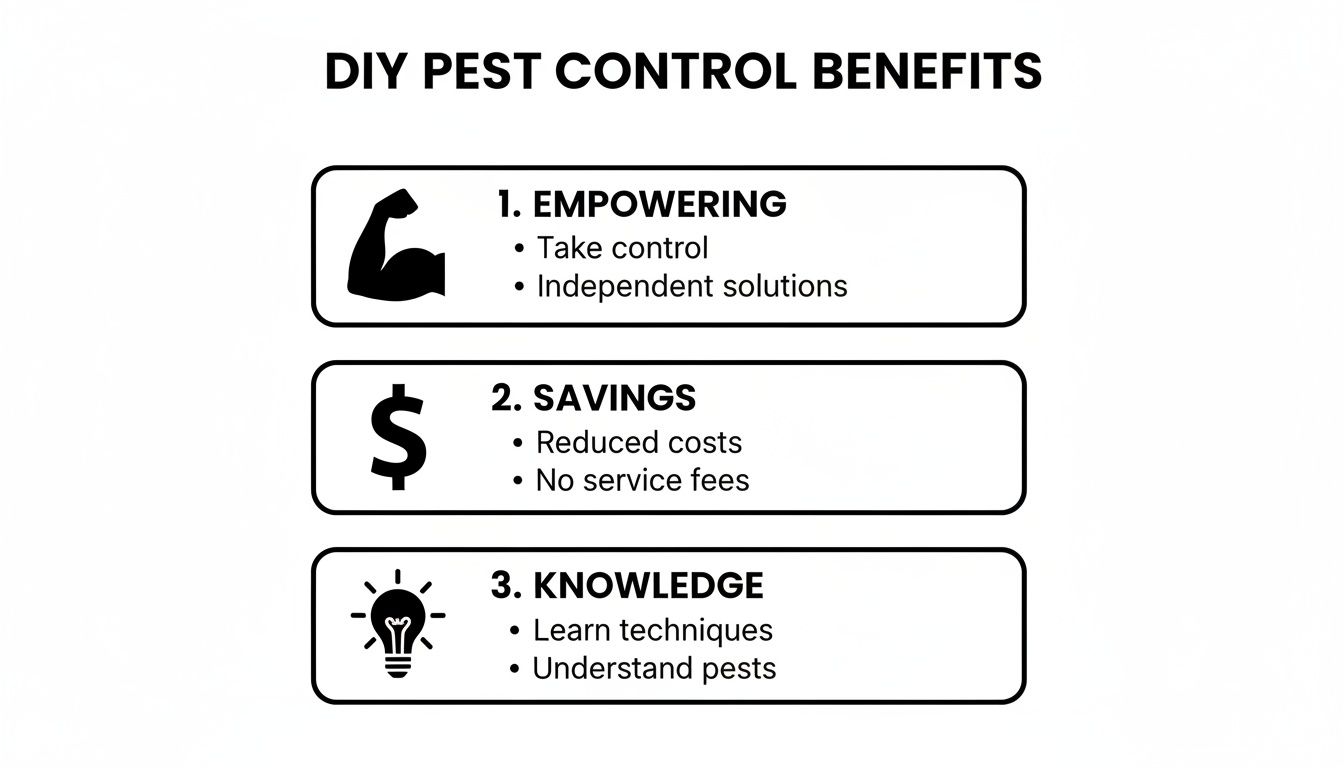
Taking control yourself isn't just about killing bugs; it's about gaining the confidence and know-how to protect your home before problems get out of hand.
Spotting Scorpions in the Wild (or Your Garage)
Here in Abilene, wondering if that's "just a bug" or something with a stinger is a legitimate concern, especially on a hot summer night.
Question: How can I be sure what I'm seeing is a scorpion?
The easiest way to tell is by the classic silhouette: pincers up front and a long, segmented tail curving over its back with a stinger at the tip. Most are a yellowish-tan to dark brown. I once found a Striped Bark Scorpion—the most common species around here—hiding in a pair of work boots I’d left in the garage. They have two dark stripes down their back, which is a dead giveaway. Remember, scorpions are nocturnal. If you see one during the day, it’s probably because its hiding spot was disturbed.
Fire Ants vs. Regular Ants
Not all ants are created equal. While some are just a nuisance, fire ants are an outright hazard that demand a specific, aggressive game plan.
Question: How can I tell if the ants in my yard are dangerous fire ants?
Start by looking at the mound. Fire ant mounds are unique; they’re fluffy, dome-shaped piles of dirt with no central opening, especially after a good rain. If you accidentally kick one, you'll know immediately. They swarm out with a vengeance, and their stings leave painful white pustules a day or two later. Your typical sugar ants just don't do that. A crucial part of any DIY pest control plan is accurate identification. Using a general ant bait on fire ants is a waste of time and money—their colony structure requires a specific bait that workers will successfully carry back to the queen.
To help you get a quick read on what you might be dealing with, here's a simple chart for our area's most common intruders.
Quick Guide to Identifying Abilene Pests
| Pest Type | Key Identifiers | Common Signs | Where to Look |
|---|---|---|---|
| Termites | White, ant-like insects; "swarmers" have wings. | Mud tubes on foundation; hollow-sounding wood. | Foundation, crawl spaces, woodpiles. |
| Scorpions | Pincers, segmented tail with a stinger. | Shed skins; sightings at night. | Garages, woodpiles, attics, shoes. |
| Fire Ants | Small, reddish-brown ants. | Fluffy dirt mounds with no center hole. | Lawns, sidewalks, near AC units. |
| German Cockroach | 1/2 inch long, tan with 2 dark stripes behind the head. | Droppings (like coffee grounds), musty odor. | Kitchens (behind appliances), bathrooms. |
| American Cockroach | Up to 2 inches long, reddish-brown, can fly. | Large droppings, egg casings. | Basements, drains, under sinks. |
| Brown Recluse Spider | Tan/brown with a violin-shaped mark on its back. | Irregular, messy webs in undisturbed areas. | Closets, attics, sheds, cardboard boxes. |
This chart is a great starting point, but always double-check with reliable sources if you're unsure.
Telling Your Cockroaches Apart
Spotting a roach is always unsettling, but knowing which kind you have is key to getting rid of them for good.
Question: A roach is a roach, right? Does it matter what kind it is?
Yes, it matters immensely. In Abilene, you're usually dealing with one of two culprits: the American cockroach or the German cockroach. American cockroaches—often called "water bugs"—are the big ones. They can be up to 2 inches long, are reddish-brown, and can fly. They love damp, dark places like basements, drains, and the cabinet under a leaky sink. The German cockroach is your real enemy. They are much smaller (about half an inch), light brown, and have two distinct dark stripes behind their head. These are the roaches that infest kitchens and bathrooms. If you see one, you can bet there are dozens—or hundreds—hiding nearby. They reproduce incredibly fast, making them a top priority for any DIY effort.
Building a Practical DIY Pest Control Action Plan
So, you’ve identified the enemy. Now for the real work: keeping them out for good. A smart DIY pest control plan isn’t about just spraying chemicals and hoping for the best. It’s about creating a layered defense that makes your home the last place pests want to be.
I’ve spent years dialing in my own routine here in Abilene, and it’s simpler than you might think. We're going to focus on a practical, quarterly plan that builds a serious barrier around your property. This is the exact strategy I use for my own house.
Creating a Formidable Exterior Barrier
Look, the vast majority of pest problems start from the outside. If you can stop them from getting in, you've already won most of the battle. My quarterly routine is all about inspecting and reinforcing my home's exterior armor.
Question: What can I do to stop pests before they even reach my house?
This is my go-to checklist every few months:
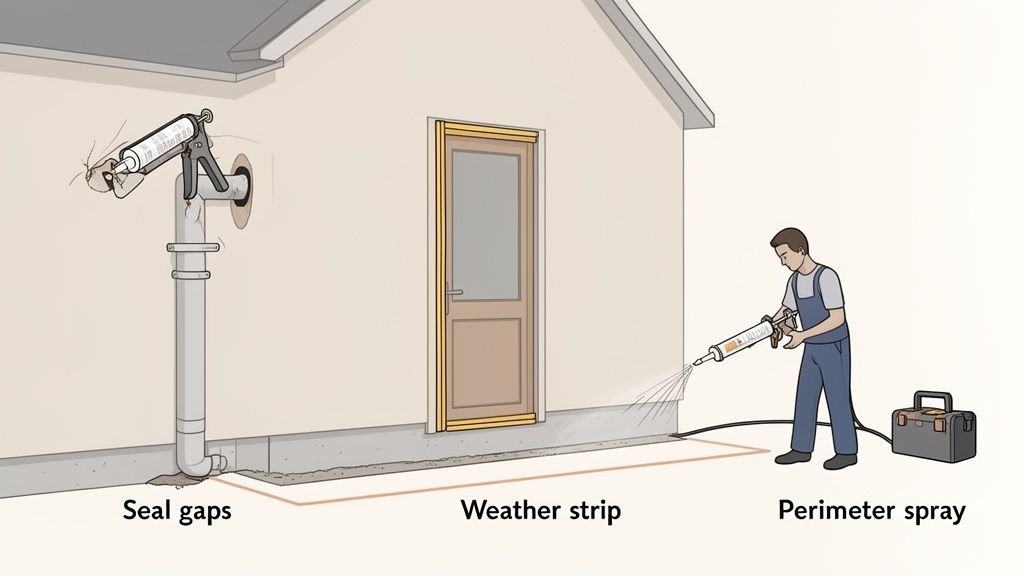
- Seal Every Gap: I grab a tube of good exterior caulk and take a slow walk around the entire house. I’m looking for any little crack where pipes, wires, or the A/C line enters the home. I once found a hole the size of a quarter near my outdoor spigot that was a superhighway for spiders. Sealed it, and the problem vanished.
- Check Doors and Windows: I run my hand along the weather stripping on all my doors. If it feels brittle or I can see daylight peeking through, it gets replaced. A crucial part of this is also checking and repairing window screens. Even a tiny tear is an open invitation for mosquitoes and flies.
- Create a "No-Go Zone": This is a big one. I trim back any shrubs or tree limbs that touch the side of my house, creating a clear space of about 18 inches. This simple step removes the bridges that ants and other critters use to get right up to your siding.
This whole process only takes an afternoon every season, and it dramatically cuts down on the number of pests that even get a chance to test your home's defenses.
How Do I Apply Products Correctly?
This is the number one question I get. It's easy to buy a product, but using it effectively is another story. The strategy breaks down into two key areas: the perimeter and the interior.
For the outside, you want to create a solid, unbroken band of protection.
Question: Where exactly do I spray around my foundation for the best results?
Great question. The key is to apply a consistent 2-3 foot band on the ground all the way around your house, and then spray another 2-3 feet up the foundation wall itself. This creates a wide barrier that pests have to cross. Pay extra attention to areas around doorways, window wells, and vents. When I do my quarterly spray, I use a simple pump sprayer for an even coat. I start at one corner of my garage and just work my way around the whole perimeter, making sure there are no gaps. It’s this consistent barrier that does most of the heavy lifting.
Targeting Interior Hotspots
Even with a strong defense, a few determined pests might find a way inside. Your interior strategy shouldn't be about spraying everywhere. It's about surgical strikes in high-traffic pest areas.
Question: Is it safe to spray pesticides inside my home? Where should I focus?
I concentrate my efforts in three key zones, and I rarely use sprays indoors.
- Kitchens: Under the sink, behind the fridge, and beneath the stove are prime real estate for pests. They're dark, often have moisture, and collect tiny food crumbs.
- Bathrooms: Much like kitchens, the cabinet under the sink and the area around the base of the toilet are common hiding spots for silverfish and roaches.
- Utility Areas: I always give my laundry room a quick check, especially around the washer/dryer hookups and near the water heater.
For these indoor spots, I almost always use baits or gels instead of sprays. It’s a much more targeted approach and keeps the amount of pesticide in our living space to a minimum.
Honestly, the growing availability of quality products is what makes this all possible. In 2022, the DIY pest control market was valued at an incredible USD 44.63 billion, partly because people are more aware of the issues pests can cause. For those of us in Abilene, this means we can get our hands on effective stuff. But remember, while DIY can handle most minor issues—with about 60-70% success for common pests—our Texas climate means some problems just keep coming back. That's when you know it's time to call in a pro.
Building your own action plan is empowering. You stop reacting to pests and start proactively managing your home. It just becomes another part of your regular maintenance routine.
Selecting Safe and Effective Pest Control Products
Walking into the pest control aisle at a hardware store can be overwhelming. You're hit with a wall of different sprays, baits, traps, and granules, and making the right choice feels incredibly high-stakes. It is. The health and safety of your family and pets are on the line.
Let's cut through that confusion. The real goal is to find a product that solves your specific Abilene pest problem without bringing unnecessary chemicals into your home. This comes down to understanding what you're buying and, most importantly, becoming a stickler for reading the fine print on the label.
Are Natural Pest Control Methods Truly Effective for Tough Texas Pests?
This is a question I get all the time, and it's one I asked myself when I first started handling my own pest control. I wanted the mildest option, but I also needed something that could handle scorpions and fire ants. The short answer is yes, natural methods can work, but you have to know their limitations.
From my experience, natural products are fantastic for specific, targeted jobs.
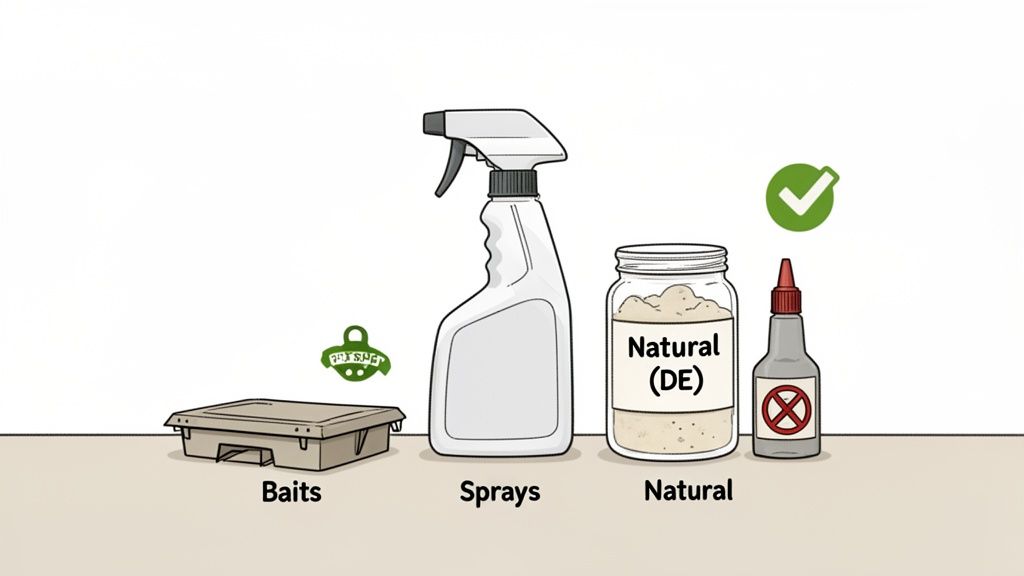
- I use food-grade diatomaceous earth as a preventative barrier in dry, out-of-the-way places. A light dusting behind the fridge or along the back of lower kitchen cabinets works wonders on crawling insects like roaches and silverfish by damaging their exoskeletons. It's completely non-toxic to my family.
- For a few stray roaches, I've had success with boric acid. I'll mix a little with powdered sugar and place it in tiny amounts deep under the sink or in other areas my pets absolutely can't access.
But you have to be realistic. Natural methods have their weak points. Diatomaceous earth is completely useless the second it gets wet, which makes it a poor choice for an outdoor perimeter. And while boric acid can help with a minor issue, it's not going to stop a full-blown German cockroach infestation.
So, When Should I Use Baits Versus Sprays?
This choice really boils down to understanding the pest's behavior. Think about their social structure.
Question: What's the real difference between a bait and a spray? Which one should I use?
Baits are my go-to for social insects like ants and cockroaches. The goal isn’t to kill the one ant you see; it's to have that worker ant carry the poison back to the nest and wipe out the entire colony. Placing a liquid ant bait station near their entry trail is infinitely more effective long-term than just spraying the ones you see.
Sprays, on the other hand, are for creating a barrier or for tackling solitary pests. When I do my quarterly perimeter treatment around my foundation, a liquid spray is the only practical way to create that wide, protective band. I also rely on a targeted spray for knocking down a wasp nest forming on the eaves before it gets too big. You can also see how different treatments work by learning more about how to get rid of mosquitoes in our detailed guide.
The Most Important Rule: Read the Label. Every. Single. Time.
I honestly cannot stress this enough.
Question: Why is reading the label so critical if I've used these products before?
Because it can prevent a tragedy. I almost made a terrible mistake once that I’ll never forget. I’d bought a new brand of granular insecticide for a fire ant mound in the backyard. I was about to start spreading it when I decided to just glance at the label one last time. In tiny print, it said: "Toxic to dogs. Keep pets off treated area for 48 hours." My heart sank. The mound was right next to my dog's favorite sunbathing spot. I immediately sealed it back up for safe disposal and went straight back to the store for a pet-safe alternative. Now, I have a non-negotiable rule: I read the active ingredients and all safety warnings before the product ever goes into my shopping cart.
This kind of vigilance is why so many people are taking control of their own pest management. People want convenience, but they're also rightly concerned about health and the environment. It's no surprise that 23.5% of the global pest product market has shifted toward eco-friendly options. Here in the U.S., about 70% of households now prefer a DIY approach for minor pest issues, often driven by potential 20-40% cost savings. Your choice in that store aisle is part of a much bigger picture.
Knowing When to Throw in the Towel on DIY Pest Control
Look, I get it. There's a real sense of pride in tackling a home project yourself. But I’ve learned over the years that true homeownership wisdom isn't just about knowing how to do something—it's about knowing when not to. When it comes to pests, knowing when to put away the spray bottle and call in a pro is the most important skill you can have.
My personal rule is simple: if I treat a pest issue and see it pop up again within a few months, I'm out. That comeback is a tell-tale sign that my efforts were just a temporary fix, not a real solution. It means I'm missing the root of the problem, and it's time for an expert to step in.
Is This a Major Infestation?
That’s the million-dollar question, isn't it? A few ants on the counter or a spider in the corner can be easy to dismiss. But sometimes, those are just the scouts for a much larger army hiding in your walls or attic. Being able to spot the signs of a bigger problem can save you a fortune in potential damage and keep your family safe.
Question: How do I know if I have a "small" pest problem or a "major" one?
Here are the warning signs I always tell people to watch for—the ones that signal you're out of your league:
- The Pests Are Relentless: You spray for roaches, they vanish for a week, and then they're back. You set out ant traps, and they just forge a new path. This kind of persistence means you're dealing with an established colony or a major entry point you haven't found.
- You Find Evidence Everywhere: Finding rodent droppings in one cabinet is one thing. Finding them in the kitchen, the pantry, and hearing scratching in the attic means you have a full-blown, active infestation on your hands. The same goes for seeing roaches in multiple, unconnected rooms.
- You're Dealing with High-Stakes Pests: Some critters are simply too risky to handle on your own. Any hint of a termite problem, recurring scorpions inside the house, or venomous spiders like brown recluses fall squarely into this category.
While you can tackle plenty of minor pest problems yourself, it's critical to know the limits. It helps to read up on the common pitfalls and learn about the 5 times DIY pest control fails so you can spot these situations early.
The Red Flags You Can't Afford to Ignore
Some pest problems are absolute deal-breakers. These are the situations where trying a DIY solution can actually make things worse or even create a dangerous environment for your family.
Question: So when is it time to give up and call a pro?
Calling a professional isn't giving up. It's making a smart decision to protect your home and family. It’s knowing when a specialist with the right training and equipment is needed to do the job right. Keep an eye out for these undeniable signs that it's time to call for backup:
- Any Sign of Termites: See mud tubes snaking up your foundation? Knock on a piece of wood and hear a hollow sound? Find a small pile of discarded wings on a windowsill? Don't wait. The risk of structural damage is far too great to gamble on.
- Scorpions Keep Getting In: Finding a single scorpion in the garage is just part of living in Abilene. But if you're finding them inside your house repeatedly over a short time, you likely have a nest nearby or a significant entry point that needs professional sealing.
- An Uncontrolled Rodent Problem: When traps sit empty but you keep finding fresh droppings or hearing scurrying in the walls, it's time for professional intervention. Rodents are notorious for chewing through electrical wiring and carrying diseases, making them a serious threat to both your property and your health.
The DIY pest control market is massive, and for good reason. Here in Abilene, and especially for military families at Dyess, grabbing a kit for a quick fix is common—over 40% of U.S. homeowners try DIY methods each year. The problem is, their effectiveness plummets when you're facing an entrenched issue, with failure rates hitting 50% for complex infestations.
While the upfront savings are tempting, professionals offering pest control in Abilene, TX deliver lasting results that save you money and stress in the long run.
Your Abilene DIY Pest Control Questions Answered
Alright, we've walked through the basics of identifying pests and setting up your defenses. But I know from experience that's when the real, practical questions start to surface. Let's tackle some of the most common ones I get asked by folks right here in Abilene.
How Often Should I Perform DIY Pest Control Treatments in Abilene?
This is probably the number one question I get, and the answer is all about consistency. Given our wild West Texas weather, a proactive, quarterly schedule is your best bet for general prevention. I just mark it on the calendar—one afternoon every three months for a full home checkup.
Question: What should my regular pest control routine look like?
Making it a routine really helps. My quarterly pest patrol always includes these key steps:
- Seal Check: I take a slow walk around the outside of the house, specifically looking at the caulk around pipes and the weather stripping on doors. The Abilene sun is no joke, and it can bake these materials, causing them to crack and create tiny highways for pests.
- Perimeter Cleanup: I make sure there’s at least an 18-inch gap of clear space between my foundation and any mulch, shrubs, or other vegetation. This simple step removes the "bridges" that roaches and ants love to use.
- Barrier Spray: With a basic pump sprayer, I apply a perimeter treatment. My rule of thumb is to spray about 2 feet up the foundation and 2 feet out from the base of the house, creating a solid defensive line.
Of course, you have to be ready to adapt. A heavy rainstorm can bring fire ant mounds popping up all over the yard seemingly overnight, and those need immediate attention. Likewise, during the scorching peak of summer, scorpions become much more active, so I'm always more vigilant about checking the garage and entryways after dark.
Are There Pests in Abilene I Should Never Handle Myself?
One hundred percent, yes. It's smart to be self-reliant, but it's even smarter to know your limits. Some pest problems carry risks that just aren't worth the DIY gamble.
Question: Which pests absolutely require a professional?
Here’s my personal "don't touch it, call a professional" list:
- Termites: This is a hard and fast rule. Termites can cause devastating structural damage that your homeowners insurance almost certainly won't cover. Professionals have access to specialized termiticides and equipment, like soil injection tools, that are absolutely essential for wiping out an entire colony.
- A Serious Venomous Pest Problem: Finding a single scorpion in the garage is one thing. But if you're consistently finding scorpions or black widows inside your home, especially with kids or pets around, it's a sign of a bigger issue. A pro can hunt down and seal entry points you would never spot.
- Established Rodent Infestations: If you're hearing scratching in the walls or finding droppings in several different places, you're past the point of setting a few traps. Rodents are notorious for spreading diseases and chewing through electrical wires, which is a major fire hazard. You need an expert for proper eradication and exclusion work.
What Is the Most Effective Non-Chemical Pest Control Tip?
If I had to boil it all down to one single piece of advice, it would be this: become obsessed with exclusion and sanitation. Pests invade our homes for two simple reasons: they're looking for food and shelter. If you systematically deny them both, your house becomes a place they just ignore.
Question: What's the best thing I can do that doesn't involve chemicals?
I learned this the hard way years ago with a stubborn roach problem under my kitchen sink. I sprayed, I baited, but they always came back. It wasn't until I was doing a deep clean that I found a tiny, slow drip from a pipe fitting. It was just enough to keep the cabinet floor damp. I tightened the fitting, dried and sanitized the area, and never saw another roach there again. They weren't after food scraps; they were there for the water.
My most powerful pest control tool isn't a spray bottle. It's a caulking gun. I spend one afternoon each spring and fall sealing every tiny crack and gap around pipes, vents, and the foundation. Inside, we're strict: all pantry food is in airtight containers, the dog's bowl is picked up at night, and counters are wiped down before bed. No exceptions. This proactive, non-chemical strategy is what prevents 80% of potential pest problems before they can even get started. It's the true foundation of any successful DIY pest control plan.