

If you're an Abilene homeowner, you already know Bermuda grass is one of the few things tough enough to handle our West Texas heat. But keeping those stubborn weeds out can feel like a constant, losing battle. What's the secret to the best weed control for Bermuda grass? I can tell you from experience it isn't a single magic product; it's a year-round strategy that combines smart lawn care with the right herbicides applied at the perfect time.
This integrated approach is the only real answer for a thriving, beautiful Bermuda lawn in our unique climate.
Your Winning Strategy for a Weed-Free Bermuda Lawn
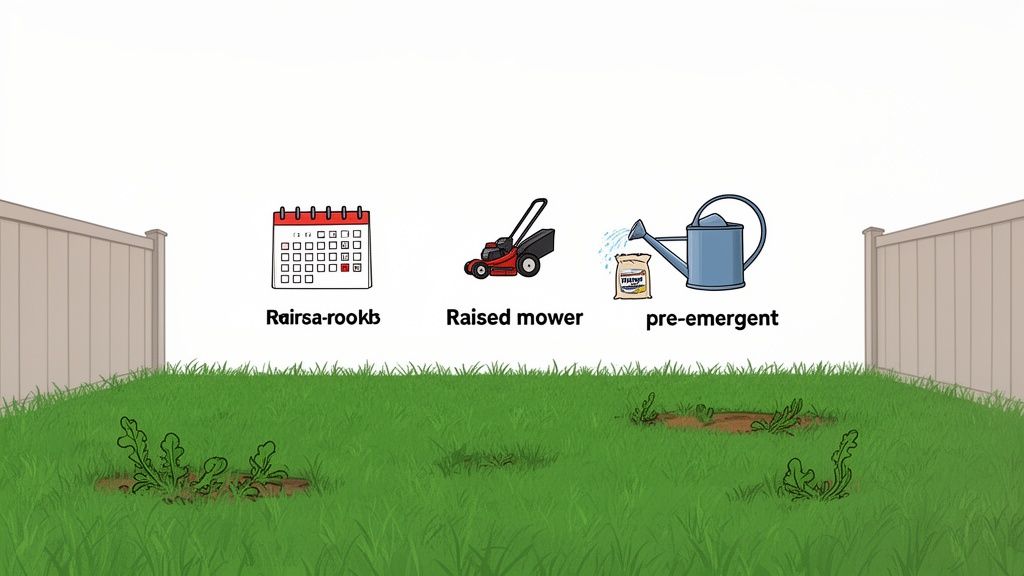
Getting that dense, green carpet of Bermuda grass is a goal for so many of us here in West Texas. While Bermuda’s aggressive growth is a huge plus, opportunistic weeds will find and exploit any weak spot in your turf. The key is to stop reacting to weeds after they appear and start proactively managing your lawn’s health to keep them from showing up in the first place.
I saw this firsthand a few years back with a neighbor near the Abilene Zoo. He was getting absolutely nowhere fighting a relentless crabgrass invasion. He was frustrated, constantly spot-spraying every weed he saw, only for more to pop up a week later. The solution wasn't just killing the weeds he could see; it was stopping the next generation from ever breaking ground.
What Is An Integrated Weed Control Strategy?
Question: I've heard about "integrated" strategies. What does that actually mean for my lawn?
Answer: In the professional world, we call this Integrated Pest Management (IPM). It sounds complicated, but it’s a common-sense idea: use a combination of methods to control weeds while being smart about the products you use. Instead of just grabbing a "weed and feed" bag off the shelf, you build a system where every action supports the others.
For your Bermuda lawn, this system looks like this:
- Preventative Treatments: Using pre-emergent herbicides to form a barrier that stops weed seeds from germinating. This is your frontline defense.
- Targeted Killing: Applying post-emergent herbicides to knock out any weeds that manage to sprout. This is for cleanup.
- Cultural Practices: Mowing high, watering deep, and fertilizing correctly to promote a thick, healthy turf that naturally chokes out weeds.
Question: Why can't I just spray one thing and be done with it?
Answer: I get asked this all the time. The truth is, different weeds need different treatments, and a healthy lawn is its own best defense. A strong, dense Bermuda canopy blocks the sunlight that many weed seeds need to even get started. When I first started in lawn care, I learned the hard way that a one-size-fits-all approach just leads to disappointment.
The Core Components of Success
To give you a clearer picture, let's break down how these different control methods work together throughout the year.
Core Components of Bermuda Grass Weed Control
| Control Method | Primary Goal | Best Time for Abilene | Example |
|---|---|---|---|
| Cultural Control | Strengthen the lawn to outcompete weeds | Year-Round | Mowing at 2-3 inches to shade the soil |
| Pre-Emergent Control | Prevent weed seeds from sprouting | Late Winter / Early Fall | Applying prodiamine when soil temps hit 55°F |
| Post-Emergent Control | Eliminate existing, visible weeds | Late Spring / Summer | Spot-spraying nutsedge with a selective herbicide |
Each of these pillars is essential. Think of it like building a fortress. Pre-emergents are the walls, post-emergents are the guards who handle intruders, and healthy lawn habits are the strong foundation that makes the whole structure resilient. If you neglect one, the entire defense system gets weaker.
For instance, putting down a pre-emergent in late winter is a game-changer for stopping summer crabgrass. I did this for a client in the Wylie area, and it cut their crabgrass problem by about 80% in the first year alone. But if you follow that up by mowing your Bermuda too short, you’ll thin out the turf, creating sunny, open spots perfect for weeds like spurge to take over. You see how every step is connected.
This guide will walk you through building this integrated strategy piece by piece. We'll give you an actionable plan tailored specifically for the Abilene area, from identifying your weed enemies to creating a year-round calendar that puts you back in control.
First, Know Your Enemy: Identifying Weeds in Your Abilene Lawn
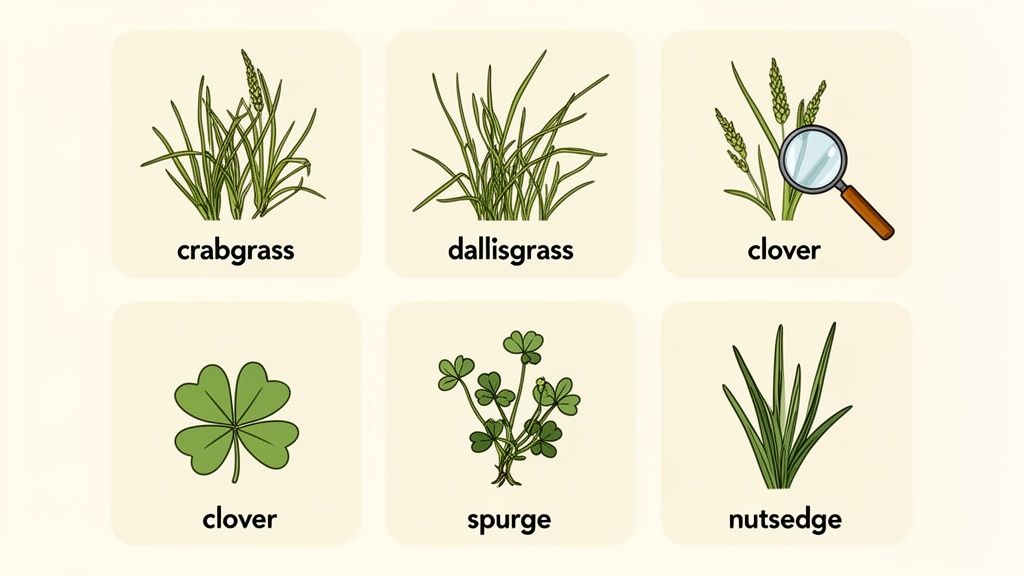
You can't win the war on weeds if you don't know what you're fighting. To get the best weed control for Bermuda grass, you first have to correctly identify exactly what's popping up in your yard. Here in Abilene, our warm-season lawns have a particular set of invaders that just love our West Texas climate.
I once spent an entire spring trying to kill what I thought was crabgrass in my own yard. Turns out, it was dallisgrass, and the product I was using wasn't effective against it. That's why grabbing a generic weed killer and hoping for the best is a recipe for frustration. Knowing your enemy is truly half the battle.
Is That a Grassy Weed or Just My Bermuda?
Question: This weed looks just like my grass, but it's a different color and texture. What is it?
Answer: This is the number one question I get from homeowners. Grassy weeds are sneaky because they try to blend in, but if you know what to look for, our two biggest culprits are easy to spot.
- Crabgrass (Digitaria): This is your classic summer annual. It starts out as a light, almost lime-green plant and sprawls out in a low-growing, star-shaped clump. Its blades are noticeably wider than your Bermuda grass.
- Dallisgrass (Paspalum dilatatum): This one's a real problem. Dallisgrass is a perennial that forms a distinct, ugly circular clump. It has coarse, wide blades and grows ridiculously fast—you'll see tall, ugly seed stalks pop up just a couple of days after you mow.
I remember helping a family over in the Wylie school district who were completely fed up with what they called "thick grass patches." It was dallisgrass, and the weed-and-feed they'd been using wasn't formulated to control it at all. That’s why it just kept getting worse.
What About Weeds That Aren't Grass?
Question: What are these ugly, broad-leaf plants that are taking over my lawn?
Answer: We call these broadleaf weeds, and they're usually much easier to identify since they stick out like a sore thumb against your turf. Their different leaf shapes and textures completely disrupt that uniform, green carpet you're trying to cultivate.
In Abilene, you're almost guaranteed to run into these two:
- Spurge (Euphorbia maculata): Keep an eye out for a weed that grows low and forms a thick mat. It has tiny, oval leaves on a reddish, hairy stem. If you break the stem, it leaks a sticky, milky-white sap.
- Clover (Trifolium): Everyone knows this one. It’s got the classic three-leaflet leaves and, in the spring, little white or pinkish flowers. If you have a lot of clover, it's often a sign that your lawn is low on nitrogen.
Proper identification is the absolute cornerstone of a successful weed control plan. Using the wrong product isn't just a waste of time and money; it can seriously stress your Bermuda grass, especially in the summer heat. That stress actually makes your lawn more vulnerable to even more weeds.
Is This Shiny Weed a Grass or Something Else Entirely?
Question: There's this bright yellow, shiny "grass" growing faster than everything else. What am I dealing with?
Answer: If you spot a bright, yellow-green weed that's shiny, grows way faster than your lawn, and has a weirdly triangular stem, then you’ve met nutsedge—the most aggravating weed of them all.
A few years back, I got a call from a client near the Paramount Theatre who was convinced some bizarre new grass had taken over half his yard. As soon as I arrived, I knew it was a serious yellow nutsedge problem.
Here’s how to be sure:
- It’s Not a Grass: Nutsedge is technically a sedge. This is critical because most standard weed killers for grassy or broadleaf weeds won't even faze it.
- The Triangle Test: Roll the stem between your fingers. A grass stem is flat or round. If it feels triangular, you've got nutsedge.
- Loves Wet Spots: It usually pops up in the wetter areas of your lawn and will spread like wildfire once it gets established.
Getting a handle on these common culprits is your first real step toward taking back your lawn. If you need a closer look, our guide on common weeds in Abilene and how to kill them has even more detailed pictures and tips. Once you know what you're up against, you can finally choose the right weapon for the fight.
Choosing the Right Herbicide: Pre-Emergent vs. Post-Emergent
Figuring out which weed killer to use is where most folks get turned around. It really boils down to two simple strategies: stopping weeds before they start or killing the ones already popping up in your lawn. Getting this right is the key to a great-looking Bermuda grass lawn.
Question: I put down a weed preventer, so why do I still have weeds?
Answer: I get this question all the time. Nine times out of ten, it’s a simple matter of timing or grabbing the wrong product for the job. You might have missed the application window, or you're dealing with a weed that isn't affected by a pre-emergent.
Pre-Emergents: Your Protective Shield
Think of a pre-emergent herbicide as an invisible shield for your lawn. You put it down before weeds even think about showing their ugly faces. It works by creating a barrier in the top few inches of soil that stops weed seeds from germinating. It won't kill existing weeds, but it's your best defense against annuals like crabgrass.
For this shield to actually work here in Abilene, you have to apply it at just the right time. The secret is getting it on the ground before the soil temperature consistently hits 55°F. That's the magic number that tells crabgrass it's time to wake up.
- When to Apply: This window usually opens in late February and closes in early March for our West Texas climate.
- How it Works: The product absolutely must be watered in. Rain or irrigation activates the barrier.
- Bermuda-Safe Products: Look for products with active ingredients like prodiamine or dithiopyr.
My first year trying to manage my own Bermuda lawn, I made the classic mistake. I waited until April when I saw the first tiny crabgrass shoots. By then, it was too late for a pre-emergent. I spent that whole summer fighting a losing battle, pulling weeds every weekend instead of enjoying my yard.
Post-Emergents: Your Targeted Sword
So, if pre-emergents are the shield, post-emergent herbicides are your sword. You use these to go after weeds that have already broken through and are actively growing. This is your clean-up crew, the reactive part of your plan for when prevention wasn't quite enough or for those stubborn perennial weeds that come back every year.
But this is where you have to be careful. Not all post-emergents are created equal, which brings us to another critical difference: selective vs. non-selective.
Question: What's the difference between "selective" and "non-selective" weed killers?
Answer: Understanding this difference is non-negotiable. Using the wrong one can turn a small weed problem into a dead lawn disaster overnight. A selective herbicide is designed to target specific weeds (like dandelions and other broadleaf weeds) without harming your Bermuda grass. Products with ingredients like 2,4-D, quinclorac, or sulfentrazone are your go-to options for selectively taking out the invaders. On the other hand, a non-selective herbicide kills everything it touches—weeds, grass, you name it. Glyphosate is the most common one. It’s incredibly effective, but it will kill your Bermuda grass just as fast as it kills the weed you're trying to eliminate.
So, Which Herbicide Do I Need?
People ask me this constantly, and the honest answer is almost always, "It depends on the weed and the time of year."
A truly solid weed control plan always uses both pre- and post-emergents.
- Start with Prevention: Always, always apply a pre-emergent in late winter or early spring. This one step will prevent the vast majority of your summer crabgrass headaches.
- Scout and Spot-Treat: Keep an eye on your lawn through the spring and summer. When you see a weed pop up, hit it with a selective post-emergent to knock it down before it spreads.
- Use the "Big Guns" Carefully: For tough, isolated patches or for killing off an area to lay new sod, a non-selective herbicide is the right tool. But you have to be precise and protect your surrounding turf.
For instance, you might be surprised to learn that in our scorching Texas summers, careful spot treatments with glyphosate are a reliable way to manage unwanted grasses. Research from Kansas State University shows a single application can eliminate about 75% of a bermudagrass infestation. Following up with another application 3-4 weeks later boosts that to 90% control. It just shows how effective a targeted approach can be. You can dive deeper into these findings about controlling invasive grasses on the K-State turf site.
Choosing the right herbicide is all about using the right tool for the job at exactly the right time. When you combine that preventative shield with a targeted sword, you create a powerful one-two punch that keeps your Bermuda looking its best.
Your Year-Round Bermuda Weed Control Calendar for Abilene
Alright, let's put all this theory into a practical, actionable plan. A lush, weed-free Bermuda lawn in West Texas doesn't just happen. It’s the direct result of a smart, consistent schedule tailored to our unique Abilene climate.
Having a plan is what separates a frustrating, weed-filled yard from a beautiful one. It removes all the guesswork and makes sure you’re putting down the right product at the right time. I give all my clients a calendar like this, and it’s how you win the war against weeds instead of just fighting endless battles.
The core of our strategy is simple: we use pre-emergents as a shield to stop weeds before they start, and post-emergents as a sword to handle anything that manages to sneak through.
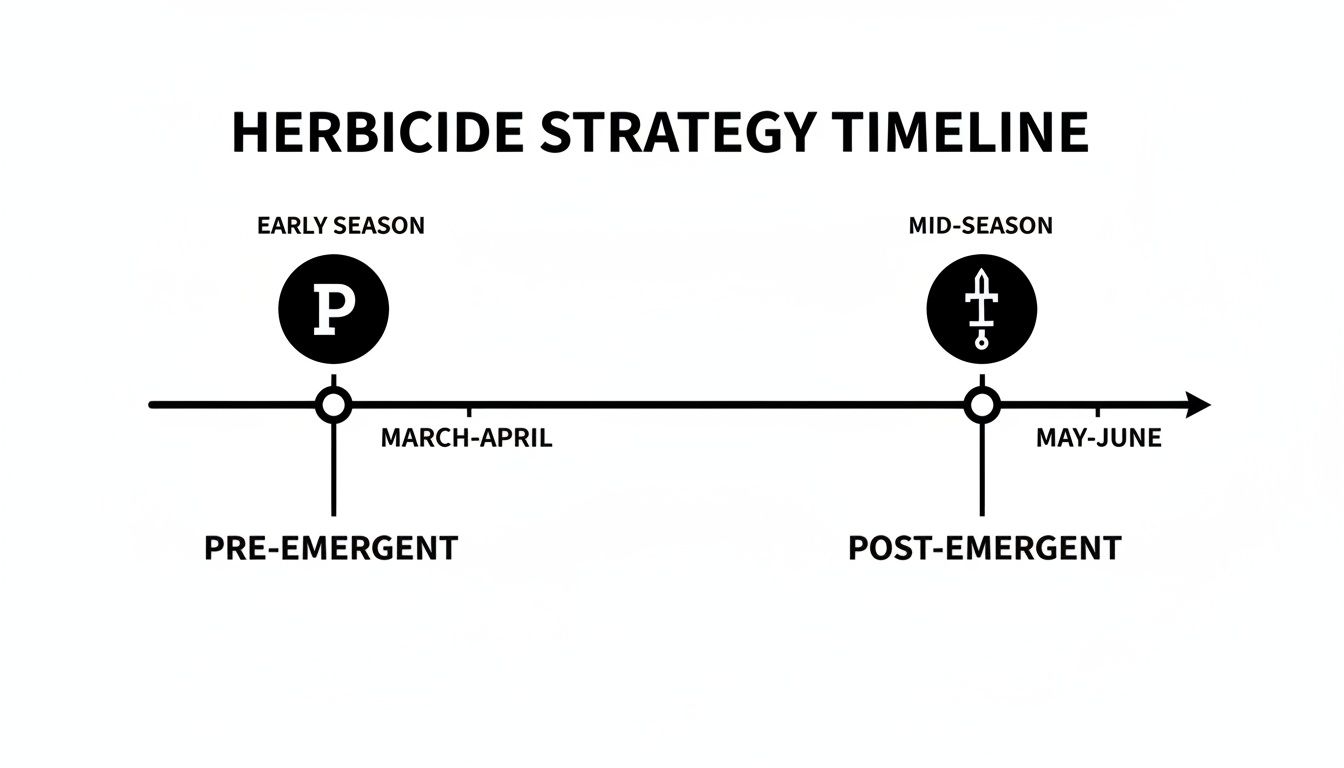
This timeline perfectly illustrates that one-two punch. Prevention comes first, followed by targeted action to keep your lawn clean all season long.
The Abilene Seasonal Playbook
Question: What should I be doing for my lawn in October? Or is it too hot to spray for weeds in July?
Answer: I get these questions constantly. This calendar breaks down the entire year, giving you clear answers and a manageable to-do list for every season.
Late Winter (Late February – Early March)
This is arguably your most important application of the entire year. Your goal is to get ahead of summer weeds—especially that pesky crabgrass.
- The Play: Apply a granular pre-emergent herbicide. Look for products with active ingredients like prodiamine or dithiopyr.
- Pro Tip: Timing is everything. You want to apply it as soil temperatures are climbing toward 55°F, but before they consistently stay there. After you spread it, you absolutely must water it in within 24-48 hours to create the protective barrier in the soil.
Spring (April – May)
Now your Bermuda is waking up and starting to grow aggressively. The focus shifts to encouraging that growth while knocking out any early broadleaf weeds that pop up.
- The Play: Start your regular mowing routine, keeping your Bermuda cut to a nice, tight height of 2 to 2.5 inches. If you see broadleaf weeds like clover or spurge, hit them with a selective post-emergent spray.
- My Personal Tactic: I keep a small, pre-mixed sprayer of selective herbicide handy. It lets me zap any weeds I spot while I'm out in the yard, turning a potential infestation into a non-issue.
Summer (June – August)
West Texas heat is no joke. Your main job is to help your lawn manage stress while staying on top of any weeds that break through your pre-emergent barrier.
- The Play: Keep an eye out for tough summer weeds like nutsedge or dallisgrass. Spot-treat them carefully with the right selective herbicide, but do it in the cooler morning or evening hours. Spraying in the midday heat can seriously damage your Bermuda.
- Watering Wisdom: Water deeply, but not too often. Giving your lawn about 1 inch of water all at once, once per week, encourages deep roots that are much more resilient to our brutal summer heat and drought.
Fighting unwanted grasses invading your pristine Bermuda can feel like a losing battle. But a groundbreaking study from Michigan State University found a powerful solution. Researchers discovered a specific trio of herbicides—fenoxaprop-P, triclopyr, and mesotrione—that dramatically reduced unwanted bermudagrass cover from 71% down to a mere 2% in just one season. For those facing a tough turf conversion, you can read the full research about these powerful findings.
Fall (September – November)
As the weather cools, it's time to prevent a whole new batch of weeds and get your lawn ready for its winter nap.
- The Play: Put down a second round of pre-emergent herbicide in September or early October. This application specifically targets winter annuals like poa annua (annual bluegrass), which is responsible for those ugly, seedy patches you see in spring. Fall is also the perfect time for core aeration and the final fertilizer application of the season.
- Answering the "October Question": That fall pre-emergent is precisely what your lawn needs in October. It prevents a headache next spring. For the best results, you'll want to coordinate this with your feeding schedule. You can learn more about that by reading our guide on the ideal lawn fertilization schedule for Abilene.
By following this seasonal playbook, you're no longer just reacting to weeds. You're proactively building a thick, healthy lawn that becomes its own best defense.
Essential Lawn Care Habits That Prevent Weeds Naturally
Herbicides are great for cleaning up a weedy mess, but they're only half the battle. If you want a truly beautiful lawn, the best defense is a thick, healthy stand of Bermuda grass that literally chokes out any would-be invaders. This is what we in the business call ‘cultural control,’ and it’s your secret weapon for getting the best weed control with fewer chemicals.
I’ve had this conversation with countless homeowners in and around Abilene. Many are surprised to learn that their instincts are often the exact opposite of what Bermuda grass needs. A short, frequently watered lawn sounds right, but it's a recipe for weakness and weeds.
Master Your Mowing Height
Question: How high should I be mowing my Bermuda? I want it to look like a golf course.
Answer: It’s one of the first questions I get asked. Many people chase that super-short, golf-course look, but for a home lawn, that can do more harm than good by inviting weeds in. When you mow Bermuda grass a bit higher, you encourage it to form a dense, lush canopy. Think of this canopy as a living mulch that shades the soil, blocking the sunlight that weed seeds like crabgrass desperately need to sprout. For a typical home lawn here in West Texas, I always recommend a mowing height of around 2 to 2.5 inches. You’re essentially forcing weeds to compete for light, and that’s a fight they’ll almost always lose against a thriving Bermuda turf.
This isn't just a hunch; it's backed by science. Bermuda grass is tough, but it hates shade. Studies have shown that when forced to compete with other grasses mowed at a "jungle" height of 4 inches, the Bermuda can be completely smothered by the lack of light. You can discover more insights about these turf competition findings on the Virginia Tech site.
The takeaway for your lawn is simple. Keeping a taller, denser canopy is a free, non-chemical way to dramatically reduce weed pressure.
Water Smarter, Not Harder
Question: How often should I really be watering in this Abilene heat?
Answer: Another common question I hear is, “How often should I really be watering in this Abilene heat?” The gut reaction is to give the lawn a little drink every day, but that’s one of the worst things you can do for Bermuda. Shallow, daily watering creates a lawn with shallow, weak roots. It becomes dependent on that daily sip of water and is easily stressed by our scorching summers. It also creates the perfect damp, weak environment that weeds absolutely love.
The right way to water is deeply and infrequently.
- The Goal: Apply about 1 inch of water in a single session.
- The Frequency: Only do this once or twice a week, even in the dead of summer.
- The Result: This approach trains your Bermuda's roots to dig deep into the soil for moisture, building a far more drought-resistant and resilient lawn.
Not sure how to measure an inch? I tell my clients to just toss a few empty tuna cans around your yard before you run the sprinklers. Once they’re full, you’re done. For a deeper dive, take a look at our complete guide on local lawn watering tips for Bermuda and St. Augustine grass.
Fertilization and Aeration: Building Strength from the Ground Up
A hungry lawn is a weak lawn. Your Bermuda grass needs a steady diet of the right nutrients—nitrogen, phosphorus, and potassium—to grow thick and strong enough to crowd out weeds. A well-fed lawn has the energy to maintain that dense canopy we talked about and recover quickly from stress.
Our heavy clay soil in West Texas also has a tendency to get packed down over time from foot traffic and mowing. This compaction suffocates your lawn's roots, cutting them off from air, water, and nutrients.
That’s where core aeration comes in. By pulling up small plugs of soil, you open up the ground and give your lawn’s roots room to breathe. I recommend it for most of my clients every couple of years, ideally in late spring or early summer when the Bermuda is growing at full tilt. This one simple service can work wonders:
- It improves the exchange of air between the soil and the atmosphere.
- It allows water and fertilizer to penetrate deeper.
- It encourages roots to grow deeper and stronger.
By making these habits part of your routine—proper mowing, deep watering, consistent feeding, and occasional aeration—you build a lawn that naturally defends itself. It’s a proactive strategy that creates a genuinely healthier turf and makes you far less reliant on herbicides in the long run.
Your Top Bermuda Grass Weed Control Questions Answered
Even the most dedicated homeowner runs into questions when trying to get their lawn perfect. Over the years, I've heard just about every question you can imagine about keeping Bermuda grass looking its best here in Abilene and across the Big Country.
This isn't textbook advice; it's hands-on knowledge from years of tackling these exact problems in yards just like yours. My hope is to give you the confidence to handle these issues like a seasoned pro.
Can I Kill Weeds Without Killing My Bermuda Grass?
Question: Is there a way to kill all these weeds without turning my Bermuda brown?
Answer: You sure can. The key is using a selective herbicide. Think of these as smart bombs for your lawn—they’re designed to attack specific weeds like clover, dallisgrass, or that pesky spurge while leaving your Bermuda grass untouched. I always point people toward products with active ingredients like 2,4-D, quinclorac, or sulfentrazone.
The most important step, though, is reading the label every single time. Make absolutely sure it says it's safe for Bermuda grass and follow the mixing instructions to the letter. Pushing the rate, especially in our summer heat, is a quick way to stress or even injure your lawn.
I still remember a lawn over in south Abilene that was a mess of discoloration. The owner had good intentions but grabbed a powerful herbicide meant for a completely different grass type. If you're ever in doubt, test a small, out-of-the-way patch before you spray the whole yard.
Why Do I Still Have Weeds After Using a Pre-Emergent?
Question: I put down a weed preventer like you said, so why am I still seeing crabgrass pop up?
Answer: That's one of the most common frustrations I hear, and when it happens, the problem is almost always one of three things: timing, coverage, or breaking the barrier.
- Timing is everything. For a pre-emergent to do its job in Abilene, you have to get it down and watered in before the soil gets warm enough to wake up those weed seeds. If you can already see crabgrass starting to sprout, you’ve missed the window for the preventer to work on it.
- You had gaps in your coverage. A pre-emergent creates an invisible shield across your soil. If your spreader application is uneven, you're leaving tiny, unprotected gaps. Weeds are masters at finding those weak spots and pushing right through.
- The barrier got broken. After you water in your pre-emergent, that chemical barrier is set. Anything that disturbs the soil—aerating, digging to plant flowers, or even aggressive raking—can tear a hole in that shield, giving weeds a wide-open invitation.
It's also worth remembering that most pre-emergents are built to stop grassy weeds like crabgrass. They won't do much for many broadleaf weeds that pop up later. You'll likely still need to spot-treat for things like dandelions or clover as the season goes on.
Is It Better to DIY or Hire a Professional Lawn Service?
Question: Should I try to handle weed control myself, or is it worth it to hire a company like yours?
Answer: Honestly, it comes down to what you value most: your time, your money, or the guarantee of getting it right. Going the DIY route can definitely be rewarding and save you some cash, but only if you're willing to put in the time to learn the right products and, more importantly, the right timing for our specific climate. It took me a lot of trial and error to get it right when I first started out.
Hiring a professional service like Abilene Home Service takes all the guesswork and risk off your plate. We're trained to identify weeds correctly and licensed to use more effective, professional-grade products that you simply can't buy at the local hardware store.
For homeowners with busy schedules or for anyone who just wants to know the job is done right, a professional service is a solid investment. We handle the hard work safely and effectively, which means you get the best weed control for your Bermuda grass without the headache.