


If you've ever wondered about the single most important secret to a great lawn in Abilene, I'll tell you right now: it's timing. The simple, straight-to-the-point answer for the best time to fertilize grass in Texas is late spring and then again in early fall. Think of these as the two critical meals your lawn needs to power through and recover from our brutal West Texas summers.
Your Quick Guide to Fertilizing Grass in Abilene
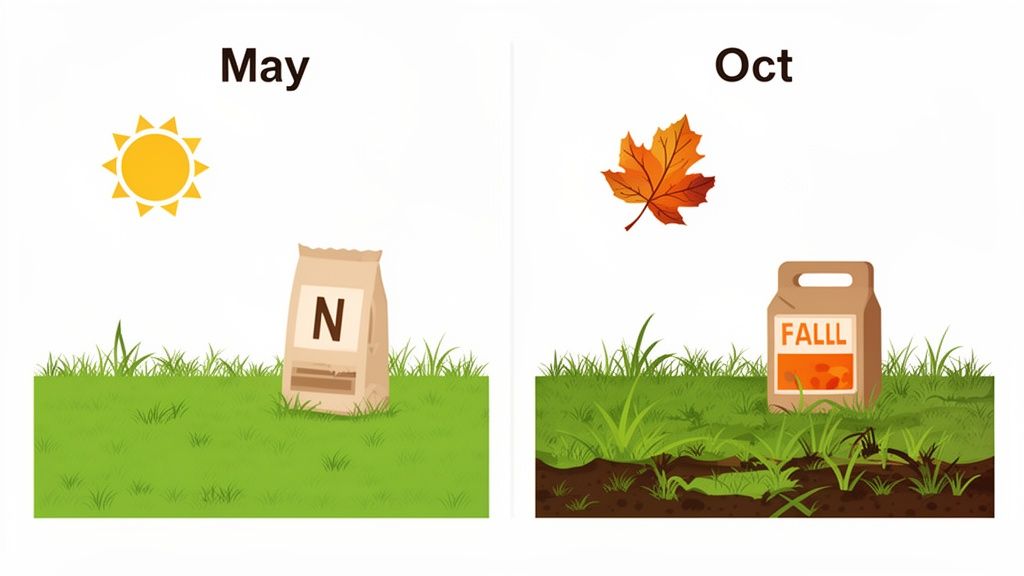
I learned this the hard way years ago. I got overeager and fertilized way too early, only to grow a fantastic crop of weeds instead of the green carpet I was hoping for. To help you avoid the same costly mistakes, I’ve put together this quick-start schedule.
For a simple overview, here's a schedule you can reference throughout the year.
Abilene Lawn Fertilization Calendar at a Glance
| Season | Timing | Primary Goal | Recommended Action |
|---|---|---|---|
| Spring | Late April – Early May | Fuel initial green-up | Apply a balanced, nitrogen-rich fertilizer after the lawn is actively growing. |
| Summer | Early June | Build resilience | Apply a slow-release fertilizer before the intense summer heat sets in. |
| Late Summer | Late August – Early September | Promote recovery | Feed the lawn to help it bounce back from summer stress and heat. |
| Fall | October – Early November | Prepare for dormancy | Apply a "winterizer" fertilizer to strengthen roots for the cold months. |
| Winter | December – March | Rest and prepare | No fertilization needed. Focus on pre-emergent weed control in late winter. |
This calendar gives you a reliable blueprint for keeping your warm-season grasses healthy and thriving in our unique climate.
What Is the Best Time to Fertilize Grass in Texas?
Here in West Texas, from Abilene's plains to the surrounding Big Country, the intense sun dictates our every move—and your lawn is no exception. Figuring out the best time to fertilize grass in Texas isn't just a suggestion; it’s the key to working with your lawn's natural rhythm instead of against it.
This isn't just a hunch; it's based on how grass actually grows. For warm-season grasses like the Bermuda and St. Augustine common in our area, the prime fertilizing windows are late spring (mid-April to early June) and again in late summer (mid-August to early September).
Why then? It all comes down to soil temperature. Your grass's roots can't effectively absorb nutrients until the soil warms up to at least 65°F. At the same time, you want to avoid fertilizing in the dead of summer when air temperatures are consistently over 90°F, which can scorch the grass.
Experts have found that feeding your lawn in these specific windows can boost nitrogen absorption by as much as 30-40%. The result? You can see 20-25% thicker turf by the time fall rolls around.
I can personally vouch for this. When I first moved to the area, I thought I was getting a head start by fertilizing in early March. All I did was feed a massive explosion of spring weeds before my Bermuda grass had even thought about waking up from its winter nap. It was a mess.
Why Does My Lawn Need Fertilizer at These Specific Times?
Think of your lawn like an athlete. You don't just feed them whenever—you give them a high-energy meal before the big game and a recovery meal afterward to rebuild. Your lawn needs the same strategic approach.
- Late Spring Feeding: This is the pre-game meal. It gives your grass a shot of energy to grow thick and dense, which helps it naturally choke out weeds and stand up to the stress of summer heat and foot traffic.
- Late Summer/Early Fall Feeding: This is the post-game recovery. This meal helps your lawn repair itself from summer damage and, more importantly, store up nutrients in its roots for the dormant winter season. That stored energy is what gives it a powerful head start for a faster green-up next spring.
By sticking to this simple two-season schedule, you're giving your lawn exactly what it needs, right when it can actually use it.
Why Fertilization Timing Is the Secret to a Great Texas Lawn
Ever glance over at your neighbor's lawn, wondering how they get it so green and lush while yours struggles? More often than not, their secret isn't some expensive, magic product. It’s all about timing. Knowing when to fertilize your grass is the single most important part of lawn care here in our tough West Texas climate.
Think of your lawn like a hibernating bear. You wouldn't shove a five-course meal in its face the moment it cracks an eye open in the spring. Your grass is the same way. It needs to be fully awake, active, and hungry before you give it a nutrient-packed meal.
Why Is Timing Everything When Fertilizing?
Question: "I just bought the most expensive fertilizer at the store. Does it really matter when I put it down?"
Answer: Yes, it absolutely matters. You can spend a small fortune on the best fertilizer money can buy, but if you spread it at the wrong time of year, you're just throwing that money away. Worse yet, you could actually damage your lawn. Your grass has a natural growth cycle tied directly to the temperature, and you have to work with that cycle, not against it.
For your grass to actually absorb and use the fertilizer, the soil needs to be warm enough. The roots of our common warm-season grasses, like Bermuda and St. Augustine, simply can't process nutrients effectively until the soil temperature is consistently above 65°F. Fertilizing cold soil is like setting the dinner table when no one is home—the food just sits there, and not in a good way.
What Happens If I Fertilize Too Early?
Question: "What’s the harm in fertilizing early? I want to get a head start on a green lawn."
Answer: This is the most common mistake I see homeowners make, and I learned this lesson the hard way myself. My first spring in our Abilene home, I was determined to have the greenest lawn on the block. So, in early March, I got a jump-start and spread my first round of fertilizer.
The result? I ended up growing a spectacular crop of crabgrass and other weeds. My Bermuda grass was still mostly dormant, but the weed seeds buried in the soil were ready to party. That early dose of nitrogen woke them up and gave them an all-you-can-eat buffet. I spent the rest of the spring and summer fighting a weed invasion that I had personally funded.
What About Fertilizing in the Middle of Summer?
Question: "My lawn looks stressed from the heat. Won't a dose of fertilizer help it recover?"
Answer: No, fertilizing in the dead heat of an Abilene summer is just as bad as fertilizing too early. When temperatures are screaming past 90°F, your lawn shifts into survival mode. All its energy goes toward conserving water and enduring the stress, not producing new growth.
Slapping down a high-nitrogen fertilizer during intense heat can literally burn your lawn, leaving ugly yellow and brown patches. It forces the grass to grow when it should be conserving energy, which weakens the roots and makes it more vulnerable to drought and disease.
If you’re a new homeowner staring at a patchy lawn after winter, it’s tempting to fertilize at the first sign of spring. But the real pros know to wait. The ideal time for that first feeding is in late spring after your second mow, usually around late April here. Any leftover nitrogen from a fall feeding is plenty to get the grass through its initial green-up.
By waiting and applying a 3-1-2 ratio fertilizer at the right time, you can see a 15-20% faster green-up compared to jumping the gun in March. If you want to dive deeper into what those numbers mean, it's worth understanding how fertilizer actually works.
It all comes down to a simple principle: feed your lawn when it’s hungry and growing, and let it rest when it's stressed or sleeping.
Identifying Your Grass: Bermuda vs. St. Augustine
Here in West Texas, not all grass is created equal. Treating it that way is the fastest way to get frustrated with your lawn. Before you even think about grabbing a bag of fertilizer, the single most important thing you can do is figure out what kind of grass you’re actually working with.
For most of us in the Abilene area, that boils down to two main types: Bermuda and St. Augustine.
How Do I Tell What Kind of Grass I Have?
This is the number one question I get, and thankfully, it's pretty easy to answer once you know what to look for. When I first bought my place, I had a mix of both, and learning to spot the difference was a total game-changer for my lawn care routine.
Here's a quick field guide based on what I look for in my own yard:
Bermuda Grass: Think of Bermuda as the sun-loving athlete of the grass world. Its blades are very fine and pointed, with a color that ranges from a grayish-green to a deep, dark green. It spreads like crazy with both above-ground runners (stolons) and underground ones (rhizomes), forming a dense, tough turf that can handle a ton of sun and foot traffic. For a deeper dive on its growth, check out our guide on how to grow Bermuda grass from seed.
St. Augustine Grass: This is Bermuda's shade-tolerant cousin. You can spot it by its much broader, flatter blades that have a distinctive boat-shaped tip. The color is typically a rich, blue-green. It only spreads using thick, rope-like stolons that run right on top of the soil, making it easy to identify. It creates a coarser-looking lawn that's perfect for areas that get some shade, like under our big oak trees.
In my own yard, I have St. Augustine growing under a big pecan tree in the back, while the rest of the lawn that bakes in the sun is all tough Bermuda. Once you see them side-by-side, the difference in blade width is unmistakable.
This chart really drives home how differently they handle our Texas environment.
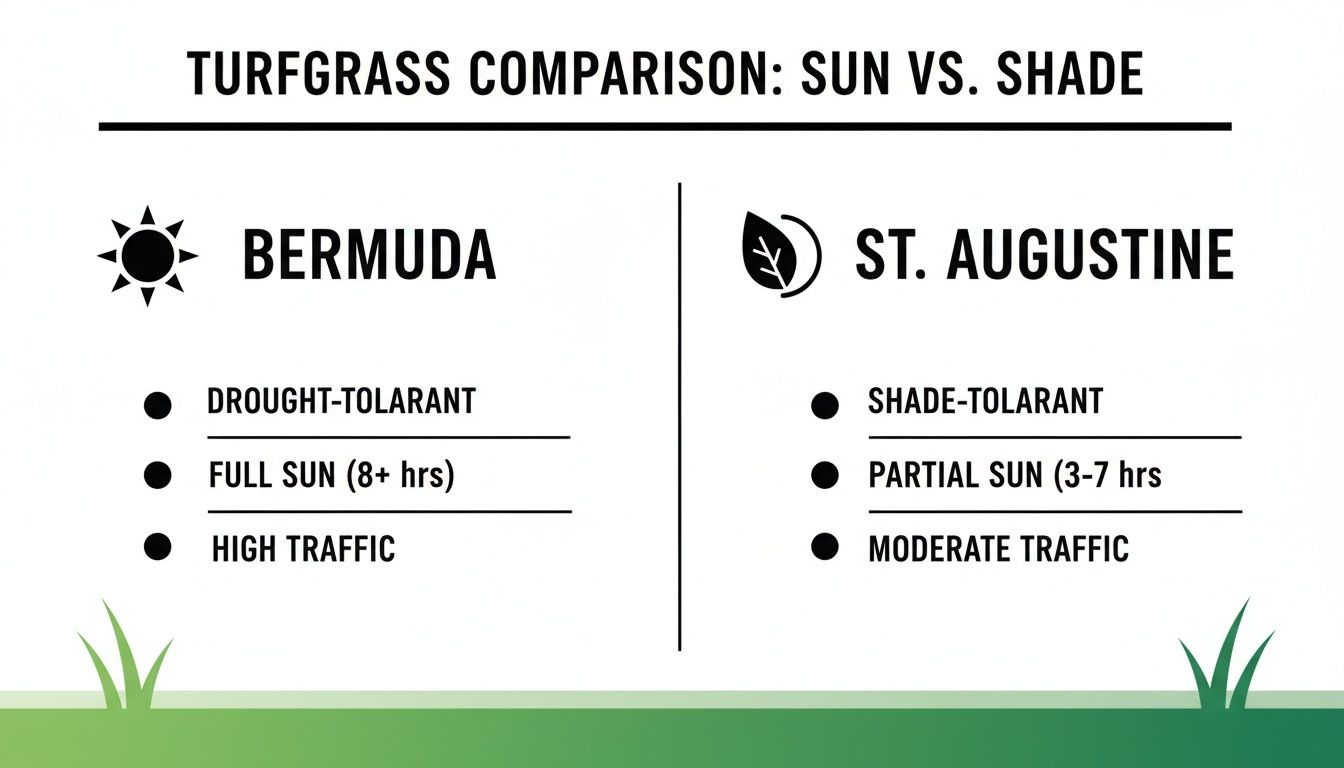
As you can see, Bermuda craves full sun while St. Augustine can get by with partial shade. This one difference has a huge impact on how you should feed them.
Why Does Grass Type Matter for Fertilizing?
So, why does any of this matter? Because identifying your grass type tells you exactly how and when to feed it. Taking the wrong approach isn't just a waste of time and money—it can seriously harm your lawn.
For example, Bermuda is a heavy feeder. It needs a steady diet of nitrogen to fuel that dense, carpet-like growth all summer long. I end up fertilizing the Bermuda sections of my lawn several times throughout the growing season.
St. Augustine, on the other hand, is much more sensitive. It needs less nitrogen, and giving it too much can cause major thatch buildup and make it a prime target for fungal diseases like brown patch. For that shady patch in my yard, I always use a much lighter touch and a different fertilizer blend.
By understanding these basic differences, you can stop just guessing and start feeding your lawn strategically. You'll give each area exactly what it needs to thrive, instead of applying a one-size-fits-all product that doesn't really work for anything.
A Seasonal Fertilization Plan for Abilene Homeowners
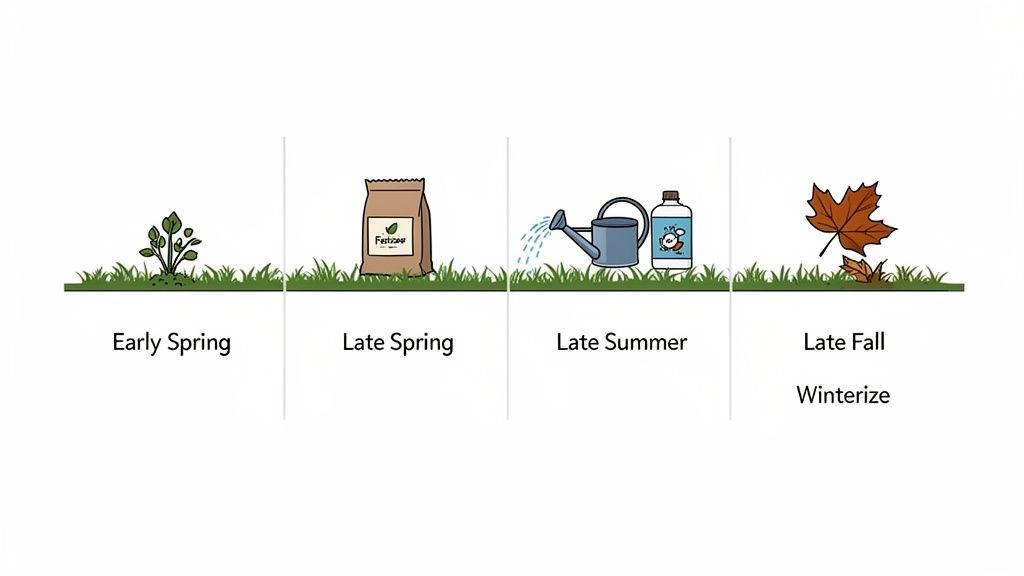
Let’s get straight to it: here's a practical, year-round game plan for a great-looking lawn in Abilene. This isn't about guesswork; it's a simple, repeatable schedule built for our unique West Texas climate. We’ll break down the year so you always know exactly what your lawn needs and when.
Whether you're a busy military family at Dyess Air Force Base or juggling life near Abilene State Park, you need a plan that just works. The sweet spots for fertilizing are spring (April-May) and fall (September-October). Data from the TexasET Network confirms this is when warm-season grasses like Bermuda use nutrients most efficiently, so nothing goes to waste.
Phase 1: Early Spring Weed Prevention
The first, and most critical, step of the year has nothing to do with feeding your grass. It's all about stopping weeds before you ever see them.
What Should I Be Doing For My Lawn Right Now?
Your main job in late winter to early spring—think late February to early March—is to apply a pre-emergent herbicide. This product forms an invisible barrier in the soil that stops weed seeds like crabgrass and stickerburs from sprouting. I learned this the hard way; skipping this step one year meant I spent the entire summer pulling weeds instead of enjoying my yard.
Phase 2: Late Spring First Feeding
Alright, now it’s time for your lawn’s first real meal of the year. This application is what fuels that vibrant green-up and helps the grass grow thick and strong for the months ahead.
When Should I Apply My First Feeding?
Timing is everything here. You have to wait until your grass is actively growing. A great rule of thumb I always use is to wait until after the second or third mow of the season. For us in Abilene, that’s usually in late April or early May. If you fertilize any earlier, you’re just feeding the weeds you missed.
What Type Of Product Is Best?
For this first feeding, go with a balanced fertilizer that's rich in nitrogen. A slow-release formula is your best friend because it provides a steady diet of nutrients over several weeks, encouraging even, healthy growth instead of a sudden, weak surge.
This late spring feeding is like giving your lawn a full tank of gas before a long road trip through the summer heat. A well-fed, dense lawn is your best natural defense against weeds and drought stress.
Phase 3: Late Summer Recovery Feeding
After battling through a brutal West Texas summer, your lawn is tired and needs some help to recover. This feeding is all about repairing summer damage and getting ready for the cooler weather.
When Is The Best Time For A Second Feeding?
The window for this application opens up as the intense summer heat finally starts to break, typically from late August through September. This is a crucial time to determine the best time to fertilize grass in Texas, as it helps the lawn bounce back from stress and store up energy. Proper watering is also vital now; our guide on the best lawn watering tips for Abilene can help you dial that in.
Phase 4: Late Fall Winterization
The final application of the year is arguably one of the most important, especially if you want a fast green-up next spring.
What Does A Fall Fertilizer Application Do?
Applying a "winterizer" fertilizer in October or early November does a few key things for your lawn:
- It strengthens the root system, making the grass more resilient to cold.
- It provides essential nutrients for the grass to store over the dormant winter months.
- It gives the lawn the energy reserves needed for a quick, healthy start next spring.
I can personally vouch for this. A proper fall feeding completely changed how my own lawn handled the winter. It came back greener, thicker, and weeks ahead of my neighbors' yards. This simple, four-phase plan is your blueprint for a healthy lawn, year after year.
Going Beyond the Basics with Soil Testing and Fertilizer Types
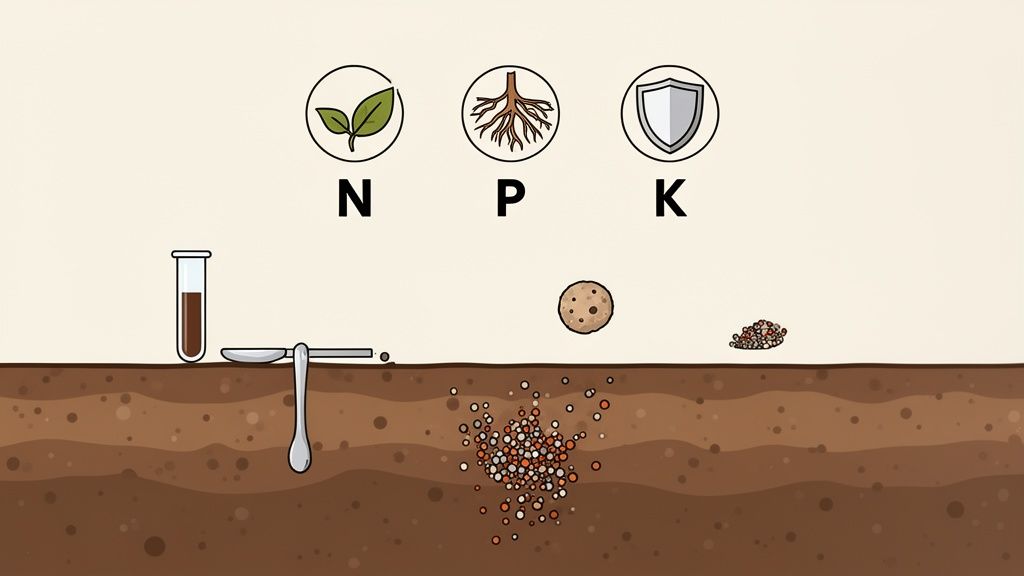
If you're ready to stop guessing and start getting professional-level results, we need to talk about what's happening under your grass. Knowing when to fertilize is half the battle, but knowing exactly what your soil needs is the secret to a truly outstanding lawn. Just grabbing a random bag of fertilizer is like trying to cook a five-star meal by throwing whatever you find in the fridge into a pot. You might get edible, but you won’t get exceptional.
This is where a simple soil test changes everything. It's the single most valuable tool for understanding what your lawn is actually hungry for.
Is a Soil Test Really Necessary for My Abilene Lawn?
I get this question all the time, and my answer is always an emphatic "yes." Fertilizing your lawn without a soil test is like taking medicine without a diagnosis. You could be wasting money on nutrients your soil already has plenty of, all while ignoring a critical deficiency that's holding your lawn back.
Our heavy clay soils here in West Texas are especially tricky. They can hold on tight to certain nutrients while making others unavailable to the grass roots. For years, I was on a standard fertilizing schedule and my lawn looked fine, but it never really thrived. I finally spent the small amount of money on a soil test—less than one bag of premium fertilizer—and the results were a game-changer.
I never would have guessed this on my own. My soil had plenty of nitrogen and phosphorus but was extremely low in potassium. After applying a potassium-rich fertilizer, the difference was night and day. My lawn became more resilient to summer stress and developed a much deeper, richer color. The test saved me money in the long run because I stopped buying fertilizers with nutrients I didn't even need.
How Do I Decode the N-P-K Numbers on the Bag?
Question: "What do the three big numbers on the fertilizer bag mean?"
Answer: Once you have your soil test results in hand, you can walk into any garden center with confidence. Every fertilizer bag features three prominent numbers. This is the N-P-K ratio, and it's basically the nutritional label for your lawn's food.
- N (Nitrogen): This is all about green, leafy growth. Think of Nitrogen as the engine for that vibrant color and thick, lush turf.
- P (Phosphorus): This is for deep, strong roots. Phosphorus is the foundation, helping new grass establish itself and building a robust root system that can search for water during our long, dry spells.
- K (Potassium): This is for overall plant health and resilience. Potassium acts like a vitamin shield, helping the grass manage stress from drought, disease, and extreme temperatures.
So, when I see a bag labeled 21-0-0, I know it’s a pure shot of Nitrogen for greening up, with no other nutrients. A "winterizer" blend I use might be something like 10-0-20, which gives the lawn a little potassium boost to toughen up the roots for dormancy without pushing a lot of fragile top growth.
What's the Difference Between Quick-Release and Slow-Release Formulas?
Question: "The store has quick-release and slow-release fertilizers. Which one should I buy?"
Answer: This choice determines how the nutrients are delivered. You'll generally see two types:
Quick-Release Fertilizers
These give your lawn an immediate, powerful jolt of nutrients. They work fast and are great for a quick green-up, but the effect is short-lived. This can sometimes lead to weaker growth and means you'll have to apply it more often.
Slow-Release Fertilizers
This is what I almost always recommend for lawns here in Texas. These granules are coated to break down gradually over several weeks, spoon-feeding your lawn a steady diet. This encourages stronger, more consistent growth and practically eliminates the risk of burning your grass, which is a major concern in our heat. I personally stick to slow-release formulas for my own lawn to get consistent, healthy results without the risk.
To learn more about the best ways to apply these products, check out our guide on lawn fertilization services.
Common Fertilizing Mistakes to Avoid in West Texas
I’ve learned a lot about lawn care over the years, and trust me, many of those lessons came the hard way. It’s far cheaper and a whole lot less frustrating to learn from someone else's blunders. So, here’s my straight-shooter advice on the biggest fertilizing mistakes I see homeowners make all over Abilene and West Texas.
Getting these wrong can undo all your hard work. Let's walk through what not to do, so you can get the beautiful, healthy lawn you’re aiming for.
Mistake 1: Fertilizing a Dormant or Stressed Lawn
Every single year, I see it happen. People get antsy in late winter and put down fertilizer, or they try to "fix" a struggling lawn in the dead of summer. This is one of the most common and damaging mistakes you can make.
Putting fertilizer on a dormant lawn doesn't wake it up; it just feeds every weed seed waiting for a little encouragement. You’re basically rolling out the welcome mat for crabgrass and giving it a head start on your Bermuda or Zoysia.
Trying to feed a heat-stressed lawn in July or August is even worse. Your grass is just trying to survive, and forcing new growth can cause serious fertilizer burn. It leads to those ugly yellow and brown patches that can kill the grass right down to the roots. Think of it like trying to force a marathon runner to sprint the last mile in 100-degree heat—it’s a recipe for total collapse.
Mistake 2: Uneven Application and "Zebra Stripes"
Have you ever seen a lawn that looks like a botched green and yellow striped paint job? That’s a classic sign of an uneven fertilizer application. I’ll admit, I did this to my own front yard once, and it looked like a failed art project for weeks.
This happens when you don't overlap your spreader passes correctly. Some spots get a double dose of nitrogen and turn a dark, almost artificial green, while the strips you missed stay pale and hungry.
The fix is incredibly simple. Just cut your spreader's application setting in half. Then, make two passes over the entire lawn at right angles. Walk north-to-south for your first pass, and then go east-to-west for the second. This crisscross pattern guarantees every part of your lawn gets covered.
A simple rule I live by: Half the rate, twice the pass. This little technique ensures every square inch of your turf gets a consistent meal, completely eliminating those dreaded zebra stripes for good.
Mistake 3: Using Way Too Much Fertilizer
When it comes to fertilizer, more is definitely not better. It’s a natural impulse to think adding a little extra will make your lawn even greener, but it almost always backfires.
Over-applying fertilizer, especially the quick-release nitrogen kind, will absolutely burn your lawn. The excess mineral salts literally pull the moisture right out of the grass blades, leaving them scorched, brown, and dead.
Worse, all that extra fertilizer that the lawn can’t absorb just washes away into our local streams and lakes with the next rain. It’s not just bad for the environment; it’s a complete waste of your money. Always read the instructions on the bag and stick to the recommended rate.
Mistake 4: Using "Weed and Feed" at the Wrong Time
Combination "weed and feed" products sound like the perfect two-for-one deal, but their timing is a real headache here in Texas. The "weed" part is a pre-emergent herbicide, and the "feed" part is the fertilizer. The problem is, they work best at two different times.
To be effective, the pre-emergent needs to go down in early spring before weed seeds germinate. But your warm-season grass isn't ready for a heavy meal until late spring when it's actively growing.
If you apply it early enough for the weed control, you’re throwing fertilizer onto dormant grass. If you wait until the grass is ready to be fed, the pre-emergent is useless because the crabgrass has already sprouted. Your best bet is always to treat them as two separate jobs, timed correctly for maximum impact.
Your Top Fertilizing Questions Answered
Working with homeowners across Abilene, we hear a lot of the same great questions. Here are some clear, straightforward answers to the most common ones, so you can feel confident you're doing what's best for your lawn.
Can I Fertilize My Lawn During a Hot Abilene Summer?
That's a question I get all the time, and the answer is almost always a hard no. Applying a standard nitrogen fertilizer when temperatures are consistently soaring above 90°F is a really bad idea.
Think of it this way: your grass is already stressed, working overtime just to stay alive in the intense West Texas heat. Forcing it to grow with fertilizer is like making someone run sprints after they've already worked a full day in the sun. It can easily scorch the grass, leaving you with big, ugly brown patches. It's much safer to hold off until the cooler weather of late summer or early fall.
Should I Use a "Weed and Feed" Product?
This is a tricky one. "Weed and feed" products sound great in theory, but the timing just doesn't work for our climate. Here’s the problem:
- The "weed" part (a pre-emergent) is most effective when applied in early spring, usually late February to early March, to stop weed seeds from sprouting.
- The "feed" part (the fertilizer) shouldn't go down until late spring, around late April or May, when your grass is wide awake and actively growing.
Because these two tasks have different ideal timelines, using a combination product means you’re compromising on at least one of them. I've seen it time and again—you get much better results by applying a separate, dedicated pre-emergent first and then following up with a good fertilizer a couple of months later.
How Soon After Fertilizing Should I Water My Lawn?
You’ll want to give your lawn a light watering immediately after spreading any granular fertilizer. I learned this one the hard way years ago and ended up with a few faint burn marks on my grass blades. Don't make the same mistake!
Watering right away does two crucial things. First, it knocks the fertilizer granules off the grass blades to prevent burning. Second, it starts dissolving the nutrients and moving them down into the soil where the roots can actually use them. You don't need to do a deep soak; a quick cycle is usually all it takes unless the product instructions say otherwise.
I Missed the Spring Feeding—Is It Too Late?
Not at all! You haven't missed your chance, but you do need to be smart about it. If you missed the ideal late spring window, the worst thing you could do is try to play catch-up in the middle of a scorching July.
Your best move is to simply wait for the late summer or early fall application. This feeding, which is typically done from late August to early October here in the Big Country, is perfect for helping your grass recover from summer stress and store up energy for the winter. It’s always better to make one perfectly timed application than two poorly timed ones.